
There is a kind of Rolex buyer who deliberately avoids the striking and for that very reason arrives at the Explorer. It is the most honest tool watch of the brand, built for adventure and freed of everything superfluous. Anyone seeking a Rolex that wants to prove nothing is in the right place here. In the atelier the Explorer is the watch of the connoisseurs who know what they want. This guide shows what defines Explorer I and Explorer II and what matters when you buy.
The watch for adventure without noise
The Explorer is the most sober line in the Rolex programme. No gold, no rotating colour bezel, no complication that distracts. Instead robustness, outstanding legibility and a form that has barely changed in decades, because it was right from the start. This reduction is not a lack but a statement. The Explorer is made for people who want a reliable watch and can do without every gesture. That is exactly what makes it the quietest and for some the most mature Rolex.
The history at Everest and beyond
The Explorer arose in 1953, in the spirit of the great expeditions of that time, above all the first ascent of Mount Everest. Rolex had tested its Oyster watches on mountain expeditions for years, and from this experience a watch took shape that was conceived for extreme conditions. Robust, reliable, legible even in cold and at altitude. From this heritage the Explorer draws its character to this day. It is not a watch that fakes an adventure but one that emerged from real adventures.
Explorer I, the essence of the tool watch
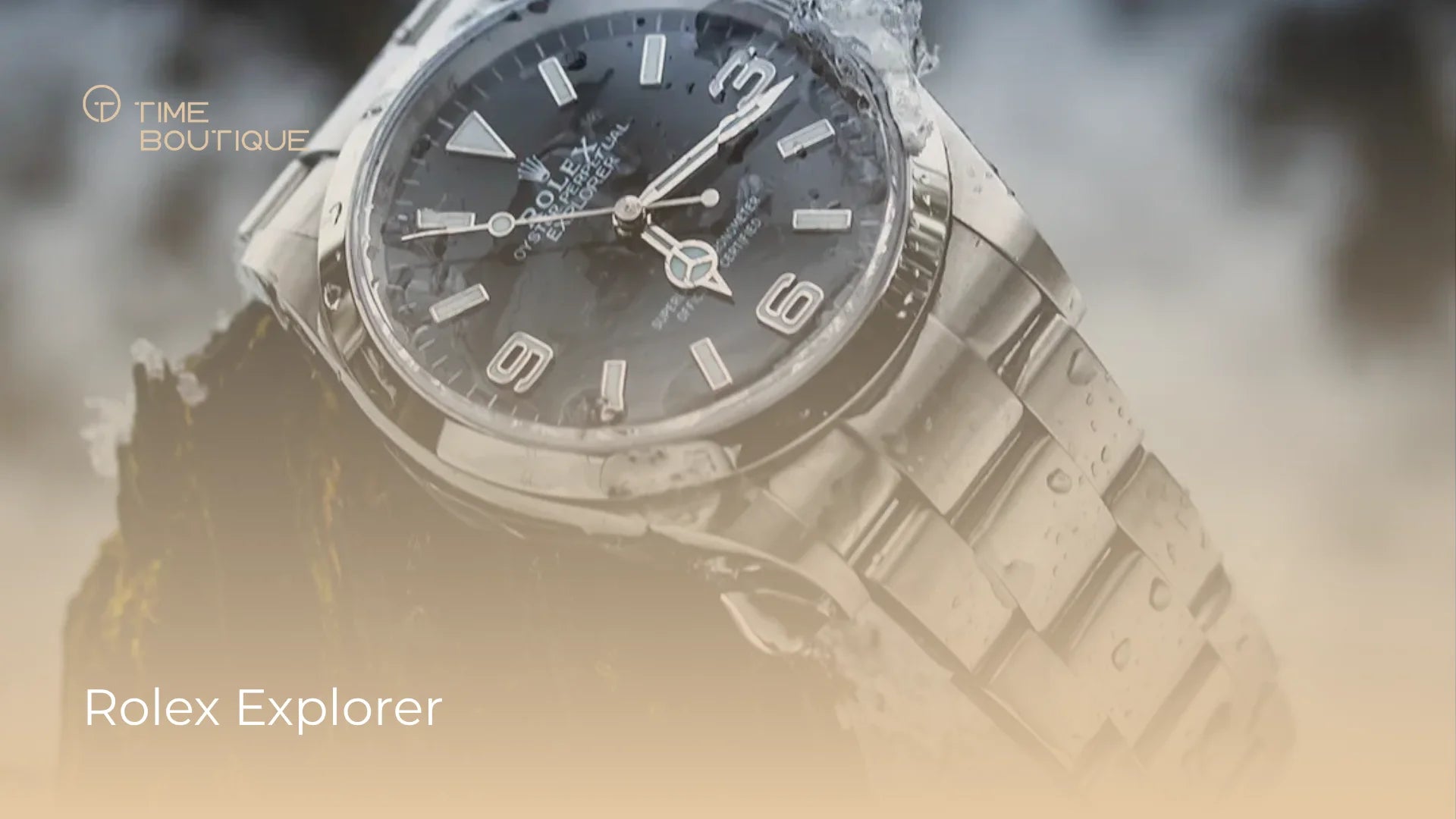
The Explorer I is the pure form. A black dial, the striking numerals 3, 6 and 9, large luminous indices and nothing else. The current Explorer 36 carries the reference 124270 and returned in 2021 to the classic size of 36 millimetres, after the model had grown in the meantime to 39 millimetres. Since 2021 there has also been a variant in the steel and gold combination, which lends the sober watch a warmer note without changing its character. Inside works the modern calibre 3230 with around 70 hours of power reserve. The Explorer I is the watch you can wear without ever thinking about it.
Explorer II, the larger, more versatile tool
The Explorer II came in 1971 and is a different animal. Larger at 42 millimetres, it carries a fixed 24-hour bezel, an additional orange hand and a date. Originally it was conceived for cave explorers, for whom the 24-hour hand helped to distinguish between day and night under artificial light. The current reference 226570 exists with a black or with a white dial, with the white variant known as the Polar. Inside works the calibre 3285. The Explorer II is the more versatile, more functional sister, which at the same time sits more present on the wrist.
Sizes, movements and materials
The two Explorer models cover two needs. The Explorer I at 36 millimetres is the compact, classic tool watch, predominantly in steel and recently also in steel and gold. The Explorer II at 42 millimetres is the larger, more functional variant in steel. Both carry modern in-house movements with a long power reserve and are designed for all-day accuracy. Anyone who likes it compact and plain reaches for the Explorer I, anyone who wants more presence and the additional function for the Explorer II. A fundamental placing in comparison with other models is given by which Rolex to buy.
How the Explorer wears
The Explorer I is one of the most inconspicuous watches you can wear. At 36 millimetres it disappears under every cuff and suits the suit as well as the sweater. It is the anti-status watch, which makes an impression precisely through its restraint. The Explorer II wears more present and sportier but, through its sober design, stays far removed from any boastfulness. What unites both is that they never push themselves forward. Anyone seeking a watch for life that suits every occasion and never goes out of fashion finds in the Explorer an honest answer.
Explorer I or Explorer II, the decision
Anyone interested in an Explorer first faces this choice, and it turns out clearer than you might think. The Explorer I is the plain, compact watch for those seeking maximum restraint. It has no date, no additional display, only the time and the striking numerals. The Explorer II is the larger, more versatile variant with a fixed 24-hour bezel, an additional hand and a date. It appeals to those who want more function and more presence on the wrist. A simple rule of thumb helps. Anyone seeking the quietest possible Rolex takes the Explorer I. Anyone wanting a robust tool with a little more substance, the Explorer II. Both share the same sober spirit and the same origin from the world of expeditions.
The vintage Explorer
The Explorer has a loyal collector community, and that applies especially to the older models. Early Explorer I watches with acrylic crystal and gently aged luminous material have a charm all their own, as do the first Explorer II watches with their striking dials. With these pieces originality decides a great deal, from the dial through the hands to the luminous material. Because the Explorer as an honest tool watch was often genuinely worn, many examples are found with signs of use that, for collectors, belong to the history of the watch. Anyone stepping into the vintage world of the Explorer needs a trained eye or a reliable partner. In the atelier we are glad to place such watches before a decision is made.
The movement and the robustness
Both Explorer models carry modern in-house movements with a long power reserve and the Chronergy escapement. They are designed for all-day accuracy, and the chronometer rating goes without saying. More important than any technical figure, however, is the Explorer's nature as a tool. The case is robust, the legibility outstanding, the form reduced to the essential. From the workshop's point of view the modern Explorer movements are uncomplicated and durable, which suits a watch conceived for hard use. An Explorer is built to be worn and not spared, and that is exactly what makes it so likeable and suited to everyday use.
What to look for when buying a used Explorer
Because the Explorer is a tool watch, many examples were genuinely worn. Check the case for clean edges and for the traces of over-intensive polishing. Check the evenness of the luminous material and the originality of dial and hands. With the Explorer II a look at the function of the 24-hour hand and the date switching pays off. Completeness with box and papers raises value and liquidity, more on that in box and papers, how important are they really. The whole process of a safe purchase is described in the Rolex buying guide.
Service and care
The Explorer is designed for robustness as a tool watch and is correspondingly uncomplicated in care. Even so, it too needs a service at longer intervals, during which the movement is cleaned and the gaskets renewed. Because many Explorer watches were genuinely worn and put to the test, a look at the service history pays off especially with used pieces. A well-kept Explorer runs reliably over decades, which suits its honest character. What a service costs and when it makes sense is set out in our article Rolex service costs. A watch built for adventure deserves a service that does justice to its purpose.
The Explorer in the collector market
The Explorer has gained noticeable attention in recent years. For a long time it was regarded as an insider's tip, as the Rolex of the connoisseurs who avoid the striking. By now more and more collectors appreciate precisely this restraint, and older references too have become more sought-after. Even so the Explorer remains one of the more down-to-earth models of the brand, less driven by hype than the great sports icons. For the buyer that is good news, because the watch stays closer to a sensible valuation. Anyone seeking an honest tool watch with growing recognition is in the right place with the Explorer.
Frequent questions about the Explorer
What distinguishes Explorer I and Explorer II? The Explorer I is the plain 36-millimetre watch without a date. The Explorer II is larger at 42 millimetres and has a fixed 24-hour bezel, an additional hand and a date.
Is the Explorer a good first Rolex? Yes, especially for people who avoid the striking. It is plain, robust and timeless in its form.
Which size is the right one? The Explorer I at 36 millimetres is the classic, inconspicuous choice, the Explorer II at 42 millimetres the more present and more functional one.
Is the Explorer water-resistant enough for everyday use? Yes, both models are solidly water-resistant and thus designed for daily use including washing hands and rain. A diving watch the Explorer is not, however; the Submariner is conceived for that.
Why is the Explorer cheaper than some sports models? Because it is less driven by hype than the great icons such as the Daytona or the sought-after GMT variants. That makes it for many a sensible entry into the professional line, one that stays closer to a fair valuation.
Which Explorer is the more value-stable? Both hold their value well, because demand grows steadily. The Explorer I in the classic size is regarded by many as the more timeless choice, the Explorer II as the more functional one with a little more character.
The Explorer at Time Boutique
In our atelier in Munich we appreciate the Explorer for exactly what it is, an honest tool watch without airs. We advise on which of the two variants suits your wrist and your taste. You will find an overview of our current stock in our Rolex selection, and a placing of the whole family in our overview of Rolex models. Anyone wishing to part with an Explorer will find in selling a Rolex how a fair purchase works with us. Appointments are by arrangement, in person and without haste.
- The watch for adventure without noise
- The history at Everest and beyond
- Explorer I, the essence of the tool watch
- Explorer II, the larger, more versatile tool
- Sizes, movements and materials
- How the Explorer wears
- Explorer I or Explorer II, the decision
- The vintage Explorer
- The movement and the robustness
- What to look for when buying a used Explorer
- Service and care
- The Explorer in the collector market
- Frequent questions about the Explorer
- The Explorer at Time Boutique