

Anyone buying, selling or simply trying to understand a Rolex sooner or later runs into the reference number, the key to the model. A handful of digits and letters tell you which family a watch belongs to, what the case is made of and which bezel it wears. At the same time it is constantly confused with the serial number, which describes something else entirely.
This article explains where the Rolex reference number is found, how it differs from the serial and calibre numbers, and how to decode a reference yourself. Rather than a model list, you get a key made up of the material code, the bezel suffixes and a few worked examples, and you learn how to check a reference for consistency.
Reference, serial and calibre, three different numbers
A Rolex carries several numbers, and each answers a different question. The reference number describes the model, meaning the family, case size, material and bezel. Every watch of the same specification carries the same reference. Two steel Submariner Dates with a black bezel from the same generation are both a 126610LN.
The serial number, by contrast, identifies the individual watch. It is unique and sets your watch apart from every other example of the same reference. Depending on the era, the serial number narrows down the production year, and it is the number that matters to insurers and in theft reports.
The third number is the calibre number. It identifies the movement and is marked on the movement itself, inside the watch. Since Rolex closes its case backs almost without exception, you will not see it in everyday use. One calibre often powers many references: calibre 3235, for instance, runs in the current Datejust 36 as well as in the current Submariner Date. The calibre number therefore tells you about the mechanics, not about the model.
Finding the Rolex reference number, the engraving at 12 o'clock
On a Rolex the reference number is engraved into the case between the lugs on the 12 o'clock side, where the bracelet hides it. To read it, the bracelet has to come off at that end, which means releasing the spring bar. Case and lugs scratch easily in the process, so without practice this is a job better left to a watchmaker.
Without removing the bracelet, you will find the reference in the papers. The warranty card of a modern watch shows both reference and serial number, and older guarantee papers usually list both as well. Stampings on the inside of older case backs belong to the case back as a component and are not authoritative for the reference of the watch.
The serial number sits on the opposite side. On older models it is engraved between the lugs at 6 o'clock, on modern models on the rehaut, the inner ring between crystal and dial, at the 6 o'clock position. Because both numbers live on the case, the term case number is used for one or the other. With the serial number and the tool to check a Rolex serial number, you can narrow down the production year.
From four to five to six digits
The length of a reference already tells you the era. Four-digit references belong to the vintage period. Well-known examples are the Datejust 1601, the GMT-Master 1675, the Submariner 5513 and the Explorer 1016. Their last digit does not yet reliably follow the material code you will meet further down.
From roughly the late seventies and through the eighties, five-digit references took over and shaped the catalogue until beyond the turn of the millennium. Typical examples are the Submariner Date 16610, the Datejust 36 as 16233 and 16234, and the Lady-Datejust 26 as reference 69173. During this period the logic of the material code became largely consistent.
Six-digit references followed from around the turn of the millennium, family by family. Often the new number was created by adding a digit at the front. The Datejust 16233 became the 116233, the Submariner Date 16610 became the 116610LN. With the next generation the second digit usually changed, so the 116233 was followed by the 126233, the 116610LN by the 126610LN, and for the Daytona the 116500LN by the 126500LN. There are exceptions, as the Lady-Datejust shows, whose line runs from 69173 via 79173 to 179173. The principle is still visible: the rear digits stay stable, the front digits mark the change of generation.
The last digit, the material code
The most important single position in a modern Rolex reference is the last digit, which stands for the material. Rolesor is the name Rolex gives to its combination of steel and gold, in which the bezel, the crown and the centre links of the bracelet are made of gold. Oystersteel is the brand's name for its own stainless steel, Everose the name of its own rose gold alloy.
| Last digit | Material | Example |
|---|---|---|
| 0 | Oystersteel | 126610LN Submariner Date |
| 1 | Everose Rolesor, steel with Everose gold | 126711CHNR GMT-Master II |
| 2 | Rolesium, steel with platinum | 116622 Yacht-Master |
| 3 | Yellow Rolesor, steel with yellow gold | 126233 Datejust 36 |
| 4 | White Rolesor, steel with white gold | 126234 Datejust 36 |
| 5 | Everose gold | 228235 Day-Date 40 |
| 6 | Platinum | 228206 Day-Date 40 |
| 8 | Yellow gold | 228238 Day-Date 40 |
| 9 | White gold | 228239 Day-Date 40 |
This logic applies very broadly to five and six-digit references, but not without exception. Four-digit vintage references and a few special models follow their own rules. Treat the code as a reliable rule of thumb rather than a law.
On the classic Datejust and Day-Date models, the second-to-last digit often hints at the bezel as well. A 3 in that position usually stands for the fluted bezel, a 0 for the smooth one. This pattern is less consistent than the material code and does not carry over to the sports models.
The letters at the end, suffixes for the bezel colour
Many modern sports models carry a suffix after the digits. It derives from French terms and describes the colour of the bezel, not of the dial. The Daytona 116500LN, for example, was available with a white and with a black dial, and both carry the suffix LN because the bezel is black in each case.
| Suffix | Meaning | Example |
|---|---|---|
| LN | Lunette Noire, black bezel | 126610LN Submariner Date |
| LV | Lunette Verte, green bezel | 126610LV Submariner Date |
| BLNR | Bleu Noir, blue and black bezel | 126710BLNR GMT-Master II |
| BLRO | Bleu Rouge, blue and red bezel | 126710BLRO GMT-Master II |
| CHNR | Chocolat Noir, brown and black bezel | 126711CHNR GMT-Master II |
| VTNR | Vert Noir, green and black bezel | 126720VTNR GMT-Master II |
Further suffixes exist, for gem-setting for example. Note too how suffix and material code complement each other: the 126711CHNR ends in 1 and is, consistently, made in Everose Rolesor.
The M prefix and the code on modern warranty cards
On recent warranty cards and in the brand's current catalogue, the reference appears in an extended form, for example M126610LN-0001. The M in front belongs to this notation and changes nothing about the model, the reference itself is 126610LN. The code after the hyphen identifies the exact specification, meaning the combination of dial and bracelet.
On models with many variants, the Datejust above all, two watches of the same reference often differ only in this code, for instance in the dial or in a Jubilee rather than an Oyster bracelet. That makes the code valuable when checking a watch, because it records which dial and which bracelet belonged to it from the factory. Why complete papers carry weight beyond the bare reference is explained in box and papers, how important are they really.
Decoding a Rolex reference yourself, three examples
With this key you can read most modern references in a few steps.
Datejust 36, 126233 and 126234
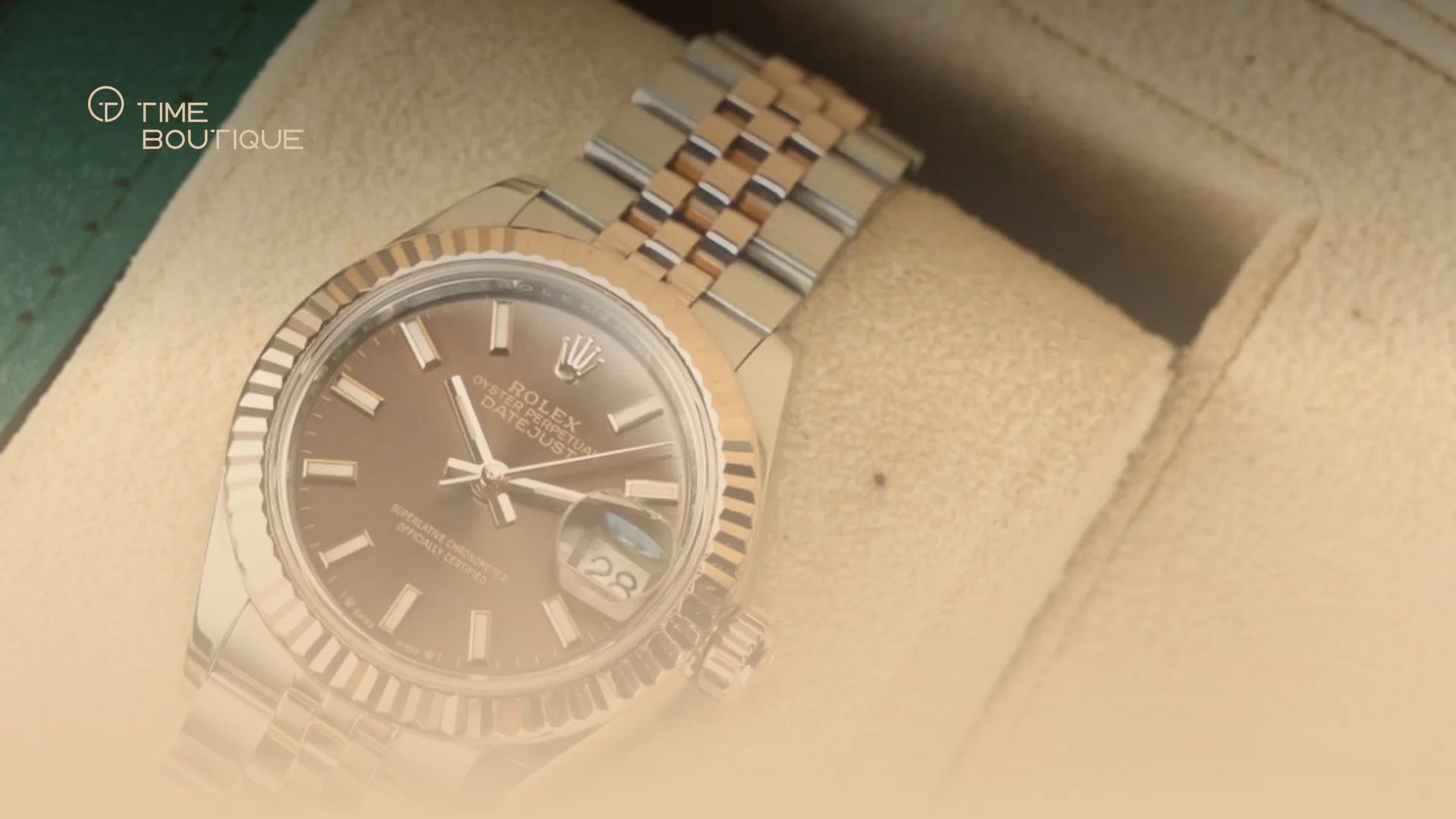
Six digits point to the modern era, and the 12 at the start marks the current generation here. The second-to-last digit, a 3, indicates the fluted bezel on the Datejust. The last digit decides the material: the 126233 is yellow Rolesor, steel with a yellow gold bezel, crown and centre links. The 126234 is white Rolesor, a steel case with a fluted white gold bezel. For yellow Rolesor the line runs from 16233 via 116233 to 126233, and for white Rolesor the 16234 was the five-digit predecessor. The full sequence of generations is set out in the overview of Rolex Datejust references.
Lady-Datejust 26, 179173
The six-digit 179173 ends in 3 and is therefore yellow Rolesor. Its predecessors 69173 and 79173 share the same ending and the same material combination, and all three measure 26 mm. The change of generation follows its own pattern here, while the rear digits stay the same.
Submariner Date, 126610LN
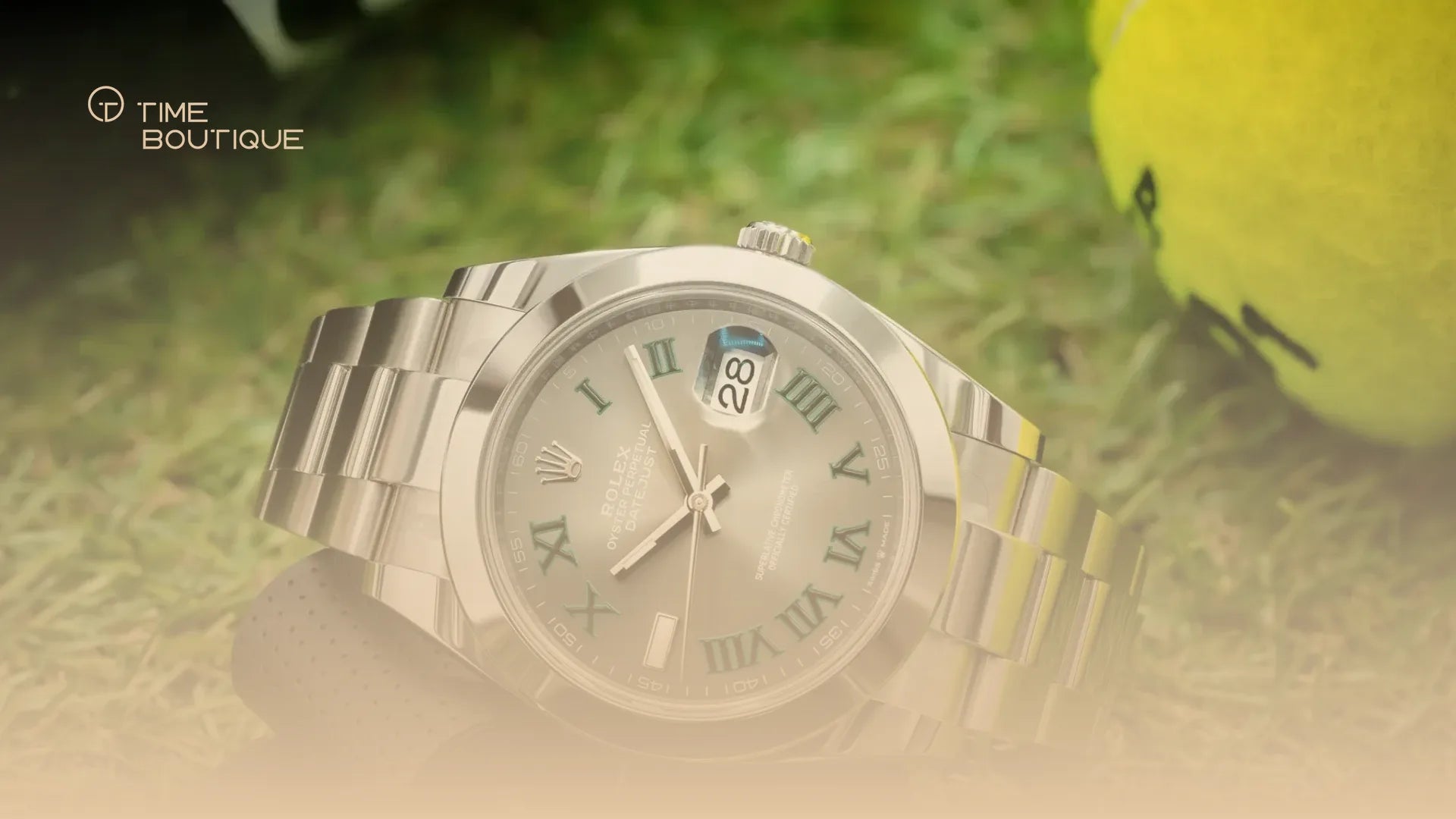
Here too, six digits and the 12 at the start point to the current generation. The last digit 0 stands for Oystersteel, the suffix LN for the black bezel. On the warranty card the watch appears as M126610LN-0001. Its sister reference 126610LV differs only in its green bezel. The line behind it reads 16610, 116610LN, 126610LN.
Does the reference number reveal the year?
Only roughly. Length and generation narrow down the era, but no specific year can be read from a reference. Most are produced for many years, and predecessors and successors overlap on the market. A 16610 may come from very different years of its long production run without the number showing it.
The production year is the job of the serial number. On older watches serials were issued largely in sequence, so number ranges can be matched to particular years. More recent watches carry randomly assigned serials, which only allow the period to be narrowed down. In that case the date on the warranty card helps, although it records the sale rather than the manufacture. The tool to check a Rolex serial number and its production year covers both systems. The reference serves as a cross-check, because the two numbers have to fit together in time.
Checking a Rolex reference number, does everything fit?
A reference is a description, and the watch has to match it. When you check one, it is best to go step by step.
- Engraving and papers: the reference at 12 o'clock must match the one on the warranty card, as must the serial number. The engraving should be clean, evenly deep and crisply cut.
- Material: a reference ending in 0 shows no gold. If it ends in 3, the bezel, crown and centre links must be yellow gold, and if it ends in 4, a white gold bezel belongs on a steel case.
- Bezel: the suffix must match the colour. A watch with a green bezel is not a 126610LN, and a smooth bezel does not belong on a Datejust whose reference describes a fluted one.
- Size and family: the 179173 is a 26 mm Lady-Datejust, not a Datejust 36.
- Dial and bracelet: both should be among the specifications intended for this reference. On modern watches the code on the warranty card helps.
- Timing: the serial number has to fall within the production period of the reference.
Not every discrepancy is cause for concern. Hands, bezel inserts or dials are sometimes replaced during a service, ideally documented in the service papers. A discrepancy without a credible explanation, however, is a clear warning sign. It can point to a watch assembled from different parts or to a counterfeit. How to assess the movement, dial, engravings and bracelet beyond this is covered in the guide to checking whether a Rolex is genuine.
Is there a list of all Rolex reference numbers?
The search for a complete Rolex reference number list is understandable but rarely leads anywhere useful. Rolex has produced a great many references over the decades, plus countless combinations of dial and bracelet, so a complete list would be almost impossible to maintain. More useful is the key in this article, combined with an overview of the model families. Such an overview of the current and classic lines is given in the Rolex models overview. A selection can be found in the Rolex watches collection.
Your Rolex at Time Boutique
Whether you are looking for a specific reference or want to place your own watch, our Rolex collection shows the current pieces, each inspected in our own workshop in Munich.
Our collection changes constantly. Tell us the reference, metal and dial, and if the piece is not in stock, we will find it for you. Get in touch.
For the Rolex you already own, we offer service and overhaul and purchase of your watch.
Frequently asked questions
How can I check a Rolex reference number?
Read the engraving between the lugs at 12 o'clock and compare it with the warranty card. Then decode the material code and suffix and check whether case, bezel, dial and size match. A discrepancy without a documented explanation is a warning sign and should be resolved before you buy.
Is the serial number the same as the reference number?
No. The serial number is unique to one single watch. The reference number describes the model and is identical on every watch of the same specification.
Where is the serial number on a Rolex?
On older models it is engraved between the lugs at 6 o'clock and only becomes visible once the bracelet is removed. On modern models it is engraved on the rehaut, the inner ring between crystal and dial at the 6 o'clock position. It also appears on the warranty card.
Can I tell the year from the reference number?
Only approximately. The number of digits and the generation reveal the era, but since a reference is usually made for many years, no specific year follows from it. The production year can be narrowed down via the serial number, and on more recent watches via the date on the warranty card.
What does case number mean on a Rolex?
The term is used inconsistently, because both the reference and the serial number are engraved on the case. Most often it refers to the serial number, sometimes to the reference at 12 o'clock. If in doubt, position settles it: the reference sits on the 12 o'clock side, the serial on the 6 o'clock side or on the rehaut.
- Reference, serial and calibre, three different numbers
- Finding the Rolex reference number, the engraving at 12 o'clock
- From four to five to six digits
- The last digit, the material code
- The letters at the end, suffixes for the bezel colour
- The M prefix and the code on modern warranty cards
- Decoding a Rolex reference yourself, three examples
- Datejust 36, 126233 and 126234
- Lady-Datejust 26, 179173
- Submariner Date, 126610LN
- Does the reference number reveal the year?
- Checking a Rolex reference number, does everything fit?
- Is there a list of all Rolex reference numbers?
- Your Rolex at Time Boutique
- Frequently asked questions
- How can I check a Rolex reference number?
- Is the serial number the same as the reference number?
- Where is the serial number on a Rolex?
- Can I tell the year from the reference number?
- What does case number mean on a Rolex?