
"Full Set" is one of the most overused terms in the watch trade. Some retailers use it as a blanket sales argument, others downplay its significance. In our atelier we see watches every week, with, without, and with partial original documentation. What box and papers actually move on the market, how to recognise authenticity, and when a "naked" watch is still a good deal, we summarise honestly here.
What belongs to a "Full Set"
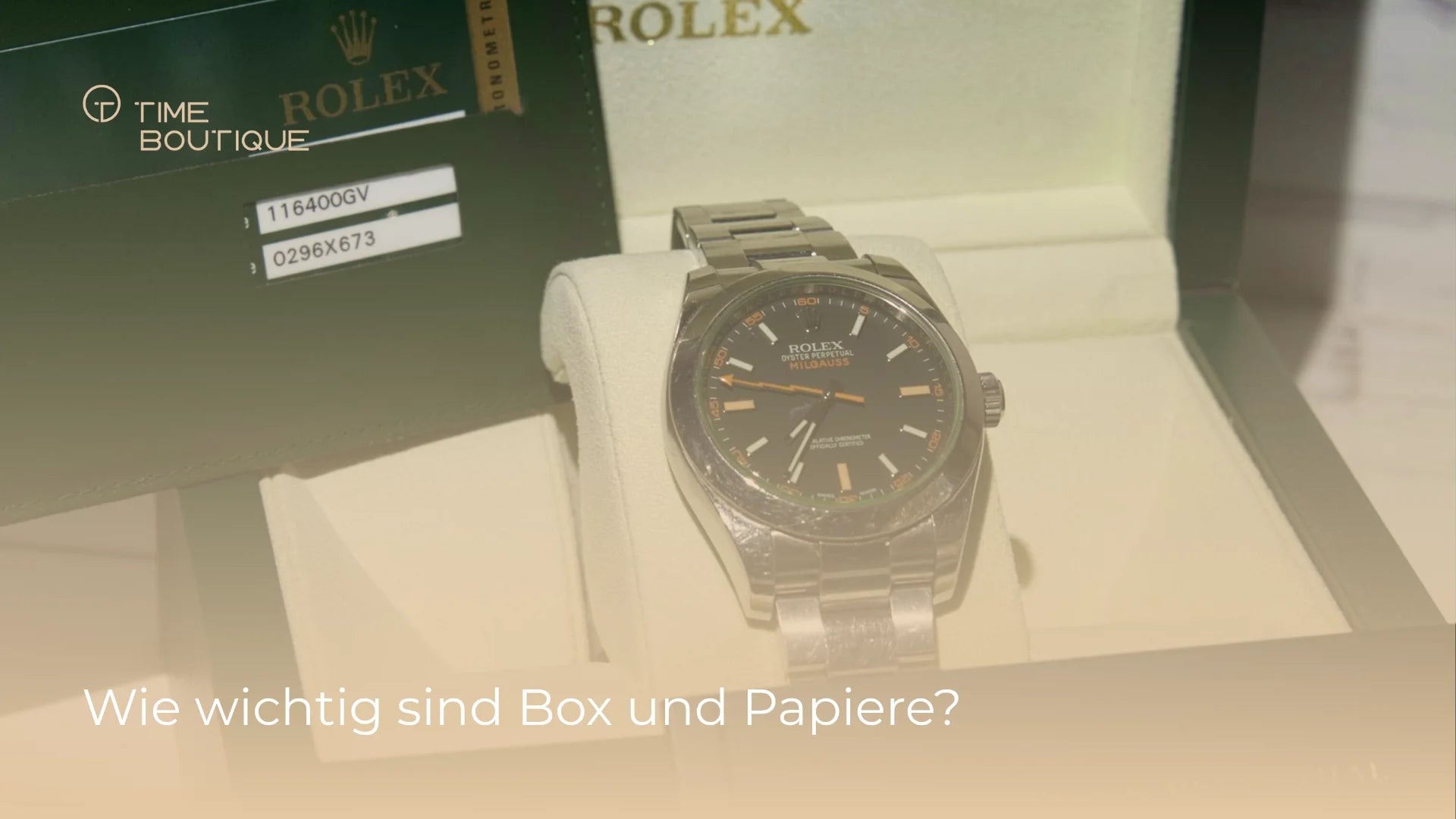
Collectors generally understand a complete set as the following, and all of it should actually be present before anyone uses the term:
- Original box, meaning outer carton (often brown, with model sticker) and watch box (inner, including pillow)
- Warranty card with reference number, serial number, dealer stamp and date of purchase. For Rolex vintage up to the mid-2000s these are "punched papers" with stamped holes, after that the credit- card-format card, and since 2020 additionally the digital warranty service
- Operator's manual in the matching language set (German cards demand a German booklet)
- Service receipts for every previous overhaul, ideally with factory stamp or receipts from an independent watchmaker
- Original invoice from the first owner, rarely present but a genuine premium feature
- Hangtag with model designation, attached to the bracelet, plus the green anchor tag on modern Rolex models
- COSC certificate from manufactures that include it separately (Omega, some AP pieces, vintage Rolex into the 1980s)
A watch with nothing around it we call internally a "naked watch". A watch with box and card but without service receipts or inner box we call a "boxset". A genuine full set demands all the items listed above, in the matching vintage and in undamaged condition.
The market surcharge, in ranges
From our market picture for common sport and dress models:
- Naked watch as reference (index 100)
- With box, without papers: +3 to 5 per cent
- With papers, without box: +8 to 12 per cent
- With box and papers: +12 to 18 per cent
- Full set including service receipts: +18 to 25 per cent
These ranges shift upward as soon as we talk about collector pieces. On a modern Rolex Datejust 41 a full set adds in the 1,000–1,800 € range. On a vintage Daytona 6263 from the late 1970s, depending on provenance, we are looking at a surcharge in the five-figure range, often 20 % to 35 % above the naked piece. On a Patek Philippe Nautilus 5711/1A with extract the surcharge over a card-less piece sits around 15 % to 20 %, because availability is already tight on this reference.
These figures are not guarantees. They are what we see in the atelier when we buy or appraise pieces. The real range depends on model, vintage year and the liquidity of the specific reference.
Why the surcharge is justified
Three reasons stand behind the premium, each with a sober core.
Authenticity. Card and service receipts make the authenticity check easier. We can cross-check reference and serial number, track service history and spot manipulation on case or dial more quickly. A warranty card with a matching dealer stamp and a plausible date is not proof of authenticity on its own, but it is an important piece of the puzzle.
Provenance. Continuous documentation, ideally with original invoice in the first owner's name, proves origin. On rare pieces this is value-defining, because the next collector does not have to guess whether the watch carries an honest history or came out of a customs case.
Resale. A full-set watch sells faster and at better prices. Anyone selling the piece in ten years recovers most of the surcharge, provided card and receipts have stayed intact. A naked watch on resale demands a fresh authenticity check from every buyer, and that costs time and trust.
What we see at the atelier in terms of deception
With the price gains of recent years, manipulation of papers has grown into its own market. What lands on our bench regularly, sorted by frequency:
- "Full set" without operator's manual or inner box. The seller often no longer knows what belonged to the original delivery. When in doubt, the smallest, most easily lost part is missing: the German booklet, the anchor tag, the model hangtag.
- Box does not match the watch. A Submariner card in a Datejust box. A box from 2018 paired with a watch from 2014. We check the outer sticker, the model code in the inner tray and the shape of the inner-box generation. Mixing boxes usually hides something.
- Repainted or freshly printed hangtags. On modern Rolex the tags are individually printed with serial and reference. A tag with smudged print, or material that looks too new for an older card, is suspect.
- Counterfeit warranty cards. They exist, and quality has improved noticeably in recent years. We check typography, ink density, hologram and consistency between card era and watch serial number.
- Genuine card, swapped watch. Card from the first sale, watch later replaced with a fake case carrying an identical serial. Elaborate work, but present in the high-price segment.
In every one of these cases the workshop check is what counts in the end. Papers are a hint, not a verdict.
Verifying Rolex papers, concretely
For Rolex we look at the following points:
- Serial number format. On models up to roughly 2005 the serial is engraved into the case between the lugs at 6 o'clock using a dot-matrix process. From around 2008 the engraving moved to the rehaut, laser-etched on the inner edge of the dial. A card whose era does not match the engraving generation is a clear warning signal.
- Hologram sticker. Rolex cards up to 2014 carried a hologram sticker with crown and model reference. If it is missing or looks flat, take care. Note: first owners sometimes peeled the sticker off themselves, that alone is not automatic proof of a fake.
- Dealer stamp. Stamp of the authorised dealer, date, branch. We check whether the dealer was a Rolex AD in that year, whether the stamp layout matches the era, and whether the date sits logically against serial-number production. A card from June 2010 attached to a watch series produced only at the end of 2010 cannot be right.
- Punched papers (vintage up to the mid-1990s). Day, month and year were marked through tiny punched holes. The shape, position and ink around the punches are all checkable.
- Digital card from 2020 onwards. Rolex links the modern card to a QR code and the manufacturer database. The dealer activates it at the point of sale. An activated card is considerably harder to fake because a database entry must exist.
If in doubt, the watch can be taken to a Rolex boutique for authenticity confirmation, or to us in the atelier.
Verifying Patek papers, concretely
With Patek Philippe the situation is simpler and at the same time stricter. Patek has kept a complete production archive since 1839. Every watch can be verified through an Extract from the Archives.
What the extract proves: model reference, movement number, case number, year of production, first sale date and original specification (material, dial, complications). What it does not prove: current condition, service history, whether dial or movement were later swapped during service.
The extract is requested directly from Patek, takes several weeks and carries a low three-figure fee. For any Patek above roughly 20,000 € we consider the extract sensible, on complications or vintage it is indispensable.
A Patek with original card and matching extract counts as paper-complete. A Patek with card only, no extract, is mostly fine on modern references, but as soon as we move toward vintage, the missing extract is felt in valuation.
Audemars Piguet, A. Lange & Söhne, Vacheron
AP issues an Archive Certificate on request. The effort is similar to Patek, the content as well. For a Royal Oak Jumbo from the 1970s or an early Offshore, the certificate is often the decisive value factor.
A. Lange & Söhne is known for particularly dense documentation from the point of sale onward, because production is small and every watch leaves the dealer with a certificate. A Lange without papers is significantly rarer and accordingly more sensitive in valuation.
Vacheron Constantin maintains an archive similar to Patek and issues a Certificate of Authenticity on request and against a fee. Particularly valuable on the Historiques and Patrimony lines.
When box and papers are not decisive
There are cases where we deliberately take watches without complete original documentation into stock, because the reality of those pieces demands it.
Vintage before 1990. Many original boxes were thrown away, papers too. A Datejust 1601 from 1972 without papers is in our assessment hardly worse than one with papers, as long as the watch itself is clearly authentic and provenance can be evidenced in other ways.
Heirlooms. If the story holds up, meaning a photo of the grandfather on the wrist, old family correspondence, certificate of inheritance, then papers are nice to have, but not mandatory. First-hand provenance often beats the formal card.
Service replacements. Anyone who received a new bezel, new dial or new movement in factory service often carries service receipts that are more compelling than the original card. We see that regularly with Rolex when the first owner had a complete overhaul done in the 1990s and the piece has remained unchanged since.
In these cases we check authenticity more deeply, document more, and sell with a detailed service pass on our side.
When box and papers are indispensable
- Limited editions. Without the original card, provenance cannot be proven, and the limited surcharge effectively disappears. A Daytona "John Mayer" or a Tiffany-blue Nautilus without card is hard to place on the market.
- Patek Philippe complications. On pieces in the six-figure range, full set is mandatory. We buy such watches without papers only in absolute exceptions, and with archive extract as minimum standard.
- Collector classics such as Daytona "Paul Newman" references. Here the card is a clear value factor, and counterfeit cards circulate more aggressively than on other models.
- Pieces less than 5 years old. Box, papers and manufacturer warranty should all still be complete. If anything is missing without a plausible explanation, suspicion is appropriate.
What you can do as a buyer when papers are missing
If the watch is authentic but without papers, there are several ways to strengthen provenance after the fact:
- Extract / Archive Certificate requested from the manufacturer, where the brand offers one (Patek, AP, Vacheron, Cartier in parts).
- Reconstruct service receipts. Factory services in Munich, Cologne or Zurich are documented under a number and can be retrieved from the manufacturer against a fee.
- Atelier authentication with workshop protocol, microscope images and movement-number cross-check. We do this as standard on every watch leaving our atelier.
- Realistic value expectation. A watch without card and without extract tends to sit 10 % to 20 % below the full-set counterpart. Anyone who factors that in often gets an attractive piece at a clean price.
Our honest sentence on this
Full Set raises confidence, but never replaces the workshop check. We have seen counterfeit cards on genuine watches, and genuine cards on manipulated watches. Anyone buying a luxury watch ultimately checks the piece itself, not the paper next to it. Helmut puts every watch under the microscope in the atelier, compares movement number to card, documents condition. Only then does it stand established for us what the watch actually is.
Every watch that leaves our atelier comes with our own service pass, regardless of whether original papers come along or not. In the service pass we document reference, serial number, condition on receipt, work carried out and 12 months warranty on the movement. On watches without original papers we add microscope images of the movement number and a photo protocol of relevant authenticity points.
If you are looking for a watch with full set, tell us in advance. Conversely we deliberately collect pieces without original documentation that we still sell with conviction. Our appraisal is transparent, with a clear reason why this piece is still a good deal.
Further reading from the atelier journal
For the deep authenticity check, meaning what Helmut actually inspects on the movement, the article Recognising luxury watch counterfeits is worth reading. Specifically for Submariner buyers we have written Recognising Submariner counterfeits, because this model attracts the most fakes. And anyone looking for a first Rolex finds the sorted entry in the Rolex buying guide.
Talk to us
If you have a watch in mind and are not sure whether the papers hold up, send us photos. Card on both sides, box from the outside and inside, hangtag, service receipts. We give an honest first assessment, usually within one to two business days. Via the atelier enquiry, by phone on +49 89 38164962 or by email to info@timeboutique.de.
- What belongs to a "Full Set"
- The market surcharge, in ranges
- Why the surcharge is justified
- What we see at the atelier in terms of deception
- Verifying Rolex papers, concretely
- Verifying Patek papers, concretely
- Audemars Piguet, A. Lange & Söhne, Vacheron
- When box and papers are not decisive
- When box and papers are indispensable
- What you can do as a buyer when papers are missing
- Our honest sentence on this
- Further reading from the atelier journal
- Talk to us