
There is one question that comes up in the atelier almost every day, and it sounds simpler than it is. When will I finally get a Daytona? The Daytona is perhaps the clearest example of the rule that the most coveted Rolex is precisely the one you can buy least easily. That very tension is what makes it a watch worth knowing about before you reach for your wallet. This guide sorts the history, the important references and the points we really look at on a used piece.
A chronograph that comes from racing
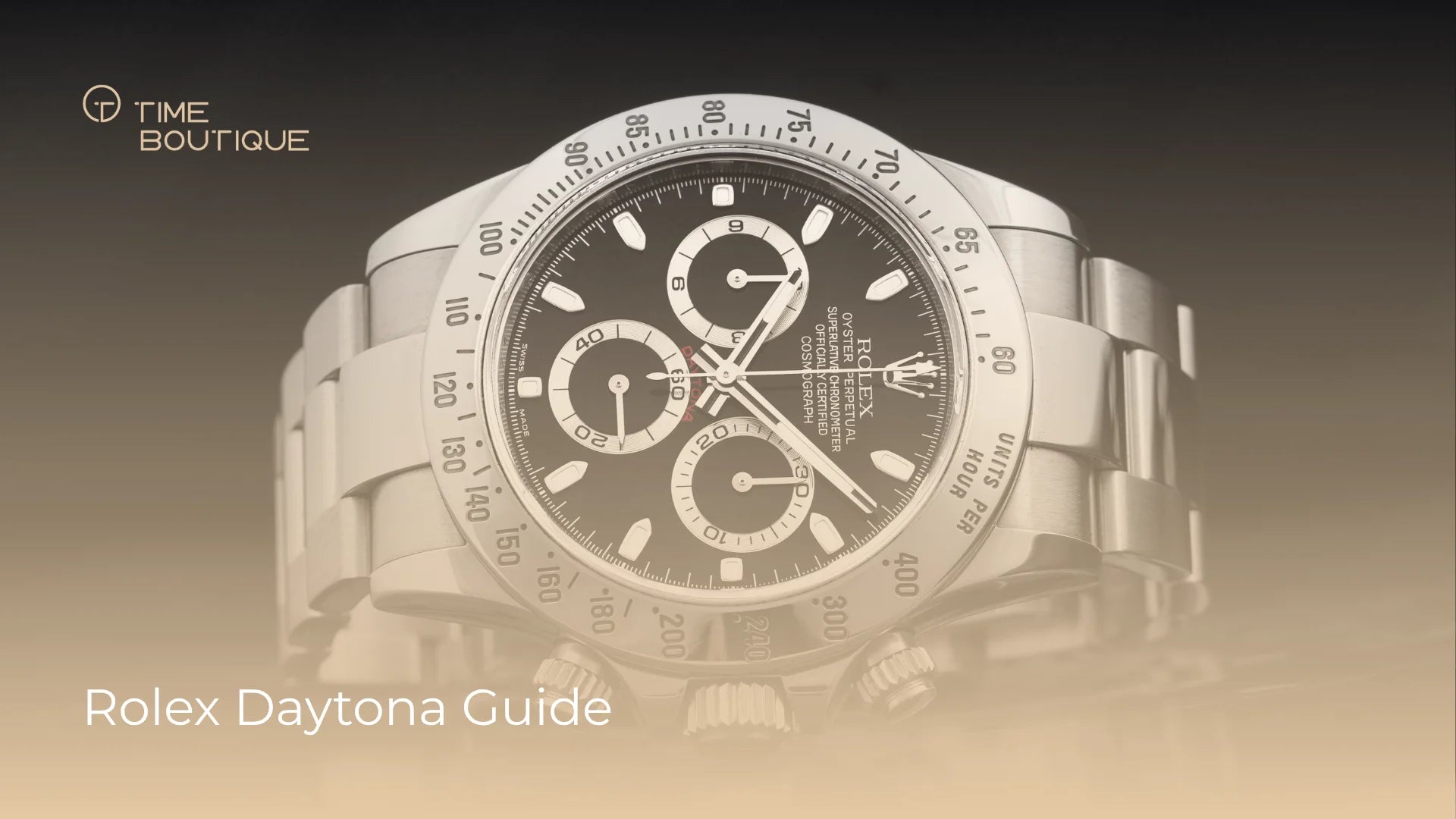
Rolex introduced the Cosmograph in 1963. The name Daytona moved onto the dial shortly afterwards, when Rolex became the official timekeeper of the race at the Daytona International Speedway in Florida. The character of the watch was clear from the start. A chronograph with three sub-dials and a tachymeter scale on the bezel, with which you can read an average speed from a measured time. That was not a fashionable detail but the tool of someone whose work involved speed.
It is interesting that the Daytona was not a bestseller from the beginning. In its first years it sat in the cases without the world fighting over it. That this rather unwieldy tool watch became one of the most sought-after watches in existence is a story of decades, of auctions and of a name we come to in a moment.
The references you should know
When you say Daytona, you mean something very different depending on the generation. It is worth keeping the major eras apart, because they sit far apart technically and in value.
The manual years
The early references carried hand-wound movements based on Valjoux. Pieces like the 6239 with its inset tachymeter scale, later the 6263 and 6265 with screw-down pushers and an Oyster case, stand for this era. These watches are collector territory in the narrow sense today. Condition, originality of the dial and completeness decide very large differences in value. Anyone stepping in here buys history and needs a trained eye, or a partner who has one.
The Zenith era from 1988 to 2000
In 1988 the Daytona received its first automatic movement with reference 16520. Rolex took the El Primero from Zenith as a base and reworked it so thoroughly that in the end it became an independent Rolex calibre, the 4030. This generation brought the 40 millimetre case and the sapphire crystal that still define the modern Daytona today. Collectors speak of the Zenith Daytona. It is the bridge between the manual past and today's manufacture world, and it has gained noticeable attention in recent years.
The in-house movement from 2000
In the year 2000 Rolex introduced the first Daytona with a fully self-developed automatic chronograph movement, the 116520, with the calibre 4130. Fewer components, a column wheel, a vertical clutch, a long power reserve. From the workshop's point of view it is a robust calibre that is clean to service. Helmut, our master watchmaker, likes to describe it as one of the most pleasant modern chronograph movements to have on the bench. This generation ran until 2016 and is for many the first genuinely everyday-capable collector Daytona.
The ceramic generation
In 2016 came the 116500LN, the first Daytona with a bezel in Cerachrom, that is, ceramic, with a black or a white dial. The white dial with its black sub-dials soon earned the nickname Panda. With this reference demand reached a level that pushed the retail trade to its limits. In 2023 the revised 126500LN followed, with fine adjustments to dial and bezel and the new calibre 4131. Anyone buying new today is usually talking about these two references. More on the Cerachrom bezel is in our glossary.
The movement that carries the modern Daytona
The calibre 4130, in use since 2000 and developed into the 4131 in 2023, is the technical heart of today's Daytona. Rolex deliberately designed it to be lean. It uses fewer components than many classic chronograph movements, which simplifies servicing and raises reliability. The stop function is governed by a column wheel, and a vertical clutch transfers the power. The practical advantage of this construction shows in daily use. The chronograph seconds hand starts without the little jump familiar from horizontally coupled movements, and it can run permanently without harming the movement. With around 72 hours of power reserve, the watch survives a weekend on the nightstand without stopping. From the workshop's point of view it is a movement that ages without making a drama of it.
Paul Newman, the name behind the exotic dials
Hardly any term causes more confusion than Paul Newman Daytona. It does not mean a separate reference but a particular kind of dial. These so-called exotic dials show a more intricate, almost Art Deco design of the sub-dials with block indices and contrasting colours. They were fitted to the manual references and were long considered hard to sell.
The dial owes its name to the actor and motor racing enthusiast Paul Newman, who wore such a Daytona. His personal example, a 6239 with an engraved dedication on the case back, was auctioned at Phillips in New York in 2017 for around 17.8 million US dollars, making it at that moment the most expensive wristwatch ever sold at auction. This single sale has shaped the market for vintage Daytonas lastingly. For practice it means above all one thing. On vintage pieces the dial decides a large part of the value, and that is exactly where fakes and later replacements are most common.
Steel, gold, platinum, what the choice means
The Daytona comes in Oystersteel, in yellow, white and Everose gold, as a combination of steel and gold, and in platinum. This choice is more than taste, it determines availability.
The steel Daytona is the most sought-after and at the same time the hardest to obtain. It is the reason for the waiting lists everyone talks about. The precious metal versions are often clearly easier to get at authorised dealers, because demand concentrates so heavily on steel. The platinum model with the ice-blue dial that Rolex reserves for platinum, and the brown ceramic bezel, stands for the most exclusive reading of the watch. Anyone looking for a Daytona to wear rather than to wait for should not dismiss the precious metal versions too quickly. They carry the same character, only in a warmer or more formal language.
How the Daytona wears on the wrist
At 40 millimetres of case diameter the Daytona is more compact than its reputation suggests. It wears surprisingly discreetly on most wrists, because the case is flat and the bezel with its tachymeter scale draws the eye onto the dial. Anyone coming from a larger sports watch finds it almost dainty at first, but soon gets used to the calm proportion. The Oyster bracelet with its folding clasp sits snugly, and the screw-down crown and screw-down pushers keep the case water-resistant to 100 metres. The Daytona is therefore less a pure jewellery watch than a tool that is well dressed. That very double nature, racing and elegance in one case, is part of its appeal.
Prices and value, looked at honestly
Here we are deliberately cautious with numbers, because market prices move faster than an article can stay current. What can be said responsibly is this. The steel Daytona belongs to the small group of watches that regularly trade above their list price on the secondary market. The reason is simply the relationship between high demand and scarce allocation. Precious metal versions sit closer to list price depending on the configuration.
The broader collector market has calmed again after the very high levels of recent years. Even in this quieter phase the steel Daytona has held its demand better than many other references. The vintage world, above all the exotic dials, follows its own rules anyway and depends more on condition and provenance than on the market's daily mood. We prefer to name concrete, current ranges in conversation, because they depend on reference, condition and completeness. Anyone thinking of the Daytona as an investment should read our article luxury watch as an investment, which brings the necessary sobriety.
What to look for when buying a used Daytona
For many a used Daytona is the more realistic route to the watch, because it avoids the waiting list. For the purchase to succeed, a look at a few points is worthwhile.
Check the function of the screw-down pushers and the stop function. A chronograph that starts, stops and resets to zero cleanly says a great deal about how it has been cared for. Pay attention to the originality of the dial, especially on older references, because reworked or swapped dials greatly reduce value. Check that reference and movement match, and ask to see the service history.
Completeness is no accessory on the Daytona but a real lever on value. Box and papers, ideally with matching reference and serial number, raise liquidity and resale noticeably. Why that is so we go into in box and papers, how important are they really. And because the Daytona in particular is a popular target for fakes, a look at our guide to spotting fakes is worthwhile before any purchase. When in doubt, the simplest advice Helmut gives applies. A Daytona whose origin cannot be cleanly proven is not a cheap Daytona but an open risk.
Buy new or used, the two routes to the Daytona
There are two realistic routes to a Daytona, and they feel very different. The route through the official dealer leads to list price, but for the steel version usually via a waiting list whose length nobody can responsibly predict. Anyone with patience, a relationship with the dealer and the ability to live with the wait takes this route. The second route leads through the secondary market. Here you get the watch immediately but pay the premium mentioned for the steel Daytona. The great advantage is choice. On the secondary market all generations stand side by side, from the Zenith Daytona to the current ceramic version. Anyone open to an older reference often finds more watch for their money here, and a piece with character. The full process of a safe purchase we describe in our Rolex buying guide.
Frequent questions about the Rolex Daytona
Why is the steel Daytona so hard to get? Because demand has clearly exceeded retail allocation for years. The steel version draws the largest part of this demand, while the precious metal models are easier to obtain.
What does Paul Newman mean on a Daytona? It is not a separate model but the term for the exotic dials of the manual references. They are especially sought-after and accordingly valuable.
Is a used Daytona a good idea? Yes, provided origin, condition and completeness are right. Precisely because the steel version is barely available new, the secondary market is the more sensible route for many. What matters is a careful inspection, ideally by someone who knows the references.
The Daytona at Time Boutique
In our atelier in Munich we see the Daytona in all its generations, from the manual classic to the current ceramic version. We advise in person, inspect every piece carefully, and decline honestly even then if something is not right. If you are looking for a particular reference, talk to us, we will keep our eyes open for you. You will find an overview of our current stock in our Rolex selection.
If you are still unsure whether the Daytona is even the right Rolex for you, our comparison which Rolex to buy helps. And anyone wishing to part with a Daytona will find in selling a Rolex how a fair purchase works with us. Appointments in Munich are by arrangement, in person and without haste.
- A chronograph that comes from racing
- The references you should know
- The manual years
- The Zenith era from 1988 to 2000
- The in-house movement from 2000
- The ceramic generation
- The movement that carries the modern Daytona
- Paul Newman, the name behind the exotic dials
- Steel, gold, platinum, what the choice means
- How the Daytona wears on the wrist
- Prices and value, looked at honestly
- What to look for when buying a used Daytona
- Buy new or used, the two routes to the Daytona
- Frequent questions about the Rolex Daytona
- The Daytona at Time Boutique