
The "genuine or fake" question is one more buyers ask each week. The secondary market for luxury watches has grown substantially since 2020, and with it the share of so-called super clones emerging from specialised workshops in Asia. Every week we inspect pieces from private ownership, inheritances and private purchases. This guide gives you the ten universal checks plus four brand-specific deep dives, so you can form a first assessment yourself.
The counterfeit market, what you should know
The replica industry now operates at three quality tiers. The lowest is the tourist market, cheap quartz imitations, often identifiable by weight alone. The middle tier are "genuine-style" fakes, mechanical movements of Chinese origin with passable exteriors. The top tier are super clones, fitted with a cloned movement that delivers acceptable values on a timegrapher and can fool even trade buyers at first glance.
The latter come out of a small number of factories at a purchase cost of between 1,500 and 4,000 euros. Anyone seeing private offers under market price should be especially careful. A Submariner at 7,000 euros instead of 12,000 is not a bargain but, in most cases, a warning sign.
Ten universal authenticity checks
These ten points apply to any mechanical luxury watch, irrespective of brand.
1. Dial print and resolution
The dial is the watch's calling card. Under a ten-power loupe you should see on a genuine luxury watch:
- Crisp edges on every letter and line. Replicas often show pixelated transitions or bleed.
- Consistent colour depth across the whole surface. On replicas colour intensity varies because inferior printing methods are used.
- Applied markers sit precisely capsuled on the dial. Replicas often glue them on or print them flat.
- Consistent typography across brand, model and function. A Patek Philippe does not suddenly use a Rolex font; replicas often mix.
2. Lume, response and colour quality
Genuine luxury watches use high-grade lume materials, mostly Super-LumiNova in grades BG-W9 or X1, at Rolex the proprietary Chromalight.
- Activation: Full charge requires five to ten seconds of direct UV light. Replicas often activate at weaker light because lower-grade lume powder is used.
- Glow duration: Genuine luxury lume holds for six hours and longer. Replicas lose substantial brightness after one to two hours.
- Colour quality: Chromalight glows blue, high-grade Super-LumiNova glows greenish-turquoise. Replicas often show a pale yellow-green or unequal colour between indices and hands.
- Consistency: Indices and hands must glow at identical brightness. Discrepancies point to retrofitted parts.
3. Case engraving and hallmarks
Precious metal cases carry statutory hallmarks (purity marks) and manufacturer engravings. On steel and titanium cases you will find brand, model and serial numbers.
- Hallmarks on the case back or inside the case: 750 for 18 carat gold, 950 for platinum. On Swiss brands additionally the Helvetic bear or squirrel stamp.
- Serial and reference number clearly engraved, not stamped or milled. Laser engraving shows sharp edges under the loupe.
- Matt and polished surfaces with perfect transitions. Replicas often show messy transitions or missing brushing.
Note: A correct hallmark on a non-precious case is its own form of counterfeit. A hallmark alone is no proof of authenticity.
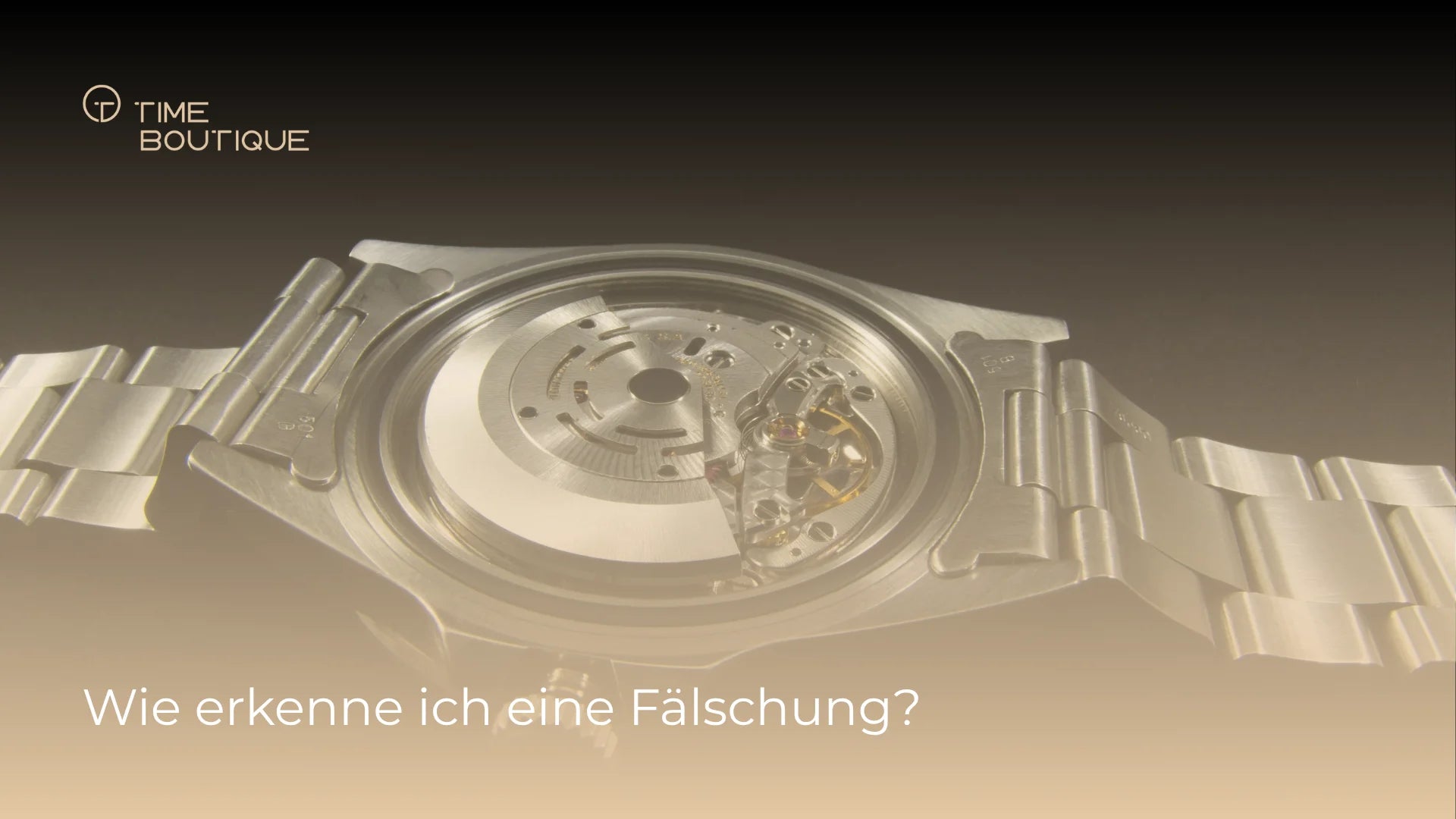
4. Movement, visible signatures and finishing
On luxury watches with a transparent case back, or during a workshop opening, you see the movement directly. This is where the biggest gap between original and replica shows.
- Côtes-de-Genève finishing on the bridges, even and parallel.
- Perlage (circular graining) on the plates, precise and geometric.
- Anglage on the edges, ground and polished. Replicas show sharp-edged, unfinished bridges.
- Screw heads: Blued on Patek and AP, polished bright on Rolex. Screw heads showing milling marks are a clear replica giveaway.
- Movement number and signatures on the bridges, clearly engraved. In-house calibres additionally carry patent numbers and jewel counts.
5. Crown and pushers, logo and finishing
The crown is one of the most frequent replica failure points.
- Logo engraving three-dimensional and sharp. Replicas often flat or blurred.
- Winding behaviour: Smooth winding without grinding or jumps. Three clear positions (wind, date, time with hack seconds).
- Screw-down: On screw-down crowns two to three full turns, smooth, with a clean stop.
- Pushers (chronograph): Clearly defined actuation point with tangible click. Mushy pushers are a clear warning.
6. Bracelet, end links, clasp, stamps
The bracelet is often the telltale detail.
- End links sit flush against the case with no rocking. Replicas often show visible gaps.
- Clasp with precise mechanics, clearly defined opening point, and a controlled click motion.
- Material stamps on the inside of the clasp (brand name, material, reference), laser engraved.
- Spring bar construction: Some brands (Rolex, AP) use special spring bars with markings. Standard spring bars on a high-end sports watch are suspect.
- Weight and sound: A solid precious-metal bracelet feels substantial and rings warm as the links fall together. Hollow imitations sound tinny.
7. Crystal, doming and anti-reflective coating
Sapphire is standard on every modern luxury watch.
- Scratch resistance: Sapphire at Mohs hardness 9 is practically unscratchable by keys or coins. Caveat: Diamond dust will scratch sapphire.
- Anti-reflective coating: Recognisable by a slight bluish or violet shimmer at an angle. Replicas often have no coating or one that flakes locally.
- Doming: Vintage models and some modern ones (Patek Calatrava, Cartier Tank) have curved crystals. The curve must be symmetrical and even.
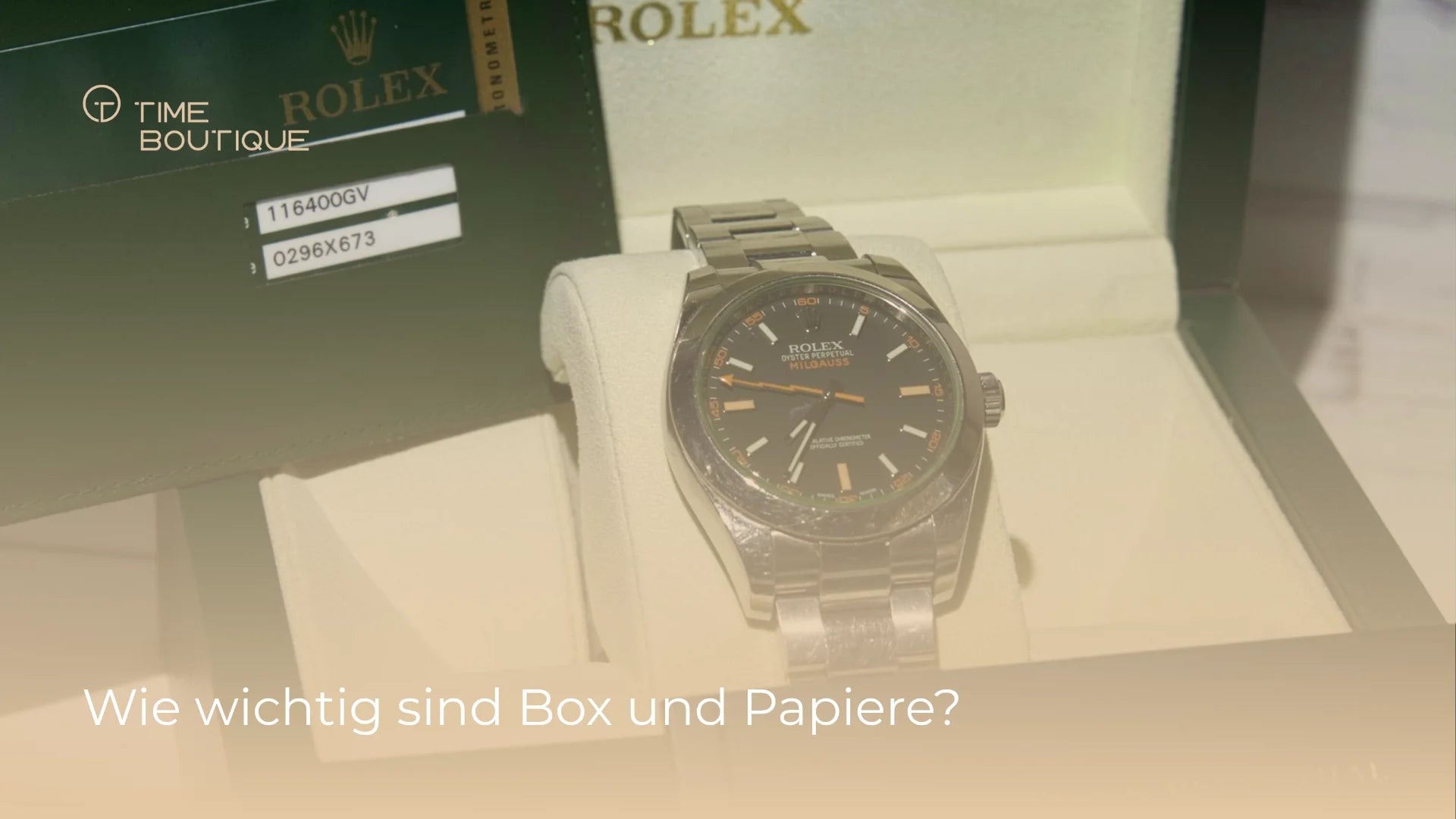
8. Papers, embossing, print, warranty stamping
Papers are not proof of authenticity but an important indicator.
- High-quality print with sharply defined fonts. Replica cards often show pixels or blurred edges.
- Embossing of the brand on warranty card and manual. Genuine cards show tangible relief embossing.
- Material quality: Genuine papers feel substantial, credit card format at correct weight. Replicas are often too thin or too smooth.
- Stamps and dates: Dealer stamp, purchase date, serial number must be consistent. More on this in our guide to box and papers.
9. Weight, tangible substance
Precious metal and steel luxury watches carry a characteristic weight. A modern Submariner weighs around 95 grams without bracelet end links, 155 grams with bracelet. A Royal Oak in steel sits at 200 grams.
- Substantial feel in the hand. Replicas are often too light because inferior alloys or hollow constructions are used.
- Weight distribution: A solid metal bracelet distributes weight evenly. A tangible shift in centre of gravity is suspect.
- Calibrating: Comparison with a known-genuine watch of the same reference on a scale gives the clearest indication.
10. Movement sound, mechanical vs quartz vs replica
Hold the watch to your ear.
- Mechanical sounds warm: A soft, regular ticking with a characteristic ring. Frequency: 4 Hz (28,800 vph) on most modern movements, audible as eight beats per second.
- Quartz sounds hard: On a mechanical luxury watch no high-frequency whine should be audible. If it is, it is probably a quartz replica.
- Rotor sound: When the watch is shaken, a soft, smooth rustle. Rattling or banging is a warning.
- Hand motion: The seconds hand of a modern luxury watch sweeps smoothly, not in individual jumps. A visibly stepping second is a quartz or replica indicator.
Brand-specific notes
Beyond the ten universal points, the major manufacturers have their own authenticity signatures.
Rolex
- Rehaut engraving from 2008 with serial number at 6 o'clock and "ROLEXROLEXROLEX" laser engraving round the full circumference.
- Cyclops lens with 2.5x date magnification.
- Cerachrom bezel with platinum or gold fill of the engravings.
- Triplock or Twinlock screw-down crown, recognisable by the dots beneath the coronet.
- Mercedes hour hand on sports models, with precisely defined three spokes.
Patek Philippe
- Calatrava cross as hallmark on the movement and on the crown.
- Geneva Seal ("Poinçon de Genève") or the in-house Patek Philippe Seal as movement signature.
- In-house movements at the highest level of finishing, anglage and polishing even on interior surfaces.
- Authorisation via the Patek database: Every watch can be checked at the manufacturer by serial number and reference.
- Gold bridge anchors on the most complex complications.
Audemars Piguet
- "AP" logo on the crown, three-dimensionally milled.
- Royal Oak octagon with eight visible screws that sit on the bezel and do not pass through.
- Tapisserie dial (Grand or Petite Tapisserie), characteristic three-dimensional pattern. On replicas often flat-printed or coarsely milled.
- Movement engraving "AP" and calibre number on the train bridge.
- Massive steel construction with characteristic weight of around 200 grams on the Royal Oak 41.
Cartier
- Guilloche dial with precise sunburst pattern, sometimes called "Flinqué".
- Cabochon (blue sapphire) on the crown, synthetic spinel on more recent models. Form and cut must be even.
- "Cartier" secret signature inside one of the Roman numerals (usually the seven or ten), visible only under strong magnification.
- Serial number on the case between the lugs, laser engraved.
- Sapphire cabochon crown with precise bezel setting; on replicas often crooked or oversized.
Tools and methods for the home check
What you can use at home:
- Ten-power watchmaker's loupe: Standard tool for print inspection. Loupe models with built-in LED ease detailed viewing.
- UV torch (365 nm or 395 nm): For lume activation and glow assessment.
- Precise scale (accurate to 0.1 grams): For weight comparison against known reference values.
- Smartphone camera in macro mode: For documentation and comparison with online images of known originals.
- Manufacturer serial number databases: Patek offers an Extract from the Archives, Vacheron Constantin and Cartier have similar services. Rolex maintains no public database; here you must work through COSC values and physical inspection.
What you should not check at home:
- Opening the case without correct tooling
- Water resistance (pressure testing requires special equipment)
- Movement identification (requires workshop experience)
When to send the watch in
In any case, bring a watch in for a workshop check when:
- You are about to buy a watch over 5,000 euros privately.
- An heirloom with unclear provenance sits in the drawer.
- You have doubts about any of the ten universal checks.
- The watch comes from a non-certified market (private internet purchase, auction without authenticity guarantee, private offer without records).
A professional authentication, depending on scope, costs between 80 and 250 euros and gives you a written assessment with photo documentation. That is money well spent on any five-figure watch.
What happens at an authentication with us
When you bring a watch to our atelier, it goes through several stations:
- Exterior visual inspection: Case, crystal, bezel, crown, bracelet, clasp. We document all features photographically at twenty-power magnification.
- Movement visual inspection: Visible directly through the case back if present, otherwise we open it with the brand-specific tooling. Côtes finishing, movement number, screws, rotor.
- Timegrapher: Rate measurement across at least five positions, comparison with factory specifications. COSC and brand-specific tolerances.
- Pressure test: Water resistance up to the rated specification. Dry or wet pressure test depending on the model.
- Written assessment: Authenticity verdict with photo attachment, assessment of service needs and (on request) a market value estimate.
Depending on scope the inspection takes a day to a week. In simpler cases you receive an initial assessment within an hour at the atelier.
In doubt
An authentication in advance costs a fraction of what a bad purchase costs. Anyone buying a five-figure luxury watch privately should not skip this step. We inspect pieces that were not purchased from us, without obligation to service or sale.
Have authenticity verified: submit a request or request a pre-purchase appraisal.
More at the atelier: service overview.
- The counterfeit market, what you should know
- Ten universal authenticity checks
- 1. Dial print and resolution
- 2. Lume, response and colour quality
- 3. Case engraving and hallmarks
- 4. Movement, visible signatures and finishing
- 5. Crown and pushers, logo and finishing
- 6. Bracelet, end links, clasp, stamps
- 7. Crystal, doming and anti-reflective coating
- 8. Papers, embossing, print, warranty stamping
- 9. Weight, tangible substance
- 10. Movement sound, mechanical vs quartz vs replica
- Brand-specific notes
- Rolex
- Patek Philippe
- Audemars Piguet
- Cartier
- Tools and methods for the home check
- When to send the watch in
- What happens at an authentication with us
- In doubt