
There are watches that are loud, and there are watches that need no noise because everyone knows what they mean. The Day-Date belongs to the second group. It is the summit of the classic Rolex line, made exclusively in precious metal, and it carries its status with a calm that louder watches lack. In the atelier it is the watch people come to once they no longer have anything to prove. This guide shows what defines the Day-Date and what matters when you buy.
The watch that writes out the day of the week
The Day-Date came to market in 1956 and was the first wristwatch to show the day of the week written out in full in a window at the top of the dial, in addition to the date at three o'clock. What feels obvious today was a technical achievement, because the written-out display calls for its own disc and its own switching mechanism. From the start the Day-Date was conceived as a flagship model, and accordingly it was never built in steel but always in precious metal. It has kept to that principle across the decades and become the calmest status watch of the brand.
Where the President nickname comes from
Hardly any Rolex carries its nickname as naturally as the Day-Date. President is what it is called, and the name has two roots. One is the bracelet designed especially for it, with its semicircular, three-piece links, which Rolex calls the President bracelet. The other is the prominent wearers, heads of state and leading figures, who accompanied the model across the decades. The two together shaped the name, which today almost merges with the model. When you say President you mean the Day-Date, and the other way round.
The President bracelet
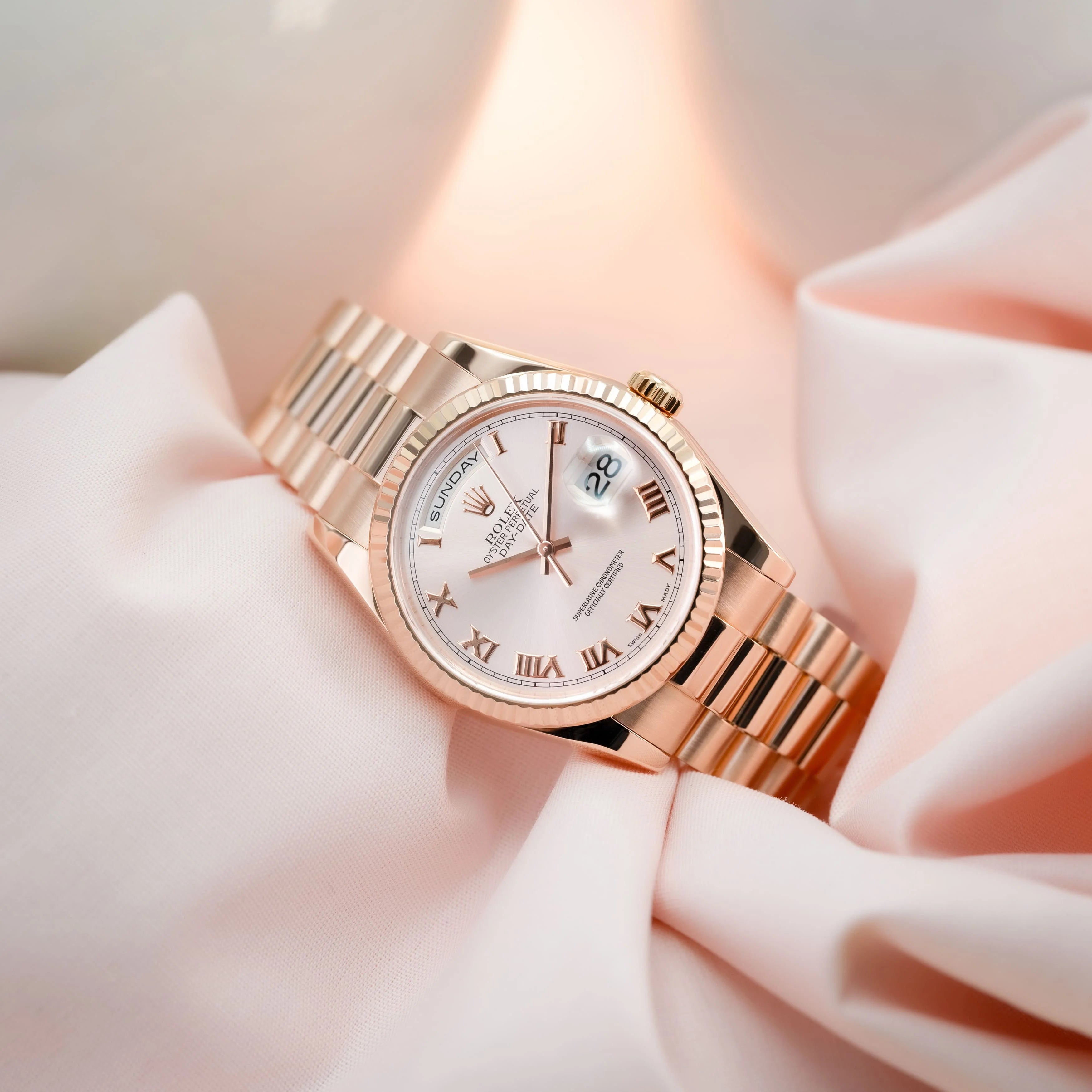
The President bracelet is more than a detail, it is an essential part of the character. Its semicircular links look more closed and more refined than the more open bracelets of the sports models and underline the formal presence of the watch. It lies supple on the wrist and adapts well. In combination with the precious metal a very homogeneous picture results, in which case and bracelet seem cast from a single piece. For many wearers this very bracelet is the reason the Day-Date feels so unmistakable.
Precious metal only, what that means
The Day-Date exists exclusively in yellow, white and Everose gold and in platinum. This restriction is deliberate. It keeps the model consciously at the top and ensures that a Day-Date always consists of solid precious metal. In practice this means that a Day-Date appears clearly more present and warmer than a steel Datejust, even at a similar size. The weight on the wrist is noticeable, the material catches the light differently. Anyone seeking the understatement of a steel watch is better served by the Datejust. Anyone who deliberately wants to wear precious metal finds in the Day-Date the calmest and most substantial form.
The sizes and references
In the current programme two sizes are relevant. The Day-Date 36 is the historical original size and for many the most classic proportion. The Day-Date 40 is the modern, somewhat more present variant and replaced the earlier Day-Date II at 41 millimetres. Both carry the in-house calibre 3255 today. Within these sizes there is a wide range of dials and bezels, from the smooth through the fluted to the diamond-set execution. Anyone looking for a Day-Date should first settle the size on the wrist and then work through the material and dial variants.
The dials, from calm to spectacular
In hardly any other Rolex model does the range of dials reach as far as in the Day-Date. On the calm side stand plain tones in champagne, silver or black that underline the formal character. On the spectacular side there are gradient dials, stone dials made from materials such as onyx or other ornamental stones, and diamond-set variants. This variety allows the same Day-Date to be worn as a restrained dress watch or as a clearly more striking piece. In the atelier we advise choosing the dial to suit your own personality and not the supposed expectation, because the Day-Date is a watch for life.
The movement
The in-house calibre 3255 works in the current models. It offers around 70 hours of power reserve and uses the Chronergy escapement for better energy efficiency. From the workshop's point of view it is a modern, robust movement that reliably governs the additional mechanism for the written-out day display. The movement carries the chronometer rating and is designed for all-day accuracy. What Helmut values most in the modern Rolex movements is their ease of servicing, which greatly benefits a watch meant to be worn over generations.
How the Day-Date wears
The Day-Date wears differently from any steel Rolex. The precious metal gives it weight and presence, the closed President bracelet hugs the wrist, and the written-out day display lends the dial a calm of its own. At 36 millimetres it looks classic and timeless, at 40 millimetres more modern and stronger. It is not a watch for the beach or the workshop but for the suit, the office and the occasion. This very clear purpose makes it one of the few genuine status symbols that manage entirely without volume.
A short history of the Day-Date
When the Day-Date appeared in 1956 it was a technical statement. A wristwatch that shows the day of the week written out called for its own disc and a reliable mechanism that flips the word over at midnight. Rolex built it from the start as a flagship model and therefore exclusively in precious metal. Across the decades the model matured carefully. The movements became more accurate and more durable, the cases minimally revised, the variety of dials grew. What never changed was the basic idea. A Day-Date was to be the calmest and most substantial form of a Rolex, a watch passed on across generations. This very constancy explains why older Day-Date models too are still coveted today. They do not age in style but for many even gain in character.
Recognising the generations
On the secondary market it pays to keep the generations apart. The older Day-Date models with four and five-digit references carry slimmer cases and in part acrylic crystal and are connoisseur territory with their own appeal. The more modern six-digit references stand for today's in-house movements and the current finishing. A special role is played by the Day-Date II, which Rolex introduced in 2008 at 41 millimetres and which was replaced in 2015 by the more balanced Day-Date 40. Anyone buying an older Day-Date should know which generation they are moving in, because that determines the expectations of movement, crystal and spare-parts supply. With a precious metal piece this look is especially worthwhile, because here substance and condition decide the value.
Day-Date 36 or 40, the decision
The choice between the two current sizes is above all a question of wrist and style. The Day-Date 36 is the historical proportion, classic and timeless, and wears coherently on slimmer wrists too. The Day-Date 40 is the more modern, more present variant, preferred by stronger wrists and a more contemporary presence. Both carry the same character, only at a different volume. Anyone unsure should compare both on the wrist, because the right size shows itself in seconds. In the atelier we often see that the decision on the arm turns out quite differently from on paper.
What to look for when buying a used Day-Date
Because the Day-Date is made of precious metal, a close look at the material and the finishing pays off. Check the case for clean edges, because over-intensive polishing removes substance especially quickly on gold and wears down the contours. Pay attention to the condition of the President bracelet, above all to the play between the links, which grows larger on heavily worn pieces. Check the originality of dial and hands and ask to see the service history. Completeness with box and papers raises value and resale here too, more on that in box and papers, how important are they really. The full process of a safe purchase is described in our Rolex buying guide.
Service and care
A Day-Date is designed for a long life, and precious metal calls for particular care in that. Gold is softer than steel, which is why scratches arise more easily and polishing should be done with discretion to preserve the contours. The movement needs a service at longer intervals, during which the gaskets are also renewed. A well-kept Day-Date with a documented service history is not only the more reliable watch but also the more value-stable one. What a service costs and when it makes sense is set out in our article Rolex service costs. Anyone who wants to pass on their Day-Date across generations should understand the service as a natural part of ownership, not as a tiresome obligation.
The Day-Date as an heirloom
Hardly any watch is as well suited as an heirloom as the Day-Date. It consists of solid precious metal, does not age in style, and carries with the written-out day a timeless distinction. Many of our customers buy it deliberately as a watch that is one day to be passed on, to a child or a godchild. It is made for exactly that. A Day-Date tells a story across the decades, it gathers fine traces of wear and becomes more personal through them. Anyone buying in this spirit should pay attention to completeness with box and papers, because that makes the watch complete for the next generation.
Frequent questions about the Day-Date
Why is the Day-Date not available in steel? Because from the start it was conceived as the flagship model of the classic line and Rolex deliberately reserves it for precious metal. A steel alternative with a date is the Datejust.
Which size is the right one? The 36 is the classic, timeless proportion, the 40 the more modern and more present. Both are best compared on the wrist.
Is the Day-Date a good store of value? It consists of solid precious metal and is usually well available. It is more a calm status watch than an object of speculation. A perspective on this is given by Rolex prices and value development.
The Day-Date at Time Boutique
In our atelier in Munich we advise on the Day-Date with the calm this watch deserves. We lay out various sizes, metals and dials and say honestly what suits you. You will find an overview of our current stock in our Rolex selection, and a placing of the whole family in our overview of Rolex models. Anyone wishing to part with a Day-Date will find in selling a Rolex how a fair purchase works with us. Appointments in Munich are by arrangement, in person and without haste.
- The watch that writes out the day of the week
- Where the President nickname comes from
- The President bracelet
- Precious metal only, what that means
- The sizes and references
- The dials, from calm to spectacular
- The movement
- How the Day-Date wears
- A short history of the Day-Date
- Recognising the generations
- Day-Date 36 or 40, the decision
- What to look for when buying a used Day-Date
- Service and care
- The Day-Date as an heirloom
- Frequent questions about the Day-Date
- The Day-Date at Time Boutique