
A good watch can outlive several generations if you understand it a little. Most damage is not caused by one dramatic accident but by small habits: the watch left on for tennis, perfume sprayed onto the leather strap, the phone in the same pocket, the crown that was not screwed back down after setting the time.
This guide is a practical owner's manual for mechanical watches, with a short section on quartz. You will learn how to clean the case and bracelet, what water and magnetic fields can do, how to wind an automatic and set the date safely, when a service is due and why restraint is usually the wiser course when it comes to polishing.
Why watch care matters, a mechanical watch is a machine
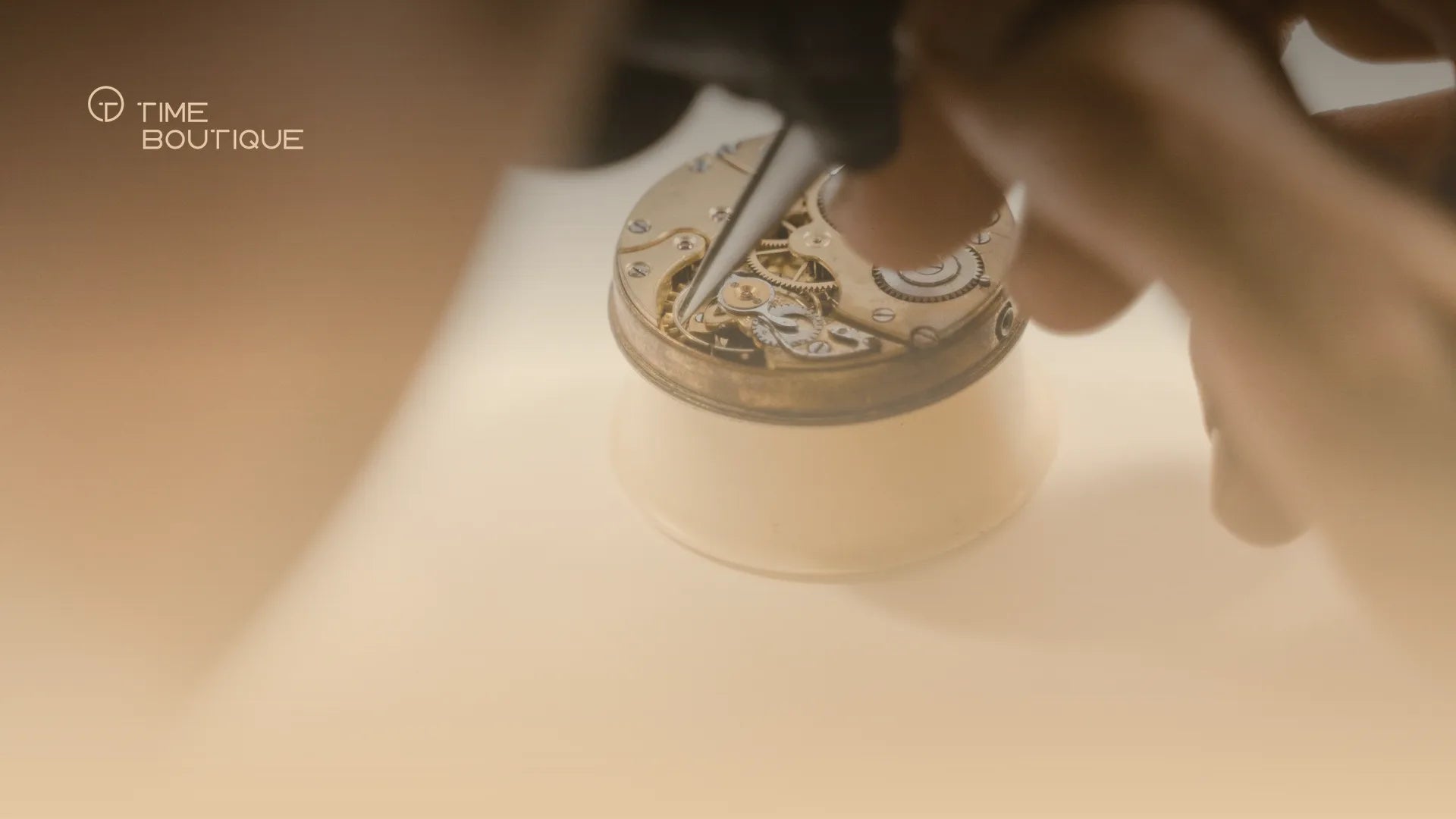
At heart a mechanical watch is a small machine. A mainspring stores energy, a gear train passes it on, and the balance with its hairspring swings back and forth many thousands of times an hour. At the pivots, tiny amounts of oil keep metal from rubbing unprotected against metal. These oils age and thicken over time, and the seals that keep out dust and moisture lose their elasticity.
With an automatic watch, a rotor also winds the mainspring as you wear it. Caring for a luxury watch therefore means two things: avoiding what puts unnecessary strain on the machine in daily life, and giving it a proper service at sensible intervals. A well-kept watch runs more reliably and holds its value better, because buyers look closely at condition and documented service history.
Luxury watch care in daily life, the right habits
The most effective protection is taking the watch off at the right moment. Sports with hard impacts, such as tennis, golf, padel or mountain biking, are tougher on a movement than most people expect. Shock protection does guard the delicate balance staff, but repeated jolts still put strain on movement, crystal and case.
Apply perfume, sun cream, hand cream and sanitiser before you put the watch on, and let them dry. Alcohol, oils and fragrances attack leather, leave marks and can, over time, take their toll on the seals. One simple habit also prevents some of the most common damage of all: put the watch on and take it off over something soft. A fall onto tiles or stone can damage the crystal, the crown and the movement.
How to clean a watch, case and bracelet
For everyday care a soft, clean microfibre cloth is all you need. Wipe fingerprints, skin oils and dust from the crystal, case and bracelet.
For a more thorough clean, a metal bracelet and a steel case can be washed with lukewarm water, a drop of mild soap and a soft brush. There are two conditions, however: water resistance must be intact and recently tested, and a screw-down crown must be fully screwed in. Brush gently between the links, around the lugs and at the clasp, rinse with clean water and dry everything thoroughly.
Avoid harsh cleaning agents, alcohol, abrasives and polishing cloths impregnated with paste, which can alter brushed surfaces. An ultrasonic bath is a watchmaker's tool for a detached metal bracelet, not for the complete watch. A leather strap should never go under water; simply wipe it dry.
Water and water resistance, what the seals do
The water resistance rating on the dial or caseback describes the condition of a new, tested watch. It is not a promise for all time. The seals at the caseback, crystal, crown and pushers harden or become brittle over the years, through heat, chemicals and simple age. A watch that was water-resistant a few years ago need not be so today.
Have water resistance tested regularly, ideally before the summer and always after the watch has been opened. A screw-down crown should be pushed in and screwed down after every winding and setting, gently and without force, until it stops. A crown left open is one of the most common causes of water in the case. Never operate the crown or pushers under water, and that includes the shower.
After swimming in the sea or in a chlorinated pool, rinse the watch with fresh water. Avoid saunas, steam rooms and hot tubs, because heat and rapid temperature changes are hard on the seals. Treat vintage watches as if they were not water-resistant at all. A misted crystal or droplets under the glass are an emergency: take the watch to a watchmaker straight away, because moisture makes steel parts in the movement rust and can permanently damage the dial.
Magnetism, when a watch suddenly runs fast
Magnetic fields are found in phones and tablets, in speakers and headphones, in laptops with magnetic lid closures and in the magnetic clasps of handbags and phone cases. If the hairspring is exposed to a strong field, its fine coils can stick to one another. The effective length of the spring shortens, the balance swings faster, and the watch suddenly runs much faster, often by many times its usual rate deviation.
Typically this happens without a knock and for no obvious reason. A simple compass gives a first clue: if the needle moves as you pass the watch slowly beside it, it is probably magnetised. Demagnetising takes a watchmaker only a few minutes, and the watch does not need to be opened.
Modern hairsprings in silicon or antimagnetic alloys are far more resistant, but hardly any watch is entirely immune. So do not leave it lying on your phone or next to a speaker.
Winding an automatic and setting the date correctly
If an automatic watch is left unworn for a few days, it stops once the power reserve is used up. That does it no harm. Before you put it back on, wind it by hand: unscrew the crown if necessary and turn it evenly in the winding position until the watch is running steadily and has built up some reserve. An automatic movement cannot be overwound, because a slipping clutch protects the mainspring. With a manual-wind movement, stop as soon as you feel resistance. Take the watch off your wrist to wind and set it, since on the arm the crown is loaded at an angle.
A watch winder is convenient but not necessary.
The date comes with a rule many owners have never heard of. In many calendar movements the date mechanism begins to engage with the gear train hours before midnight, and using the quickset during that phase can damage it. So avoid changing the date while the watch shows a time roughly between 9 pm and 3 am. A safe sequence is to set the hands to about half past six, set the date to the previous day, then turn the time forward through midnight to the current hour. Some modern movements are more tolerant, but your watch's instruction manual is the final word.
Storing your watch properly
A watch that is not being worn needs a dry place with an even temperature, away from direct sunlight and radiators. The bathroom is therefore not a good spot. Keep each watch separately, in a soft pouch or a watch box with individual compartments, so that cases and crystals do not rub against one another or against jewellery.
If an automatic is going to rest for months, wind it now and then and let it run for a while. Keep the box and papers just as dry, because they are part of the watch's value.
Caring for straps and bracelets, leather, steel and the Jubilee
A leather strap is a wear part. Sweat, water and cosmetics take their toll; it darkens and cracks. Do not wear it too tight, let it air dry after wearing, and in summer or for sport switch to metal or rubber. Once the leather becomes brittle, replace it before it gives way at the wrong moment.
Metal bracelets age differently. Between the links sit pins or tubes on which material wears away over the years, with dirt acting like a fine abrasive. The result is known as bracelet stretch: the bracelet sags and visible play develops between the links. Regular cleaning slows the process; a badly stretched bracelet can, depending on its design, be refurbished or will need replacing. Check, too, that the folding clasp closes firmly.
Pay particular attention to a Jubilee bracelet. Its five-piece construction of many small links is wonderfully supple on the wrist, but it also has many joints in which dirt collects. Regular brushing, as long as the watch is water-resistant, and an occasional ultrasonic clean of the detached bracelet keep it in good shape.
Quartz watches, battery changes and seals
A quartz watch needs less care than a mechanical one, but one rule matters: replace a flat battery promptly. An exhausted battery left in the case for a long time can leak and damage the movement through corrosion. On some movements the end is signalled by the seconds hand moving in larger jumps.
Opening the caseback disturbs its gasket, so every battery change should include a check of the seals and a water resistance test. This applies particularly to fine quartz watches such as many Cartier models, whose casebacks are held by small screws. You will find information on Cartier battery changes and servicing on the relevant service page.
How often should a watch be serviced? The service and overhaul rhythm
A service, an overhaul and a revision all mean essentially the same thing: the watch is dismantled, the movement cleaned, lubricated and regulated, worn parts and seals are replaced, and finally water resistance is tested. Thanks to better oils and materials, many brands now name intervals of roughly five to ten years. If you are wondering how often to service a Rolex: Rolex states about ten years for its current models.
These are guidelines for a watch worn normally. With frequent water use, or with older watches, it is better to watch the watch than the calendar. Do not wait until it stops, because a movement running on degraded oil wears faster and the eventual service becomes more extensive. These signs point to an earlier appointment:
| Sign | Possible cause | What to do |
|---|---|---|
| Watch suddenly runs much faster | Magnetisation | Have it demagnetised |
| Rate drifts gradually | Aged oils, wear | Have the rate measured, plan a service |
| Power reserve noticeably shorter | Failing lubrication, winding system | Plan a service |
| Crown stiff or gritty | Seal, winding stem, dirt | Have it checked, avoid water |
| Date changes hesitantly | Calendar mechanism | Have it checked, never force it |
| Mist or water under the crystal | Failed seal | Straight to a watchmaker |
What happens step by step during a service, and which factors determine the cost, is covered in the article on Rolex service costs, while the Audemars Piguet service and overhaul guide explains the particular demands of elaborately finished cases. Information on watch servicing and on Rolex servicing in particular can be found on the respective service pages. If the watch has to be posted for a service, sending a watch insured explains what matters.
Polishing, yes or no
Anyone considering polishing a Rolex or any other luxury watch should know one thing: polishing always removes material. Every pass takes a little metal off the case, and what has gone does not come back. Gold is softer than steel and loses substance faster.
The most delicate parts are the details that give a case its character: sharp edges, the bevels on the lugs, the crisp transition between brushed and polished surfaces. A case that has been polished too often looks soft and blurred, and the lugs grow thinner. For collectors that is a key criterion, and with vintage watches in particular an unpolished, honestly worn case is often valued more highly than a gleaming refinished one.
If you do refinish, do it lightly. A gentle refresh of the brushed finish largely preserves the geometry. Before a service, state clearly whether and to what extent the case should be refinished, because refinishing is part of the standard service in many places. What polishing costs depends on the extent of the work and can only be judged properly after an inspection. Often the best decision is to accept signs of wear as part of a watch's story.
Service and overhaul at Time Boutique
We handle service and overhaul in our own workshop in Munich, with refinishing of case and bracelet on request, for brands including Rolex, Patek Philippe, Audemars Piguet, Cartier and Omega. Submit your service request.
If a new watch is to join the collection, you will find current pieces in our collection. Whatever is not in stock we will source for you. Get in touch. A watch you no longer wear we will buy if you wish, via the selling enquiry.
Frequently asked questions
How often should a Rolex be serviced?
Rolex states a service interval of about ten years for its current models. If the rate changes noticeably, the power reserve falls or moisture appears under the crystal, do not wait for the interval. Vintage watches usually benefit from shorter intervals.
How can I clean my watch myself?
For everyday care a soft microfibre cloth is enough. A metal bracelet and steel case may be cleaned with lukewarm water, mild soap and a soft brush, but only if water resistance has been tested and the crown is firmly screwed down. Leather straps are only ever wiped dry.
Should I have my Rolex polished?
That depends on the condition and on your priorities. Every polish removes metal and can round off edges and bevels, which collectors view critically. Light refinishing is almost always a better choice than a heavy polish.
Can the crystal on a Rolex Datejust be replaced?
Yes. Current models have a highly scratch-resistant sapphire crystal that can nevertheless chip after a hard knock on the edge, while vintage models up to the late 1970s have an acrylic crystal whose scratches can often be polished out. The Cyclops lens sits on the crystal and is replaced along with it, and a water resistance test should follow. The cost depends mainly on the type of crystal and the model, and on whether the replacement is done as part of a service.
When should the battery in a Cartier watch be changed?
As soon as the watch stops or, if the movement has this feature, the seconds hand starts moving in noticeable jumps. A flat battery should not stay in the case for long, because it can leak. Ask for the seals to be checked and the water resistance tested at the same time.
Do I need a watch winder?
No. A stopped automatic watch comes to no harm and is simply wound by hand before you wear it. A watch winder is a matter of convenience and is mainly worthwhile for complications such as a perpetual calendar or moon phase, which take time to reset.
- Why watch care matters, a mechanical watch is a machine
- Luxury watch care in daily life, the right habits
- How to clean a watch, case and bracelet
- Water and water resistance, what the seals do
- Magnetism, when a watch suddenly runs fast
- Winding an automatic and setting the date correctly
- Storing your watch properly
- Caring for straps and bracelets, leather, steel and the Jubilee
- Quartz watches, battery changes and seals
- How often should a watch be serviced? The service and overhaul rhythm
- Polishing, yes or no
- Service and overhaul at Time Boutique
- Frequently asked questions
- How often should a Rolex be serviced?
- How can I clean my watch myself?
- Should I have my Rolex polished?
- Can the crystal on a Rolex Datejust be replaced?
- When should the battery in a Cartier watch be changed?
- Do I need a watch winder?