
Handing a luxury watch over to a parcel carrier makes many owners uneasy, and not without reason. Whether the watch is going to a buyer, to a service centre for an overhaul or to a dealer, it spends the time between posting and delivery in other people's hands, and an ordinary parcel is rarely designed for that. Anyone who wants to ship a watch with insurance has to think about more than postage and an address.
This guide sets out the rules that apply whichever service you choose: liability, insurance, documentation, packing, the day you send and customs. Specific amounts and liability caps are deliberately left out, because carriers change them regularly. Check the current terms before every shipment.
Watch shipping in a standard parcel, why it is usually not enough
Standard shipping is made for everyday goods. Many parcel carriers exclude watches, jewellery, precious metals and other valuables from their terms of carriage altogether, or cap their liability at amounts that bear little relation to the value of a luxury watch. The awkward part is that a parcel will, as a rule, still be accepted at the counter and carried even if its contents should never have been sent under those terms. Only when something goes wrong does it emerge that the sender has no claim, or is reimbursed only a fraction.
So before shipping a watch, read the carrier's terms, looking specifically at the sections on valuables, prohibited items and maximum liability. If watches or jewellery are excluded there, an extra cover option booked for a surcharge will often not help either. If in doubt, ask the carrier in writing and keep the reply.
Shipping a watch with insurance, the options at a glance
There are essentially three routes for insured watch shipping, and they can be combined.
The first is the valuables service offered by the parcel or express carrier itself. Some carriers have dedicated products for high-value shipments, with higher liability, separate handling and delivery against signature. Whether watches are accepted, and up to what value, is set out in the respective terms, which differ by country and product.
The second route is a specialist courier for valuables. These firms carry watches, jewellery and precious metals as their core business, usually with a documented chain of custody and their own insurance. For very valuable pieces this is often the calmer solution.
The third route is additional transit insurance, which insurers offer independently of the carrier. If you already have a dedicated jewellery and valuables policy, ask whether, and on what conditions, shipping is covered. Ordinary household contents insurance often does not cover items in the post, or only to a limited extent, so it is worth asking there too.
| Route | Suited to | What to check |
|---|---|---|
| Carrier's valuables service | Everyday luxury watches sent domestically or within the EU | Whether watches are accepted, liability cap, delivery against signature |
| Specialist valuables courier | Very valuable pieces, international shipments | Proof of insurance, handover record, collection and delivery |
| Additional transit insurance | A supplement where the carrier's liability falls short | Exclusions, packing requirements, deadlines for claims |
Whichever route you take, declare the watch's true value. Declare too little to save on cost and you will be underinsured if something happens. Declare too much and you will, as a rule, still only be reimbursed the value you can prove, for instance through a purchase receipt, a valuation or comparable market prices. Many insurers also attach conditions to their cover, such as a particular type of packaging or handing the parcel in at a counter rather than a locker. These conditions are part of the contract, not mere suggestions.
Documentation before you send
Good documentation is your most important evidence if anything goes wrong. It shows the condition in which the watch left the house, that it really was in the parcel and exactly which piece it is.
Photograph the watch in good light from every side: dial, case, caseback, clasp and bracelet. Record the reference and serial number as far as they are visible without opening the watch, along with the papers and receipts, whether they travel with it or stay at home. The serial number identifies the watch unambiguously and is the most important detail in the event of loss or theft. For a Rolex, the tool to check a Rolex serial number will also give you the approximate year of production.
An unedited short video is even more convincing than photographs. Film the watch running, then placing it in its pouch, packing it, sealing the carton and attaching the shipping label. Unedited means a single take without interruption, so that nobody can argue the contents were swapped along the way. Keep the proof of posting, the tracking number, the insurance confirmation and the evidence of value as well. A weight noted at the counter helps if a parcel arrives lighter than it left.
How to pack a watch for shipping
Packing has two jobs: to protect the watch from knocks and to give away nothing about what is inside.
For protection, work from the inside out. First check that a screw-down crown is fully screwed in. Then place the watch in a soft pouch or a microfibre cloth so that the crystal, case and bracelet cannot be scratched. The pouch goes, well padded, into a small rigid inner box in which nothing can move. The inner box in turn sits inside a sturdy outer carton, with enough padding on every side. Before sealing, give it a shake test. If anything rattles or shifts, more padding is needed. Seal every edge of the carton carefully, ideally with tamper-evident tape that shows if it has been opened.
For discretion, the outer carton stays plain. No brand names, no logos, no watchmaker stickers and no words such as watch, jewellery or valuables on the outside. An original box with a brand name on it should never serve as the shipping carton itself. As sender, your name is enough, without any additions that hint at watches.
That discretion applies to the outside only. Towards the carrier, the insurer and customs, the contents must be declared correctly. A false declaration puts your insurance cover at risk and can have consequences under customs law.
The original box and papers, send them or not
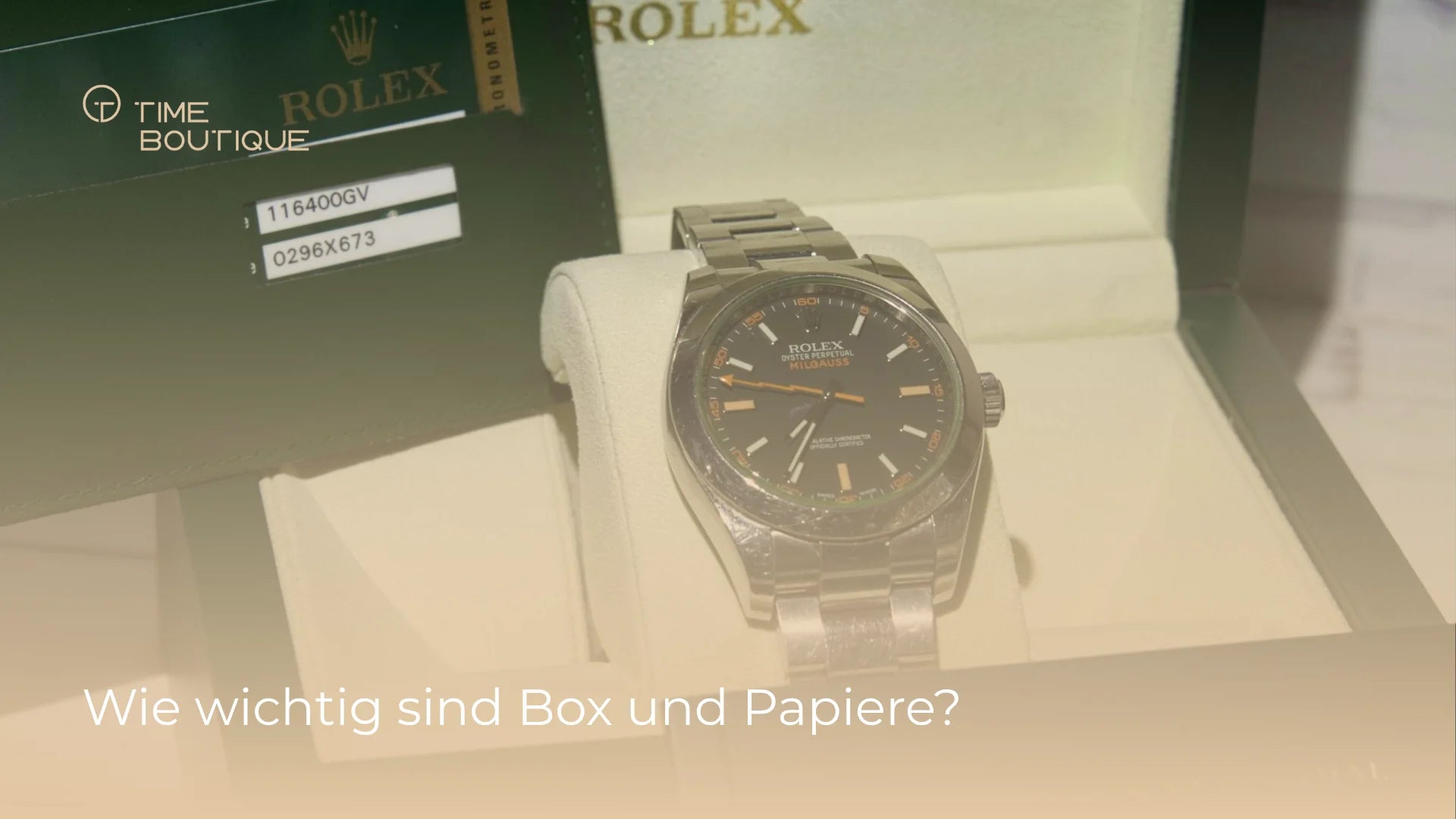
For many watches, the box and papers add noticeably to the value, as the article box and papers, how important are they really explains. That makes it all the more important to think about how they travel.
If the watch is going to a buyer, the box and papers usually go too. The original box then either goes, well padded, into the same plain outer carton, with its printing invisible from outside, or travels as a separate shipment. Sending it separately has one advantage: if a parcel goes missing, not everything is lost at once. Some sellers therefore send the papers only once the watch has safely arrived. Agree this with the recipient and put it in writing.
If the watch is going in for service, the box and original papers normally stay at home, as they are not needed for an overhaul. If a warranty claim is involved, check in advance whether a copy of the warranty card is enough or the original is required.
The right time to ship a watch
The shorter the time a watch spends in transit, the smaller the risk. So send early in the week and, where possible, early in the day. That way the parcel does not sit in a depot or sorting centre over the weekend. Public holidays, including those in the destination country, lengthen the journey too.
Choose delivery against the recipient's signature and rule out safe places, neighbours and parcel lockers, as far as the carrier allows. Share the tracking number with the recipient and agree that they will be available on the delivery day. Ask the recipient, too, to check the parcel for external damage before opening it and to film the unpacking in a single unedited take. That way the chain is documented from both ends.
Shipping an expensive watch in a private sale
In a private sale, shipping is only one part of the risk; the other is payment. The basic rule is simple: send the watch only once the full purchase price has reached your account and you have seen the credit there yourself. A screenshot, a payment confirmation by email or an assurance that the transfer is on its way is not enough. Be particularly careful if a buyer applies time pressure, wants delivery to a different address or offers to send their own courier to collect.
Agree in writing who pays for shipping, which service and which insurance will be used, and who bears the risk while the watch is in transit. Under German law, between private individuals the transport risk can in some circumstances pass to the buyer as soon as the watch is handed to the carrier, which is unpleasant for both sides if there is a dispute. A clear agreement and adequate insurance avoid that discussion. This is not legal advice; if in doubt, consult a professional.
Buyers and sellers alike should make sure a watch has not been reported stolen, and the article on how to check whether a Rolex is stolen describes the ways to do so. The whole process of a safe sale is covered in selling a Rolex and, for women's models specifically, in selling a ladies' Rolex. Information on selling directly to a dealer is available under luxury watch purchase.
Sending a watch to a service centre or watchmaker
Before a watch sets off for an overhaul, the shipment should be agreed with the workshop or service centre. Not every workshop accepts unannounced parcels, and some manufacturers have their own procedures and forms. Ask, too, how the return shipment is insured and on what terms.
Include a short covering note: your name, address, telephone number and email, a description of the watch with brand, model, reference and serial number, the work you are requesting and any noticeable faults, such as a movement that runs clearly fast or slow, moisture under the crystal or a scratch you do not want touched. Keep a copy. Ask for confirmation of receipt and for a quote before any work begins.
How often an overhaul makes sense, and what you can do yourself between services, is explained in the article on luxury watch care. Information on overhaul and repair is available on the watch service and overhaul page.
Shipping watches abroad and to Switzerland
Within the European Union there are no customs formalities, but the rules on insurance, packing and delivery apply just the same. Outside the EU things are different, and that includes Switzerland and the United Kingdom. Here every shipment needs a customs declaration or commercial invoice with an accurate description of the goods and their true value.
In the destination country the recipient may have to pay import VAT and possibly duties, often before the parcel is delivered. Clarify this in advance, so that the watch does not sit at customs because nobody expected the charges. Bear in mind, too, that some carriers carry watches and jewellery internationally only with restrictions, or not at all to certain countries.
For repair shipments to a country outside the EU, for example to a service centre in Switzerland, a further question arises: how does the watch come back without charges being levied on its full value when it is reimported? Customs law provides procedures for temporary export for repair, such as what is known as outward processing. Requirements and forms vary, and the declaration generally has to be made before the watch is sent. Ask the carrier, a customs agent or the customs authority in good time. This is general guidance, not legal or tax advice.
When something goes wrong in transit
If a parcel arrives damaged, opened or not at all, speed matters. Report the damage or loss to the carrier and the insurer immediately, because the deadlines for claims are often short and set out in the terms. If a shipment is visibly damaged, the recipient should ideally have the damage noted on delivery or refuse to accept it, depending on what the terms provide.
Throw nothing away. The outer carton, tape, inner box and padding are evidence and are often inspected by the carrier or the insurer. Photograph everything before you unpack any further. Your photographs, the packing video, the proof of posting and the evidence of value now form the basis of the claim.
If theft is suspected, also report it to the police and give them the serial number. Once the watch is recorded as stolen, reselling it becomes harder, and the chance rises that it will be recovered if it ever resurfaces.
Shipping, service and selling at Time Boutique
Every watch from our collection travels to you fully insured and in neutral packaging.
If you would like to send us a watch for service or for sale, get in touch before shipping and we will agree the safe route together.
Our collection changes constantly. If you are looking for a particular watch that is not in stock, we will find it for you. Get in touch.
Frequently asked questions
Can you ship a watch in a normal parcel?
It is possible, but rarely sensible for a valuable watch. Many parcel carriers exclude watches and jewellery from standard shipping or are liable only up to low amounts. Without suitable insurance, the risk then rests with you.
How do I ship a watch with insurance?
Choose a valuables service that explicitly accepts watches, a specialist valuables courier or additional transit insurance. Declare the true value, document the watch and the packing with photographs and video, and insist on delivery against signature.
How much does it cost to ship a watch with insurance?
The cost depends on the insured value, the destination, the delivery speed and the service you choose, and it changes regularly. For a first idea of how shipping costs for watches vary by destination and value, see the shipping calculator. The carrier's current prices and terms are always what counts.
Should I send the original box with the watch?
In a sale it usually goes with the watch, but it must never serve as the outer packaging itself. Pack it discreetly in the same carton or send it separately. For an overhaul the box normally stays at home.
What applies when shipping a watch to Switzerland?
Switzerland is not part of the EU, so the shipment needs a customs declaration with an accurate description and the true value, and the recipient may face charges. For repair shipments there are procedures for temporary export, which should be settled before the watch is sent. Ask the carrier or customs for the current requirements.
- Watch shipping in a standard parcel, why it is usually not enough
- Shipping a watch with insurance, the options at a glance
- Documentation before you send
- How to pack a watch for shipping
- The original box and papers, send them or not
- The right time to ship a watch
- Shipping an expensive watch in a private sale
- Sending a watch to a service centre or watchmaker
- Shipping watches abroad and to Switzerland
- When something goes wrong in transit
- Shipping, service and selling at Time Boutique
- Frequently asked questions
- Can you ship a watch in a normal parcel?
- How do I ship a watch with insurance?
- How much does it cost to ship a watch with insurance?
- Should I send the original box with the watch?
- What applies when shipping a watch to Switzerland?