
A luxury watch is rarely an impulse purchase. It costs more than most other everyday acquisitions, it should last for decades, and it carries a history. Anyone who decides in a rush usually regrets it half a year later. This guide is the conversation that I, Matthias, have with clients in the atelier before they decide on a piece. Brand-agnostic, in steps, without sales pressure. For Rolex specifically we have the Rolex buying guide; the steps here work across brands.
Step 1: Define the purpose
The most honest question first, before any model research: what should the watch be there for?
Daily driver. You want to wear the watch every day, at the office, on travel, in sport. Robust, water-resistant from 100 m, ideally a steel bracelet, clear legibility at a quick glance. These pieces take scratches and small knocks as character, not as damage.
Dress watch. A watch for suit, evening events, weddings. Slim, elegant in presence, leather strap, often without date, focused on the purity of the dial. Worn rarely but with intent.
Investment piece. A watch you also wear, but bought primarily with value preservation or appreciation in mind. Here brand, reference and completeness of papers count more than personal wrist feel. We covered the collector perspective in the investment guide.
Occasion piece. A watch for a specific occasion: 40th birthday, wedding, business handover, birth of a child. Here the emotional connection counts, the monetary aspect steps back. Precisely these pieces get passed down across generations.
Anyone who clarifies the purpose in advance avoids the typical mistake: budget spent on a dress watch too delicate, then worn daily anyway and ready for polishing after two years.
Step 2: Set a realistic budget
Before you look at concrete models, clarify what the watch should really cost. Not just the purchase price. That includes:
- Service every 5 to 10 years. A full overhaul sits in the range of 380 € to 1,500 € with an independent watchmaker, often higher at factory service.
- Insurance. Above 5,000 € we recommend a specialist jewellery and watch policy, typically in the range of 0.4 % to 0.8 % of value annually.
- Strap changes. Leather straps live three to five years, steel bracelets a lifetime.
A rule of thumb for first-time buyers: anyone buying a luxury watch for the first time should enter in the 5,000 € to 15,000 € range. Below that, choice narrows at the major brands, meaning Tudor, Omega mid-range, older Cartier models. Above that, the worlds of Daytona, Nautilus, Royal Oak and A. Lange & Söhne open up. Both poles have their justification. Below 3,000 € we are no longer talking about luxury but about branded watches.
Step 3: Pick the brand by purpose
Once purpose and budget are clear, the brand comes next. The major houses each have a distinct identity. We sort them by typical use case, not by list price.
Rolex. Sports watches with indestructible construction, deep collector market, high resale value and immediately recognisable status. Submariner, GMT-Master II, Datejust, Daytona. For a daily driver with value-preservation intent, structurally the safest choice. For steel sports with investment potential, the natural address.
Patek Philippe. Geneva haute horlogerie, quiet elegance, complications at the highest level. Calatrava as dress watch, Aquanaut and Nautilus as sport luxury. Collectors here buy without needing to show it constantly, but understand what sits on the wrist. Resale depth exists, although within the collector segment, not the mass market.
Vacheron Constantin. Oldest continuously producing manufacture. Patrimony as dress classic, Overseas as sport luxury, Historiques for the collector line. Slightly quieter than Patek in brand presence, technically and financially at a comparable level.
Audemars Piguet. The sport-luxury brand that invented the category itself with the Royal Oak in 1972. Royal Oak in all variants, Royal Oak Offshore for the more robust line, Code 11.59 as a younger direction. Design language is sharper and more angular than Patek, ideal for someone who wants sport luxury with a statement.
A. Lange & Söhne. German haute horlogerie from Glashütte. Lange 1, Saxonia, Datograph, Zeitwerk. Very tight production, very high finishing, quiet on the wrist. Collector segment, not mass market.
Cartier. The design house that also makes watches. Tank in all variants, Santos, Ballon Bleu. Iconic shapes rather than mechanical fetishism, but with their own manufacture depth. Ideal for someone who chases the form before the complication.
Omega. NASA heritage, master chronometer precision, fair price-value ratio. Speedmaster as iconic chronograph, Seamaster as diver, De Ville as dress line. For the entry budget or as a sporty daily next to a collector piece.
Once you have arrived at a brand, the model often curates itself because the design language per house is strong. Anyone who locks in on "a classic model" without feeling the brand first often ends up with a mainstream piece (Submariner, Tank, Nautilus) without real connection to it.
Step 4: New, pre-owned or vintage
Three options, three profiles.
New from the authorised dealer. Manufacturer warranty, factory-fresh condition, but on coveted sport references multi- year waiting lists, rarely available. For grand complications (perpetual calendar, tourbillon, minute repeater) new is the natural choice, because service history carries its own meaning here. Same for limited editions, which only carry their full story as a first-owner piece.
Pre-owned, atelier-checked. On the wrist immediately, no new- purchase discount, more stable on resale. For most models from our manufactures the more sensible choice, provided a serious inspection is documented. In the atelier this is our focus: every watch passes through Helmut's workshop check before entering stock.
Vintage (older than 25 years). Character enters the picture here. A Datejust 1601 from 1972, a Submariner 5513 from 1981, a Speedmaster Pre-Moon from 1968. The pieces tell a story that a new dealer purchase does not have. Vintage demands deeper inspection and realistic expectations on service effort, because many spare parts are scarce.
In the atelier we operate mostly in categories 2 and 3. We do bring new in when the client asks for it, and on request we refer to established dealers.
Step 5: Where to buy, the reality of each source
The options, ranked from high-risk to low-risk, with the caveat that large differences exist within each category as well.
1. Private seller via online platform. eBay, Chrono24 private sellers, Facebook groups. Cheapest price, highest risk. You pay, ship or meet, hope. Not advisable without a watchmaker as companion, certainly not above 5,000 €.
2. Small online retailer without own workshop. Middle ground. Authenticity usually OK, service competence often limited. Issues after the sale land you quickly at an external watchmaker the retailer does not control.
3. Established online retailer. Bucherer Online, Chrono24 Trusted Checkout with verified power sellers, Watchfinder. Safe, documented, but impersonal. You receive a piece from inventory without meeting the person who checked it.
4. Auction house. Christie's, Phillips, Antiquorum, Sotheby's. For rare vintage references and complications the natural address. Lots are documented in advance, watch the buyer's premium (typically 25 % to 28 %), and on online bidding without physical preview, expertise is a prerequisite. Fake risk at the top houses is minimised, at smaller auctions without specialists it is higher.
5. Maison with own workshop. We sit here. Highest price level, but documented authenticity check, 12 months warranty, personal advice, and the watchmaker (Helmut) speaks directly with you. For larger amounts the calmest option.
6. Authorised dealer for new pieces. At the major brands only selected models are available, often with waiting time. In exchange you get manufacturer service included, list price without surcharge, and a long-term AD relationship is worth building for collectors.
An honest maison will tell you when a model is cheaper elsewhere, and explain what the surcharge brings with it. Anyone pushing "special price" and "last piece" is selling you something we would not sell.
Step 6: Inspection before purchase
Let us assume the piece is found. What do you check concretely? We recommend going in the order below, and at the first red flag looking deeper rather than continuing to buy.
Dial. Print sharpness, symmetry of indices, colour of script, lume distribution. On vintage the lume must be evenly aged, both on indices and on hands. Strongly diverging tones are suspect. On modern pieces check that the print sits in the atelier- appropriate look, meaning not too pale, not over-contrasted.
Hands. Shape must match the reference. A GMT-Master II has a distinctive arrow tip on the GMT hand. A Submariner has the Mercedes hand. Anyone unfamiliar with the hand shape spends two hours in the photo archive of the reference and then catches anomalies.
Lume. Even in tone and intensity? Under UV light check whether all markers still glow. Weak or uneven glow points to a service replacement or manipulation.
Bezel. Clean shifting feel on rotating bezels, defined clicks (typically 120 on modern Rolex divers), no excessive scratches, insert (ceramic or aluminium) free of discolouration that does not fit the age.
Bracelet and clasp. On steel bracelets check the end links (end pieces at the case) for play, the clasp for function and markings. Original clasps carry brand codes and factory stamps in hidden spots that a good dealer knows.
Case. Edges sharply defined (unpolished or discreetly so) or rounded (over-polished)? Original shape beats high gloss. On vintage, an unpolished watch with wear marks is worth more than a polished one without. Crown function: pulls out easily, clear detent positions, no wobble.
Movement. Rate values (ideally documented on timegrapher), last overhaul with receipt, known weaknesses of the reference checked. Here we reach the limit of what a buyer without workshop background can do alone. Exactly here the atelier check enters.
Reference and serial number. On Rolex between the lugs at 12 o'clock (reference) and at 6 o'clock or on the rehaut (serial). Do the numbers match the model and the warranty card? We additionally cross-check against our internal production tables.
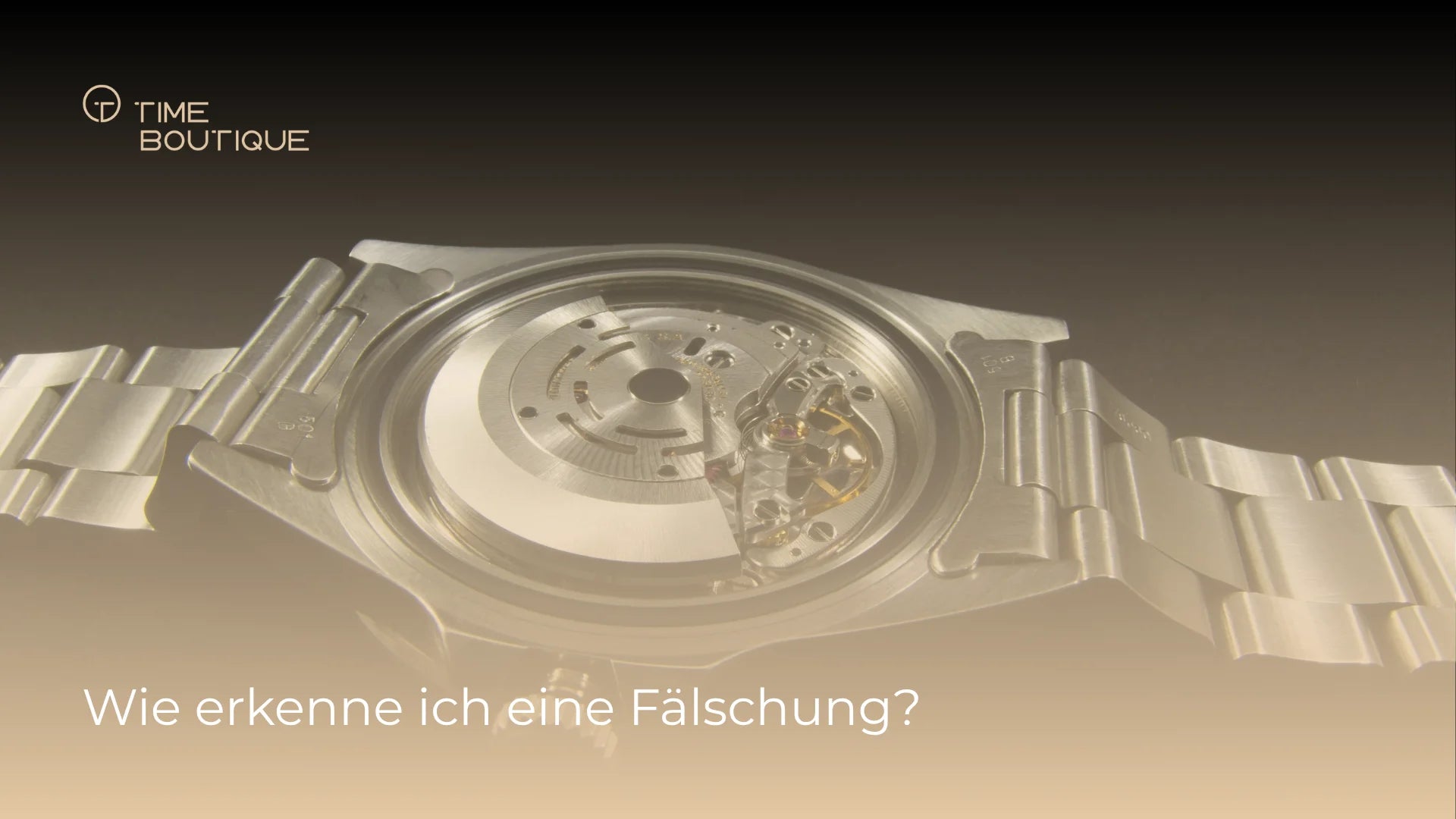
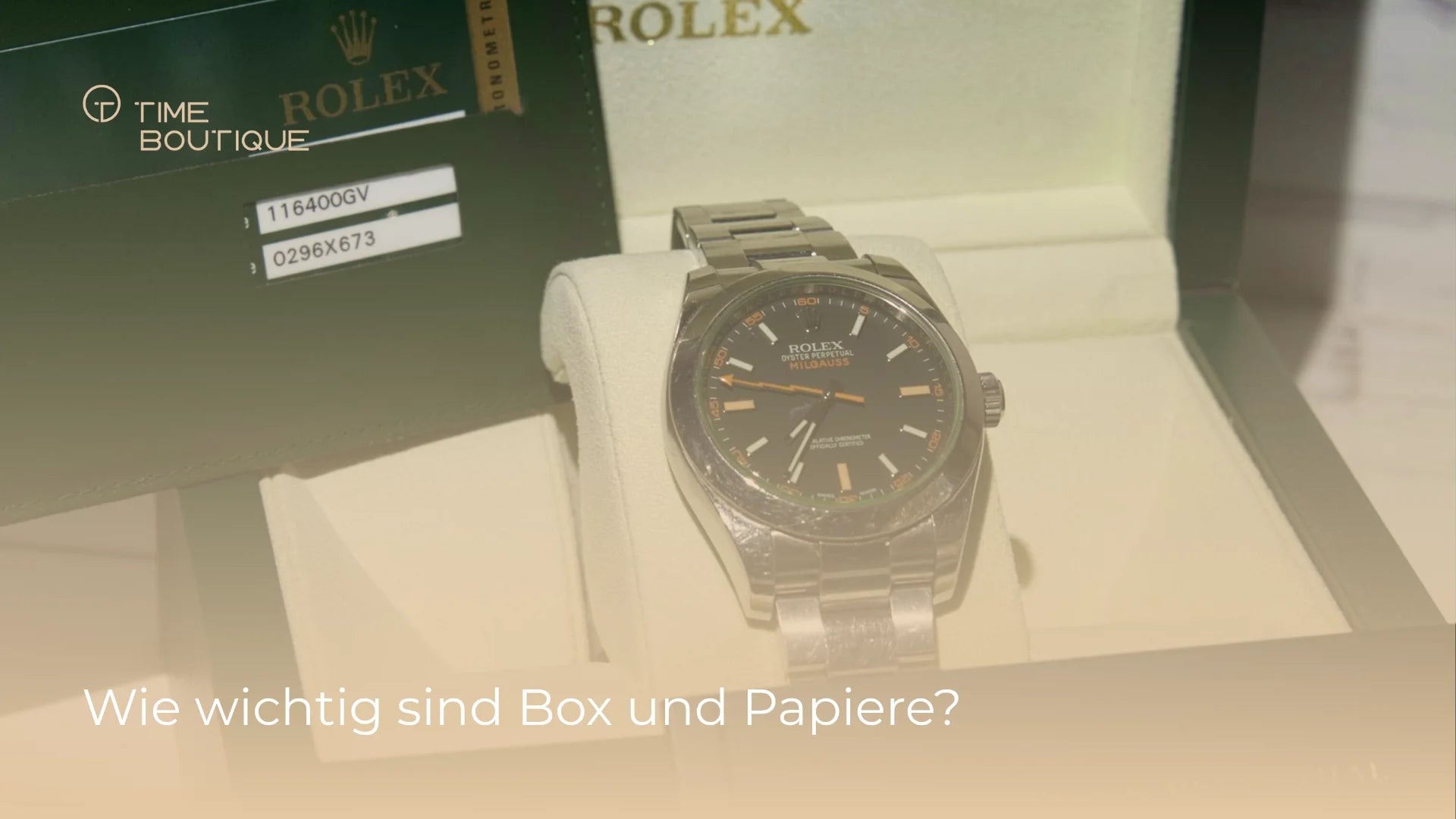
Box and papers. Check completeness, verify the card on plausibility (stamp, date, hologram). Details are laid out in the box and papers guide. A more detailed counterfeit check on the movement sits in the counterfeit guide.
In our atelier every watch goes through precisely this inspection, plus microscope check and timegrapher test. The result attaches to every watch sold in the form of a service pass.
Step 7: Provenance and service history
A luxury watch without documented history sells more slowly. What counts as service history:
- Factory service receipts. Factory overhauls at Rolex Cologne, Patek Geneva, AP Le Brassus, Lange Glashütte, Omega Biel. They are documented with a number and can later be retrieved from the manufacturer against a fee.
- Receipts from independent watchmakers with clear address, date, work performed and workshop stamp. Atelier service passes count, provided the service provider is identifiable.
- Photo documentation of condition before and after service.
A "serviced 2019, no receipt" does not sell. A "fully overhauled in Munich atelier 2019, receipt attached" sells fast. The price difference regularly sits in the range of 8 % to 15 %.
Step 8: Negotiation and payment
On the secondary market the asking price is rarely the final price. How to negotiate cleanly?
Anchor. We recommend an opening offer 5 % to 10 % below the asking price, with clean reasoning. Arguments: slight polish on one lug, missing hangtag, shorter warranty than wanted. Anyone bidding 30 % below without reasoning burns the channel.
Payment. On larger amounts we recommend bank transfer against a handover protocol, never cash in full without receipt. On online platform purchases use the platform's own escrow (Chrono24 Trusted Checkout), not direct transfers outside the platform. On private purchases above 10,000 € a notarised handover appointment in Munich is possible and sensible.
Contract. Written purchase contract with reference, serial and model number, condition statement, shipping or handover arrangement, return rights, warranty period. Consumer law applies when buying from a dealer, not in private sale. Do not accept "as is" without protection on a five-figure piece.
Shipping. Insured valuables transport with declared value above the purchase price. Common insurers for valuables shipping include Malca-Amit or specialist valuables couriers, not standard DHL. We ship across Europe via insured valuables transport with declared value matching the documented price.
Step 9: After purchase, care without exaggeration
A luxury watch needs care, but less than most think.
- Wearing. Regular wear keeps the movement supple. Drawer watches develop problems with hardened oil long before overhaul would be due.
- Service. Full overhaul in the 5 to 10 year range, earlier with frequent water contact or sport use, later for showcase pieces. Helmut says clearly: better a proper overhaul every 7 to 8 years than a quick one every 5.
- Insurance. Above 5,000 € a specialist jewellery and watch policy. Household policies often do not cover full market value.
- Storage. No direct sunlight, no strong magnetic fields (tablet, speakers, MagSafe chargers), ideally on a watch winder for automatic movements or dry in the box for hand-wound.
- Magnetisation. If the watch suddenly runs fast or slow without clear cause: have magnetisation checked. A demagnetisation costs little and solves the problem in minutes.
When buying from us makes sense
We are not the cheapest supplier. Anyone looking for the cheapest piece will find it elsewhere. You buy from us when you:
- want a documented authenticity check in the service pass
- want a 12-month warranty on the movement
- want to speak directly with the watchmaker (Helmut) who looks after your watch
- value a personal handover at the atelier in Grünwald near Munich, or insured valuables transport across Europe
- want advice that also tells you when a different model fits you better
Talk to us
Via the atelier enquiry, by phone on +49 89 38164962 or by email to info@timeboutique.de. We advise gladly, free and without obligation, even when you end up buying elsewhere. If you want to thin out an existing collection, the route is the purchase enquiry.
- Step 1: Define the purpose
- Step 2: Set a realistic budget
- Step 3: Pick the brand by purpose
- Step 4: New, pre-owned or vintage
- Step 5: Where to buy, the reality of each source
- Step 6: Inspection before purchase
- Step 7: Provenance and service history
- Step 8: Negotiation and payment
- Step 9: After purchase, care without exaggeration
- When buying from us makes sense
- Talk to us