
"Submariner or GMT-Master II?" is one of the three most frequent questions we hear in the atelier. Both are iconic Rolex sports watches in steel, both sit in a similar price bracket, both are stable in value over the long run. And yet they perform two very different jobs. This article walks through the differences calmly and ends with a recommendation on which watch fits which way of living.
We see the question most often with two groups of buyers. First, someone acquiring their first mechanical luxury watch and oscillating between the two most visible Rolex sports references. Second, someone who already owns a Datejust or a vintage classic and now wants to add a modern sports reference. In both cases it is worth thinking about the actual use case before settling on a bezel colour.
Two icons, two purposes
The Submariner is a diver, born from the professional need to read remaining bottom time reliably underwater. The GMT-Master II is a travel watch, born from the need of Pan Am pilots to read local time and home time at the same time. Anyone who has both side by side on the wrist sees immediately that these are two different tools, not two flavours of the same idea.
This is the most important early decision, well before colour, bezel or bracelet. Anyone who mainly lives in one time zone, spends time in or around water, or wants a genuinely robust all-purpose sports watch should buy the Submariner. Anyone who genuinely uses multiple time zones in daily life should buy the GMT-Master II.
History, 1953 vs 1955
The Submariner arrived in 1953, with references 6204 and 6205. At the time it was one of the first serial wristwatches with true diver capability, 100 metres water resistance, rotating bezel to track remaining time underwater. References 5512 and 5513 in the 1960s made it the archetype of the diving watch. James Bond on Sean Connery's wrist in the early 1960s films did the rest to turn a professional tool into a cultural symbol.
The GMT-Master followed in 1955 with reference 6542, developed in direct collaboration with Pan American World Airways. The pilots needed an instrument that would show home time during transatlantic flights. The red and blue "Pepsi" bezel was there from the start, in a Bakelite execution that was later replaced by aluminium and finally by Cerachrom.
The GMT-Master II arrived in 1982 with reference 16760 ("Fat Lady"). The "II" stands for the independently adjustable hour hand, meaning local time can be changed without disturbing the 24-hour hand.
Bezel, rotating diver scale vs 24-hour scale
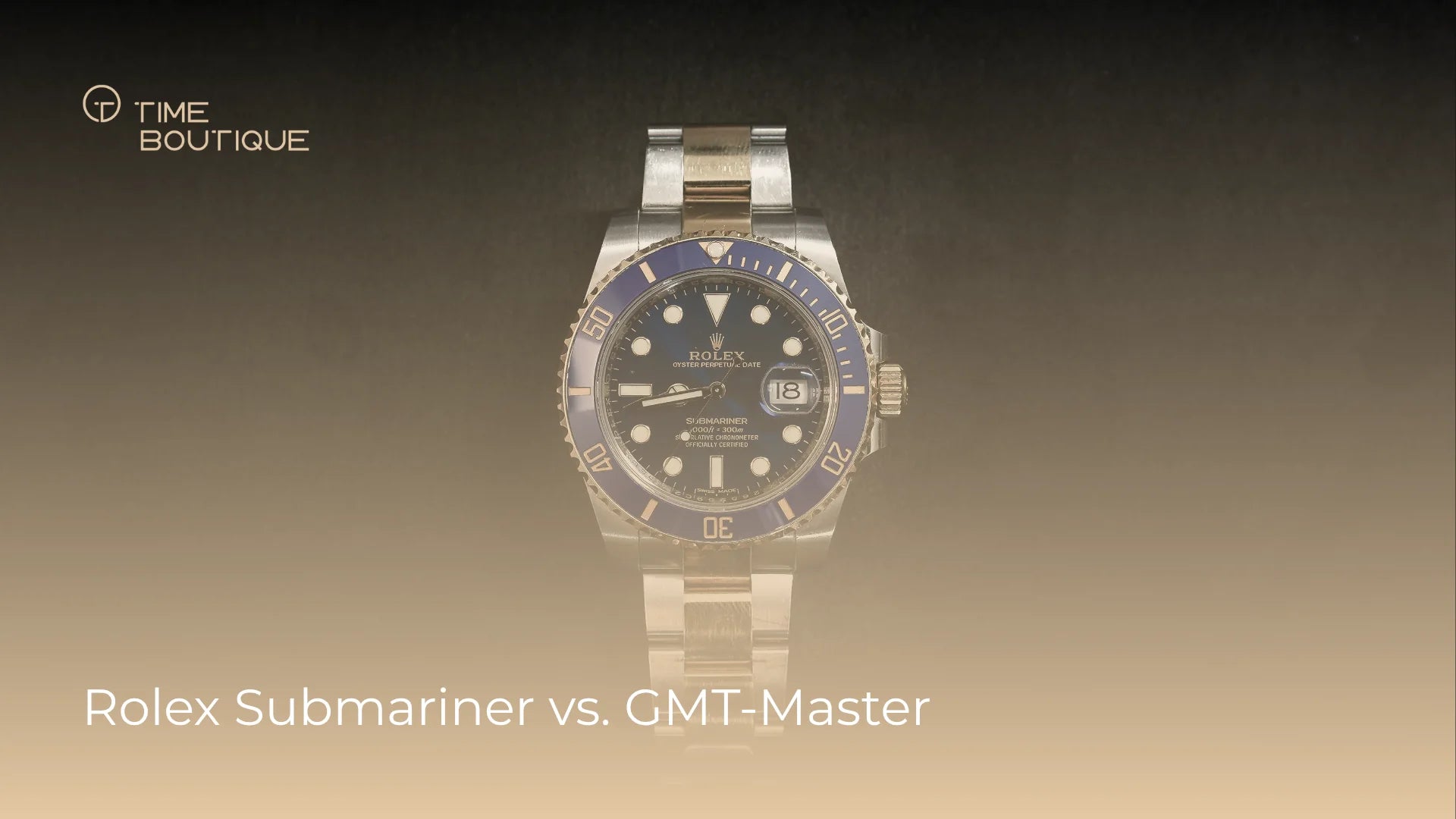
This is the most visible difference. The Submariner has a unidirectional rotating bezel with a 60-minute scale. It rotates in one direction only so that remaining time underwater cannot be inadvertently extended. On modern Submariners the bezel is made of Cerachrom, Rolex's patented ceramic, scratch-resistant and colour-stable.
The GMT-Master II has a bidirectional 24-hour rotating bezel, typically two-tone. The bezel combined with the 24-hour hand allows reading a third time zone if the bezel is rotated accordingly. The nicknames have become cultural, Pepsi (red/blue), Batman (black/blue), Sprite (black/green), Root Beer (brown/black).
| Specification | Submariner Date 126610LN | GMT-Master II 126710BLNR |
|---|---|---|
| Bezel | Unidirectional, 60 min, Cerachrom | Bidirectional, 24 hr, Cerachrom |
| Function | Diver remaining time | Second time zone |
| Crystal | Sapphire with Cyclops | Sapphire with Cyclops |
| Case | 41 mm Oyster | 40 mm Oyster |
| Water-resistance | 300 m | 100 m |
| Movement | 3235 | 3285 |
| Power reserve | 70 hours | 70 hours |
Case and wearing comfort, 41 vs 40 mm
On paper the cases differ by only one millimetre in diameter. On the wrist the Submariner reads as visibly heavier, because it carries a thicker bezel and a more substantial Oyster case. The GMT-Master II is slightly slimmer, its bezel feels more elegant, the piece sits closer to the wrist.
Anyone with a narrow wrist (under 17 cm circumference) should try both in person before buying. The Submariner can already look slightly oversized at under 16.5 cm. The GMT-Master II, with its lower case height, is often the less conspicuous choice on smaller wrists.
Both run on Oyster or Jubilee bracelets. The Jubilee variant is available only on the GMT-Master II (with Pepsi bezel, reference 126710BLRO) and on one 2024 Submariner variant. Jubilee reads more elegant and slightly less sporty, Oyster is the classic choice.
Dial and legibility
Both models carry the typical maxi indices with Chromalight luminous material, which glows blue at night. The Submariner shows the classic round hour markers with Mercedes hands, the date sits under the Cyclops magnifier at 3 o'clock. The GMT-Master II adds the red or green 24-hour hand which reads home time on the bezel.
In practice that means the Submariner is the calmer, less distracting watch on the wrist. The GMT-Master II carries more visual information through the fourth hand and the two-tone bezel, which some wearers find more engaging and others find busier.
A point often overlooked: the date window on both models sits under the Cyclops magnifier at 3 o'clock. Anyone who prefers the Submariner as a "pure" diver without Cyclops should look at the No-Date 124060, which is even more minimal in execution and shows only the 60-minute pip on the bezel. The GMT-Master II has no no-date variant, the date is part of the function package.
Movement, 3230 / 3235 vs 3285
All three calibres are modern Rolex movements of the latest generation. They share the central construction features, Chronergy escapement, Parachrom hairspring, 70 hours power reserve, COSC certification with additional Rolex in-house precision of -2/+2 seconds per day.
The 3230 sits in the Submariner without date (124060), the 3235 in the Submariner Date (126610LN) and the 3285 in the GMT-Master II. The difference lies in the GMT function and in the independent hour adjustment that the 3285 allows. Technically the 3285 is the more demanding movement, in daily life the wearer only feels the difference through the time-zone function.
The screw-down crown is constructed identically on both, with the Triplock sealing system. Both are water-resistant to their respective specifications as long as the crown is correctly screwed down.
In terms of service interval, both calibres behave practically the same. Rolex officially recommends a full revision every ten years, in our workshop practice we see robust rate readings with good care over somewhat longer stretches. Anyone wearing the watch in sport or regularly in salt water should plan a seal check every three to five years, independent of the full service.
Prices and market position
Authorised dealer list prices (as of 2026):
- Submariner Date 126610LN: approx. 11,000 Euro
- Submariner No-Date 124060: approx. 10,000 Euro
- GMT-Master II 126710BLNR (Batman): approx. 11,350 Euro
- GMT-Master II 126710BLRO (Pepsi): approx. 11,350 Euro
Dealers maintain waiting lists for both models, with notably longer queues for the GMT-Master II Pepsi and the standard Submariner Date. Realistic waiting time between 12 and 36 months.
On the secondary market prices currently sit as follows (as of May 2026):
- Submariner Date 126610LN: approx. 11,500 to 14,000 Euro
- Submariner No-Date 124060: approx. 10,500 to 12,500 Euro
- GMT-Master II Batman 126710BLNR: approx. 15,000 to 19,000 Euro
- GMT-Master II Pepsi 126710BLRO: approx. 16,000 to 21,000 Euro
- GMT-Master II Sprite 126720VTNR (left-hander): in the range of 22,000 to 26,000 Euro
The GMT-Master II currently carries the noticeably higher premium over list, especially in the Pepsi and Sprite executions. The Submariner has cooled in the market, which makes it the more rational purchase.
For context: in 2021 and 2022 secondary market prices for both models were significantly higher, the Submariner Date at times above 18,000 Euro, the Pepsi GMT above 28,000 Euro. The market has normalised since, without falling below list. Anyone buying on the secondary market today buys in a more balanced environment than three years ago, with better negotiation chances on well-documented pieces.
Vintage options
Anyone moving into the vintage segment finds a rich history in both families.
Vintage Submariner:
- 5513 (1962 to 1989): The classic No-Date Submariner with acrylic crystal. In the range of 15,000 to 35,000 Euro, cared-for pieces with tropical patina well above that.
- 1680 (1969 to 1980): The first Date Submariner, with the characteristic red or white text. From approx. 18,000 Euro, "Red Sub" from approx. 28,000 Euro.
- 14060 / 14060M (1990 to 2012): The "last with acrylic look", already sapphire glass but still without Cerachrom. In the range of 8,500 to 13,000 Euro.
Vintage GMT-Master:
- 1675 (1959 to 1980): The longest-running GMT-Master reference, available in Pepsi (red/blue) and black. In the range of 18,000 to 35,000 Euro, early gilt dials well above that.
- 16700 (1988 to 1999): Last GMT-Master without independently adjustable hour hand, aluminium bezel. In the range of 10,000 to 14,000 Euro.
- 16710 (1989 to 2007): GMT-Master II with aluminium bezel. Pepsi, Coke, black. In the range of 12,000 to 18,000 Euro.
Vintage is a collector chapter of its own in both families. Anyone who appreciates patina, history and the acrylic feel can find joy here. Anyone who wants a reliable everyday sports watch should stay with the modern references.
In the vintage segment an iron rule applies: originality before beauty. A 5513 with light wearing marks and original dial is worth significantly more than a visually flawless but polished or service-redialed version. The same goes for the 1675 GMT-Master, whose original gilt or matte dials are the actual value driver among collectors. We strongly recommend that vintage buyers have any piece inspected by an experienced atelier or specialised auction expertise before a five-figure sum changes hands.
Which one for which way of living
Buy the Submariner if:
- You are looking for a first real Rolex sports watch
- Water, sport or a genuinely robust all-purpose watch matter
- A calmer, less conspicuous aesthetic is preferred
- Value stability and quiet elegance are priorities
- The Submariner is intended as a daily driver in any situation
Buy the GMT-Master II if:
- Multiple time zones are practically needed in daily life
- A colourful, character-rich bezel is preferred
- The additional complication is felt as added value
- Collector character and speculative value play a role
- There is willingness to pay a clear premium above list
Anyone buying a first Rolex sports watch who honestly does not need a time-zone function is better served by the Submariner. It is the more rational choice, more versatile in daily life, quieter in the market. The GMT-Master II is the watch for travellers and for collectors with a clear favourite bezel style.
In the atelier we sometimes also suggest a second thought: anyone looking for a first sports watch who intends to collect long-term is better served buying the Submariner first and adding a GMT later, rather than the reverse. The Submariner is the more robust foundation of a collection, the GMT is the more specialised addition. This order has proven the calmer one over the years.
What to check when buying
Regardless of the model, we recommend checking three things before any purchase. First, the correspondence between reference and serial number and the papers. On modern Rolex sports watches the serial sits on the rehaut, engraved in a clean running line. Second, the state of the Cerachrom bezel. It should be free of scratches and without faded areas, the material is scratch-resistant but not impact-resistant. Third, the rate over at least two days. The factory tolerance of -2/+2 seconds per day should be met, otherwise a near-term factory revision should be planned.
With us, every Submariner and every GMT-Master II goes through workshop inspection with Helmut, including movement cleaning if needed, gasket replacement and multi-day rate measurement. We document the result in a service pass which is handed over with the piece.
Own one and thinking of selling?
Both models trade very well in the Munich market. We appraise and value Submariner and GMT-Master II references continuously and make fair direct offers for well-documented pieces with box, papers and service history. Own one and thinking of selling? Submit a buying request.
View at the atelier: our Rolex stock and Rolex service in Munich. Selling a Submariner or GMT? Submit a buying request.
- Two icons, two purposes
- History, 1953 vs 1955
- Bezel, rotating diver scale vs 24-hour scale
- Case and wearing comfort, 41 vs 40 mm
- Dial and legibility
- Movement, 3230 / 3235 vs 3285
- Prices and market position
- Vintage options
- Which one for which way of living
- What to check when buying
- Own one and thinking of selling?