

For many the history of the wristwatch begins with the Cartier Santos. Long before dive watches and chronographs conquered wrists, Cartier created a watch you wore on the arm because that was more practical than the pocket watch. From that idea grew an icon that to this day is immediately recognisable by its distinctive screws. In the atelier the Santos is the watch for those who want to wear design history on the wrist, in a modern, everyday-capable form. This guide shows where it comes from, which lines there are and what matters when you buy.
The history of a pioneer
The Santos was created in 1904, when Louis Cartier designed it for his friend, the Brazilian flight pioneer Alberto Santos-Dumont. The background is famous. When flying, Santos-Dumont needed both hands on the controls and could not draw a pocket watch to read the time. Cartier therefore built him a watch he could wear on the wrist. The Santos thus belongs among the first practical men's wristwatches there are, at a time when wristwatches were still considered unmanly. This pioneering role is part of its myth. Anyone who wears a Santos wears a piece of the birth story of the modern wristwatch.
What defines the Santos
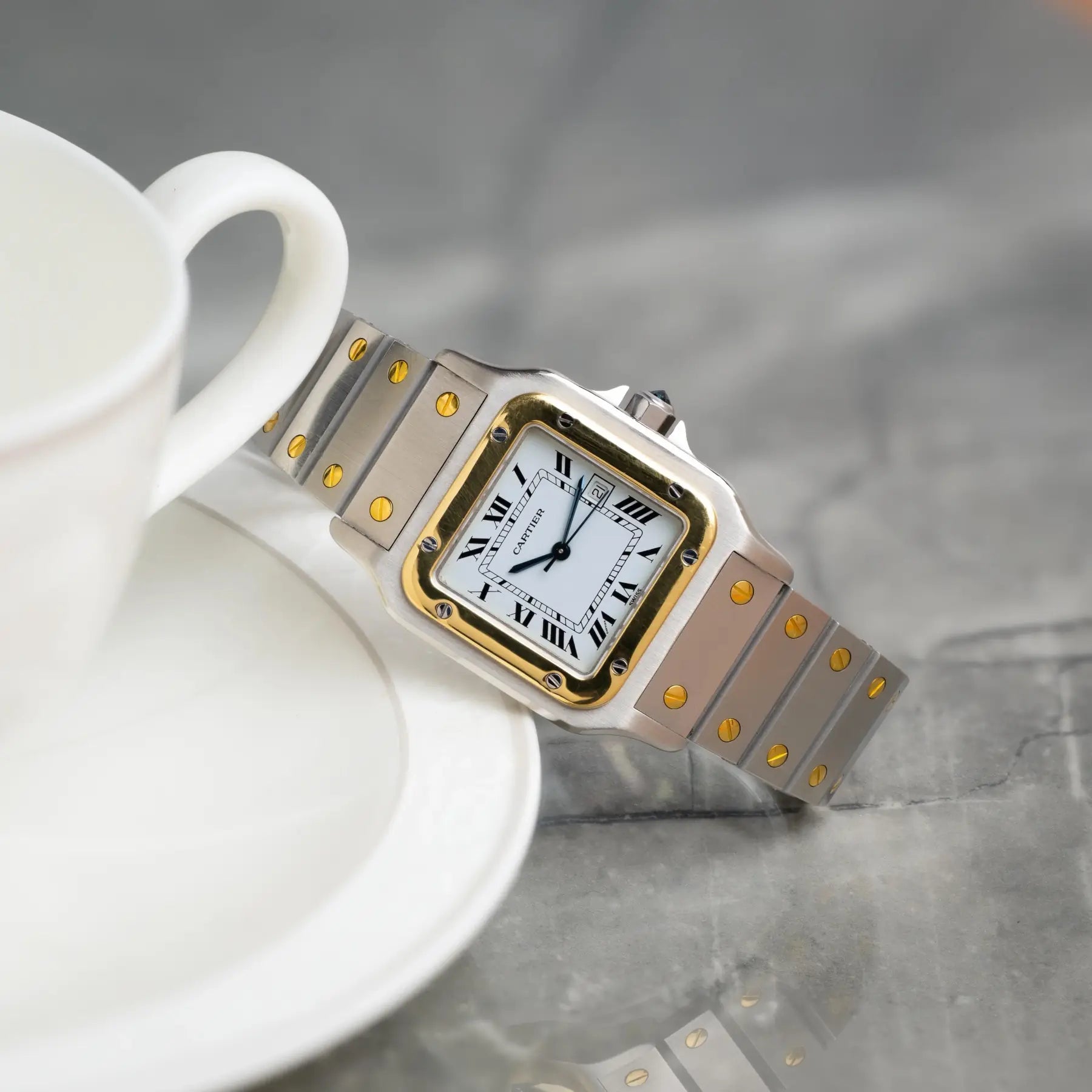
The character of the Santos lies in a few, immediately recognisable elements. The square case with rounded corners, the Roman numerals, the blue hands and above all the visible screws on the bezel. These screws are not mere decoration but at the same time a design quotation of the early, technical world from which the watch comes. They give the Santos its unmistakable, slightly industrial and yet elegant presence. Like the Tank, the Santos is a watch of clear form and proportion, only with a sportier, more robust note. That very mixture of elegance and technical echo makes it so timeless.
Santos-Dumont, the flat, elegant line
The Santos-Dumont is the slimmer, dressier interpretation and carries the name of the flight pioneer in its title. Its flat case and the fine proportions make it the elegant style watch, which often carries an especially thin quartz or hand-wound movement. It is the calmer, more classic Santos, closer to a dress watch than to a sports tool. Anyone looking for the Santos in its purest, most elegant form finds it here. The Santos-Dumont is the choice for those who treasure the historical model in a restrained, flat guise.
Santos de Cartier, the sportier sister
The Santos de Cartier is the larger, sportier and more versatile line. It usually carries an automatic movement, is more strongly built and is laid out for robust everyday life. Its great practical advantage is a tool-free quick-change system with which the bracelet can be swapped in seconds, for instance from a metal bracelet to a leather strap. This is complemented by a solution that lets the length of the metal bracelet be fine-adjusted without tools. This everyday capability makes the Santos de Cartier the obvious choice for all who want to wear a design icon as a daily watch. It combines the historical form with modern comfort.
The screws, more than a detail
Hardly any element of a watch is so closely bound to a brand as the screws of the Santos with Cartier. They sit visibly on the bezel and, on the modern models, run as a design motif right into the bracelet. Originally a sign of the technical formal language inspired by bridges and machines, they are today pure iconography. They make the Santos recognisable at first glance, even from a distance. When buying a used Santos a look at these screws is worthwhile, because their condition and their clean alignment reveal a great deal about the watch's care. A detail that unites style and function in itself.
Quartz or mechanical
As with the Tank, the question of quartz or mechanical movement is a genuine choice with the Santos. The flatter Santos-Dumont models often carry a precise, low-maintenance quartz movement or a flat hand-wound calibre. The Santos de Cartier, by contrast, mostly relies on a modern automatic movement that puts the mechanical experience in the foreground. Both paths have their justification. Anyone seeking an uncomplicated, flat style watch is well served with the quartz or hand-wound version, anyone wanting a sporty everyday watch with automatic reaches for the Santos de Cartier. In the atelier we advise openly on both, because the right choice depends on one's own expectation.
The sizes and the feel on the wrist
The Santos is offered in various sizes, from compact to more present cases. Through its square form with rounded corners it wears differently from a round watch, balanced and with a clear, modern presence. The flat Santos-Dumont slips easily under the cuff, the stronger Santos de Cartier sets a clearer marker on the wrist. Both are united in that, despite their iconic design, they remain astonishingly wearable. Which size and line is the right one depends on the wrist and on the desired character and shows itself best in direct comparison on the arm.
Materials
The Santos comes in steel, in two-tone steel and gold combinations and in solid gold. The steel versions are the everyday-capable, versatile options and for many the obvious entry. The two-tone models bring warmth into the picture with gold screws and accents, without going fully to precious metal. The gold versions are the most festive reading. Added to that are models with diamond settings, which turn the Santos into a piece of jewellery. The choice of material determines character and price and reaches from the sober steel Santos to the festive gold version.
For whom the Santos is the right choice
The Santos appeals to those who seek a sporty-elegant design icon with genuine history. It is more versatile than a pure dress watch and more stylish than a pure sports watch and so strikes a point few other watches strike as well. It suits the suit just as well as the casual look and looks good on men as on women. Anyone looking for a first Cartier that can be worn every day, or a characterful complement to a collection of sporting watches, finds in the Santos a timeless and at the same time practical answer.
Santos, Tank or Panthère
Within the Cartier world the Santos stands between two further icons. The Tank is the classic, rectangular style watch, more elegant and calmer. The Panthère is the jewellery watch with the supple bracelet. The Santos is the sportiest and most technical of the three, shaped by its origin in aviation. Anyone who prefers it more elegant and classic looks to the Tank, anyone seeking the jewel-like looks to the Panthère. A placement across the whole brand is given by our guide which Cartier to buy.
The Santos and the birth of the wristwatch
The Santos has a special place in the history of the watch, because it stands on the threshold of the modern wristwatch. At the beginning of the twentieth century men wore pocket watches, the wristwatch was considered jewellery for ladies. The Santos helped to change that. By a famous, male pioneer like Santos-Dumont wearing a watch visibly on the wrist, the wristwatch became socially acceptable and finally a matter of course. This role makes the Santos more than a beautiful design. It is a piece of cultural history, an early proof that function and style can belong together. Anyone who wears a Santos thereby also wears a chapter of the history in which the watch moved to the wrist and stayed there.
Vintage Santos and the older lines
The Santos has passed through various generations over the decades, which today form a collecting field of their own. Older two-tone models from the eighties, for instance, have an unmistakable character and stand for an era of design all their own. With these pieces, as always, originality decides the value, from the dial to the screws. Because the Santos was much worn, numerous examples are found with genuine signs of use, which for some collectors belong to the history of the watch. Anyone looking for a vintage Santos should pay attention to the overall condition and the coherence of the watch. In the atelier we like to place here too which generation and which condition lies before one, before a decision is made.
The Santos as a first fine watch
For many the Santos is an excellent first fine watch, and for good reasons. It combines an iconic, immediately recognisable form with genuine everyday capability, especially in the modern Santos de Cartier with its uncomplicated bracelet change. It is versatile enough for work and leisure and stylish enough for special occasions. Unlike a pure sports or a pure dress watch, the Santos covers a broad spectrum, which makes it a rewarding first choice. Anyone entering the world of fine watches and looking for a watch with history and character that can be worn every day makes a clever decision with the Santos.
What to look for when buying a used Santos
With a used Santos a look at the screws of the bezel, at their clean alignment and their condition, is worthwhile. Check the case for traces of too intensive polishing, because the clear edges of the Santos quickly betray it. Pay attention to the originality of the dial and hands and to the function of the quick-change system on the modern Santos de Cartier. On mechanical models a look at the service history is worthwhile, on quartz models at the clean run of the movement. Completeness with box and papers raises value and resale, more on that in box and papers, how important are they really.
Service and care
The Santos needs different care depending on the movement. Quartz models are low-maintenance and need above all a proper battery change with a pressure test. Mechanical models, foremost the Santos de Cartier with automatic, need an overhaul at longer intervals, in which the movement is cleaned and the seals renewed. Anyone who frequently swaps the bracelet via the quick-change system should occasionally have the firm seat checked. A well-kept Santos with a documented history is the more reliable and more value-stable watch. As with any good watch, it is worth seeing service as a natural part of ownership.
Frequent questions about the Cartier Santos
What sets the Santos-Dumont and Santos de Cartier apart? The Santos-Dumont is the flatter, more elegant line, often with quartz or hand-winding. The Santos de Cartier is the larger, sportier one with automatic and tool-free bracelet change.
Why does the Santos have screws on the bezel? They are a design quotation of the early, technical formal language and at the same time the unmistakable identifying mark of the watch.
Is the Santos everyday-capable? Yes, the Santos de Cartier in particular is conceived as a robust, versatile everyday watch that adapts easily to various occasions thanks to the quick-change system.
Which Santos is the right one for an entry? The Santos de Cartier in steel is the obvious entry, because it is modern, robust and especially everyday-capable with the tool-free bracelet change. The Santos-Dumont is the more elegant, flatter choice for those who seek the historical model in its purest form. Between the two there lies above all a difference in character, sporty against elegant, and both are excellent entries into the world of Cartier.
The Santos at Time Boutique
In our atelier in Munich we advise on the Santos with an eye to its history and its various lines. We show Santos-Dumont and Santos de Cartier side by side and say honestly which suits you. An overview of our Cartier selection is in our Cartier collection. Anyone wishing to part with a Santos or with questions about purchase can turn to us at any time. Appointments in Munich are by arrangement, in person and without haste.
- The history of a pioneer
- What defines the Santos
- Santos-Dumont, the flat, elegant line
- Santos de Cartier, the sportier sister
- The screws, more than a detail
- Quartz or mechanical
- The sizes and the feel on the wrist
- Materials
- For whom the Santos is the right choice
- Santos, Tank or Panthère
- The Santos and the birth of the wristwatch
- Vintage Santos and the older lines
- The Santos as a first fine watch
- What to look for when buying a used Santos
- Service and care
- Frequent questions about the Cartier Santos
- The Santos at Time Boutique