

Cartier is often mentioned in the same breath as the great Geneva manufactures, but it belongs to a different tradition. The maison comes from the Paris jeweller's craft and thinks of a watch as a piece of jewellery with a movement inside. When you buy a Cartier, you buy a shape first and a calibre second. This guide sorts the main lines and says which suits which wrist.
The short answer
- First Cartier, classic and elegant: Tank Must Large or Tank Louis Cartier in yellow gold.
- Sporty-elegant for men: Santos de Cartier Large in steel or steel-gold.
- Statement for women or smaller wrists: Ballon Bleu 36 mm or Panthère Medium.
- Vintage classics: Tank Française from the 1990s, Tank Américaine, Santos Galbée.
- Collector pieces with depth: Crash, Tank Cintrée, Pebble, early Tank Normale from the 1920s (private sale, very rare).
Let us walk through it.
Maison Cartier, the Paris jeweller identity
Cartier was founded in 1847 by Louis-François Cartier in Paris, originally as a jeweller. The first wristwatches appeared around the turn of the century, long before the wristwatch was taken seriously as a gentleman's timepiece. Cartier was one of the few houses that understood the wristwatch as jewellery from the start, not as a shrunken pocket watch.
Three stylistic constants have run through every Cartier watch since the beginning: the Roman numerals, the blued steel hands, and the crown topped with a faceted cabochon, almost always a sapphire, occasionally a spinel. Recognise these three elements and you recognise a Cartier, no matter the case.
Unlike Patek Philippe or Rolex, form precedes complication here. Cartier movements historically came from suppliers (Jaeger-LeCoultre, Piaget, ETA), and only since 2010 has the maison produced more of its own manufacture calibres. For most Cartier buyers that is beside the point. It is about the line.
The Tank family, the Paris classic
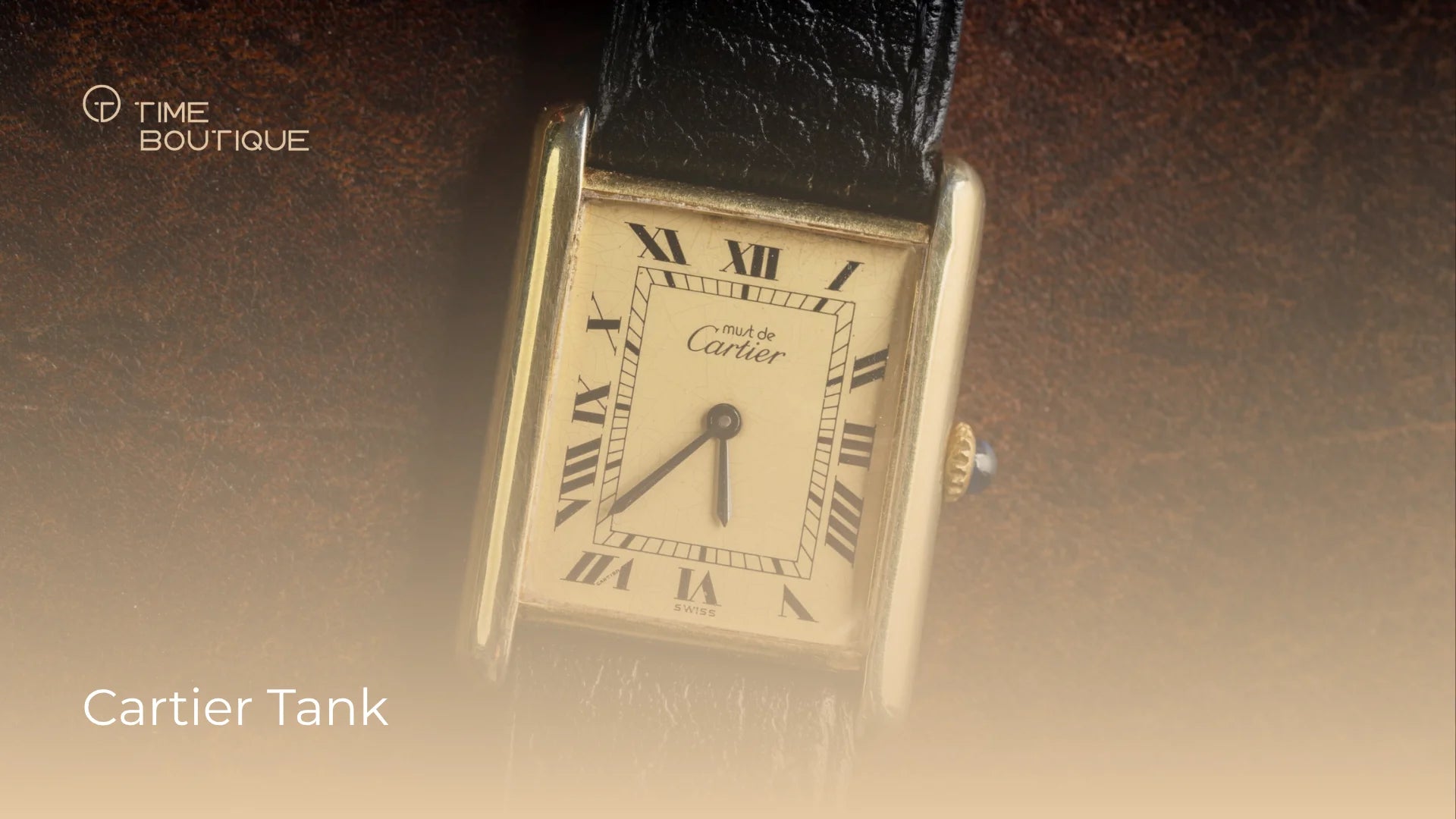
The Tank was drawn in 1917 by Louis Cartier, inspired by the top view of the Renault FT tanks of the First World War. The parallel side flanks (brancards) flow without a break into the lugs, the dial is rectangular, the lines are strictly geometric. The Tank is less a watch than a design principle.
The most important living variants:
- Tank Must. New generation since 2021, with a SolarBeat photovoltaic movement or a classic mechanical option (Tank Must or Solo). Steel case, gilded version or vermeil. An entry into the Tank world in the range of 3,000 to 4,500 euros new.
- Tank Louis Cartier. The timeless shape. Always in precious metal, mostly yellow or rose gold, hand-wound. The canonical Tank for someone who wants the original. Used market in the range of 9,000 to 16,000 euros depending on size and material.
- Tank Française. Launched in 1996, with an integrated link bracelet instead of a leather strap. A sportier-elegant presence, particularly strong on a feminine wrist.
- Tank Américaine. Elongated, slightly curved form. The choice for someone who wants the Tank translated from the classic rectangle into a more modern register.
- Tank Anglaise. With the crown integrated into the brancards, the line almost entirely closed. One of the newer Tank generations.
The question of Must versus Solo (as the previous line was called) matters on the vintage market. Tank Must models from the 1990s are friendly on price, often in the range of 1,800 to 3,500 euros, and run quartz movements. If you want a mechanical piece, look at the current generation or the Tank Louis Cartier.
The Tank is the Paris answer to the Geneva dress watch. Choosing between a Tank and a Calatrava is a choice between a shaped watch and a round classic. Both are right, both are different. The Tank carries personality on the wrist; the Calatrava recedes.
Santos de Cartier, the 1904 aviator
The Santos was developed in 1904 for the Brazilian aviation pioneer Alberto Santos-Dumont, who needed a watch he could read from the cockpit without fishing a pocket watch out mid-flight. That makes the Santos one of the oldest serious men's wristwatch designs in existence, well before the Submariner, well before the Royal Oak.
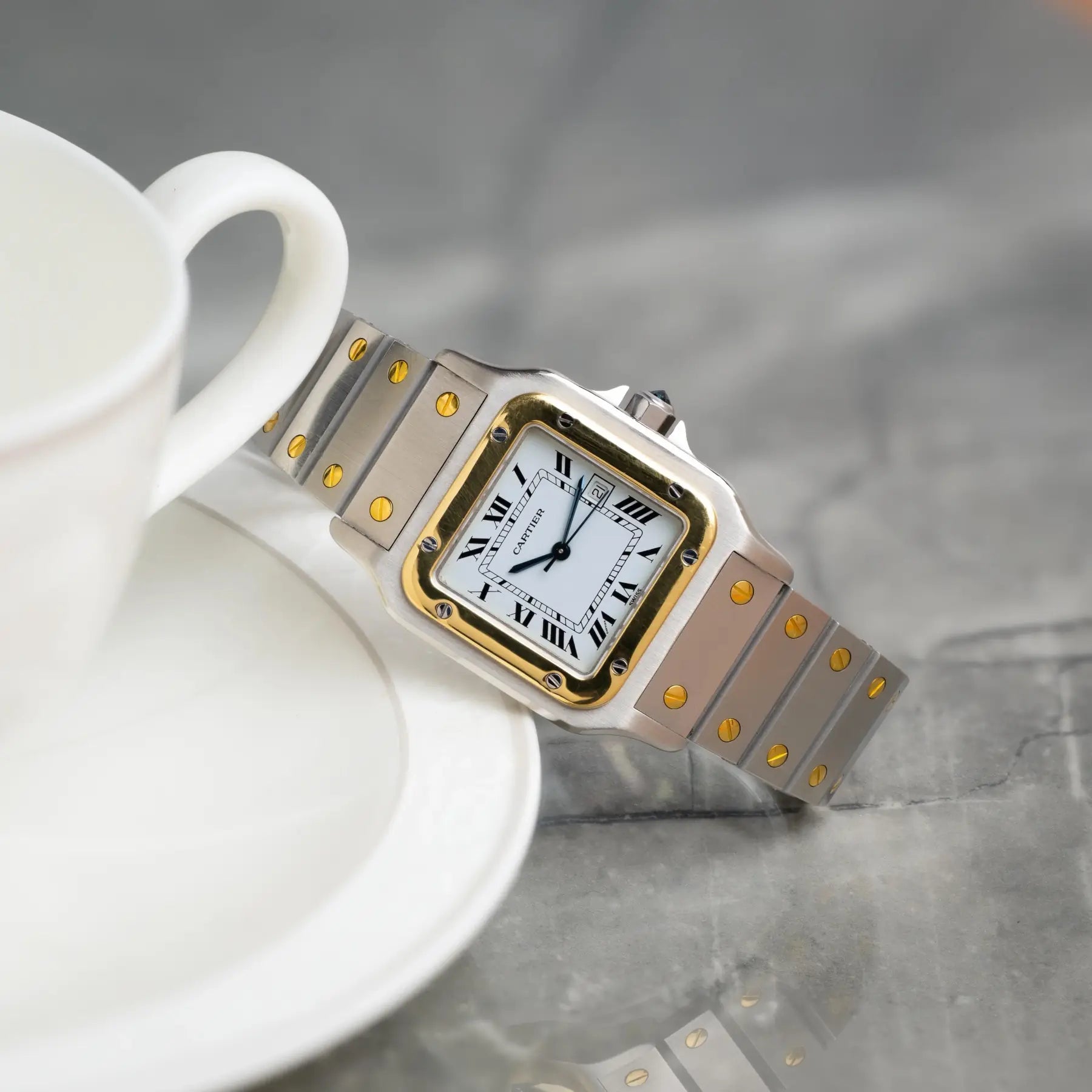
Today's Santos de Cartier (since 2018) has the classic square case with the eight visible screws on the bezel, the integrated steel bracelet and the QuickSwitch system. Three sizes (small, medium, large), in steel, steel-yellow gold or solid gold.
For men with a classic-sporting register: Santos de Cartier Large in steel, white dial. New around 7,700 euros, used from roughly 5,500 euros. The Santos handles office, restaurant and weekend equally well, sits more quietly than a Royal Oak and is far less hyped.
Of interest to collectors: the Santos Galbée from the 1980s and 1990s (steel-gold versions), with a warmer, more patinated character. Used market from around 2,500 euros.
The Santos-Dumont line (no bracelet, leather strap) is the slimmer variant, closer to a dress watch.
Ballon Bleu, the sapphire-crowned curve
Launched in 2007, the Ballon Bleu is the youngest of the major Cartier lines. Its defining elements are the crown set into the bezel with the blue sapphire cabochon, the asymmetry of the case at the three o'clock position, and the almost floating curvature of the crystal.
The Ballon Bleu reads more feminine all round than the Tank or the Santos, without being a women's watch exclusively. It works particularly well on smaller and medium wrists of either gender.
Common sizes:
- 36 mm (mid-size, works for both genders).
- 33 mm and 28 mm (clearly positioned for women).
- 42 mm (men's version, with automatic movement).
In steel, two-tone (steel-rose gold) or solid gold. Used market for the 36 mm steel in the range of 4,000 to 5,500 euros, rose gold versions notably above.
For a first Cartier on a feminine wrist, the Ballon Bleu 36 with a white dial and steel-rose gold bracelet is one of the most balanced options Cartier currently offers.
Panthère, the bracelet statement
The Panthère launched in 1983, was discontinued around 2004 and reissued in 2017 with the original design. A flat, almost jewellery-like case with soft edges, paired with a five-row link bracelet that wears like a bracelet rather than a watch strap.
The Panthère is openly conceived as a jewellery watch. Quartz movement (in service of the slim profile), a women's watch in the narrow sense, or a crossover for men who enjoy the game. The medium size sits not small on the wrist but broad and present.
Common versions:
- Panthère Medium steel. Classic, used market in the range of 4,500 to 6,000 euros.
- Panthère Medium yellow gold. The statement choice, from around 18,000 euros upwards.
- Panthère Small (Mini). Very feminine.
The Panthère is not the right first Cartier for someone after a "serious" watch in the traditional sense. It is the right choice for someone who understands jewellery as presentation and wants an unmistakable classic on the wrist.
Pasha, the sporty-elegant
The Pasha de Cartier was drawn in 1985, inspired by a special order from the 1940s for the Pasha of Marrakesh. Round case, a crown with a screwed protective cap on a fine chain, the distinctive Arabic dial layout with the inner square.
In 2020 Cartier relaunched the line. Pasha de Cartier 41 mm in steel, with two straps in the delivery (leather and steel bracelet), QuickSwitch system. New around 6,900 euros, used around 5,000 euros.
The Pasha works for someone looking for a slightly more attention-catching Cartier without reaching for the Santos or the Ballon Bleu. It is the most unconventional of the living lines.
Vintage Cartier, what collectors should know
The vintage Cartier market plays by its own rules. Unlike Rolex, what matters here is less the lume tone and the polish of a sports bezel and more the originality of the dial lacquer, the leather strap (original Cartier straps are scarce), and the crown with its original cabochon stone.
Valuable vintage Cartier pieces we occasionally see in the atelier:
- Tank Cintrée (curved Tank variant, very rare in original condition). One of the most elegant shapes in watchmaking.
- Tank Asymétrique (also Tank Parallélogramme). Limited editions, highly sought after.
- Crash. Born in London in 1967, the "distorted" Tank form. Originals trade above 100,000 euros today, with new limited reissues.
- Tank Américaine first generation (from 1989, precious metal).
- Santos Galbée steel-gold (1987 to 1999). Vintage sports watch with character.
On vintage Cartier the question of service history is less acute than on Patek, but still important: many of these watches run movements by Jaeger-LeCoultre or Frédéric Piguet that need regular overhauls. A Tank Louis Cartier that has gone fifteen years without service is more of a service project than a wearable classic.
Cartier alongside other brands in the box
A frequent question in the atelier: does a Cartier fit a collection that already holds a Rolex or a Patek? The answer rests less on price than on the function of the piece in the box.
A Cartier complements a sporty Rolex (Submariner, GMT, Explorer) very well, because the two houses cover clearly separate ranges. The Rolex is the tool, the Cartier the shape. A Tank Louis Cartier in the evening, a Submariner at the weekend, that works.
The choice is more delicate next to a Patek Calatrava. Both are dress watches, both have a quiet register. Here the decision must be deliberate: whether the piece should read as a pure round classic (Calatrava) or as a shaped statement (Tank). Most collectors commit to one of the two languages.
Compared with a Royal Oak or a Nautilus, a Cartier is complementary. A Santos and a Royal Oak overlap on the wrist only marginally, because the Santos reads sporty but with rounded edges rather than strictly angular. Anyone who keeps both keeps them for different reasons.
Which Cartier for whom?
A decision aid from atelier practice:
- First step into Cartier, tight budget: Tank Must Large in steel, classic white dial.
- Classic-elegant, precious metal, for the long run: Tank Louis Cartier in yellow gold, hand-wound.
- Men's watch with manufacture pretensions, sporty: Santos de Cartier Large in steel.
- First Cartier for a woman, versatile: Ballon Bleu 36 in steel-rose gold with white dial.
- Jewellery statement: Panthère Medium in yellow gold.
- Something of one's own, off the classics: Pasha 41 in steel.
- A collector's journey: vintage Tank Française, Tank Cintrée reissue, or a special Tank Américaine in rose gold.
If you want to wear a Cartier alongside a Rolex, remember the two houses speak different languages. A Datejust and a Tank complement each other well because they cover different occasions. A Submariner and a Santos overlap more, but both are defensible in the box.
The movements, a brief overview
If you buy a Cartier with a mechanical movement, it is worth knowing the main calibres used over the last two decades.
- In-house calibre 1904 MC (since 2010). Cartier's own movement with twin barrels, automatic, 48 hours of power reserve. Used in the Calibre de Cartier, later in Santos and Pasha. A solid modern movement with good service availability.
- Calibre 1847 MC (since 2015). A simplified version of the 1904, slightly shorter on power reserve but flatter. Found in the current Santos and Ballon Bleu.
- ETA base (in older Tank Française, Pasha, Roadster). Robust, easily serviced movements. No manufacture pretension, but service-friendly.
- Jaeger-LeCoultre base (in hand-wound Tank Louis Cartier and some vintage models). Extremely durable when properly maintained. One of the most elegant movements in its class.
- Frédéric Piguet base (in some vintage complications). Demanding in service but very finely made.
- Quartz calibres (in Tank Must Quartz, Panthère, Twenty~4-style lines). A deliberate choice at Cartier for slim profile, not a cost-saving move.
For buyers in the current range that means: a 1904 MC or 1847 MC is a safe, long-term serviceable choice. On vintage the movement is part of the appraisal. An original Jaeger-LeCoultre movement in a Tank Louis Cartier lifts the piece clearly above a late replacement or service movement.
What to check when buying
Universal checks for a used Cartier:
- Original crown with cabochon stone. A replacement is visible (colour, setting). A missing stone points to careless handling.
- Dial lacquer without cracks or spots, blued steel hands in even colour.
- Tank case edges sharply drawn, not rounded by polishing. Critical on the Tank Louis Cartier.
- Original bracelet clasp (Cartier double-folding clasp with logo). Aftermarket clasps reduce value.
- Full documentation (Cartier guarantee card, box, ideally the original invoice).
At Time Boutique every Cartier additionally passes through our watchmaker Helmut's workshop. On mechanical Cartier models with Jaeger-LeCoultre or ETA-based movements we measure timing across several days and run a water resistance test wherever the case is specified for it. The result is recorded on the service pass of every watch we sell.
For service enquiries, see Cartier service.
Get in touch
We keep a curated selection of Cartier models at our atelier in Grünwald near Munich, from the Tank Must to the Tank Louis Cartier, from the Santos to the Ballon Bleu, and occasional special vintage pieces. Private appointment or insured transport across the DACH region.
If you are looking to sell a Cartier or want an appraisal, use our purchase enquiry form or call +49 89 38164962. We reply within hours, with an honest assessment rather than a blind quote.
More at the Time Boutique atelier: our Cartier stock and Cartier service in Munich.
- The short answer
- Maison Cartier, the Paris jeweller identity
- The Tank family, the Paris classic
- Santos de Cartier, the 1904 aviator
- Ballon Bleu, the sapphire-crowned curve
- Panthère, the bracelet statement
- Pasha, the sporty-elegant
- Vintage Cartier, what collectors should know
- Cartier alongside other brands in the box
- Which Cartier for whom?
- The movements, a brief overview
- What to check when buying
- Get in touch