

There are watches you wear for their technology, and there are watches you wear for their beauty. The Cartier Panthère belongs without question in the second group. It is jewellery first and watch second, and that is precisely what makes its appeal. Its supple bracelet lays itself around the wrist like a precious piece of jewellery, light, flowing and unmistakable. In the atelier the Panthère is the watch for those who seek elegance and shine and take pleasure in a pure question of style. This guide shows where it comes from, what defines it and what matters when you buy.
The panther, Cartier's heraldic animal
To understand the Panthère, one must know the panther. For over a hundred years the big cat has been the heraldic animal of Cartier, closely bound to Jeanne Toussaint, the legendary creative director of the house, who herself bore the nickname La Panthère. At Cartier the panther stands for a particular mixture of elegance, strength and independence and appears again and again over the decades in jewellery and watches. The Panthère de Cartier carries this heritage already in its name. It is the watch-made embodiment of a symbol that shapes the brand like no other. Anyone who wears a Panthère wears a piece of the design history of Cartier.
The history, 1983 and the reissue
The Panthère de Cartier appeared in 1983 and struck the nerve of its time. The eighties loved shine, self-assurance and visible style, and the Panthère quickly became an icon of that decade, worn by style icons and figures of public life. After some years it disappeared from the range but stayed alive as a sought-after collector's piece and vintage favourite. In 2017 Cartier reissued the Panthère and so brought back an icon that had never really gone away. This reissue again struck a nerve, because the wish for a genuine jewellery watch with history is unbroken. Today the Panthère stands firmly in the range again and combines the aura of the eighties with a timeless elegance.
What defines the Panthère
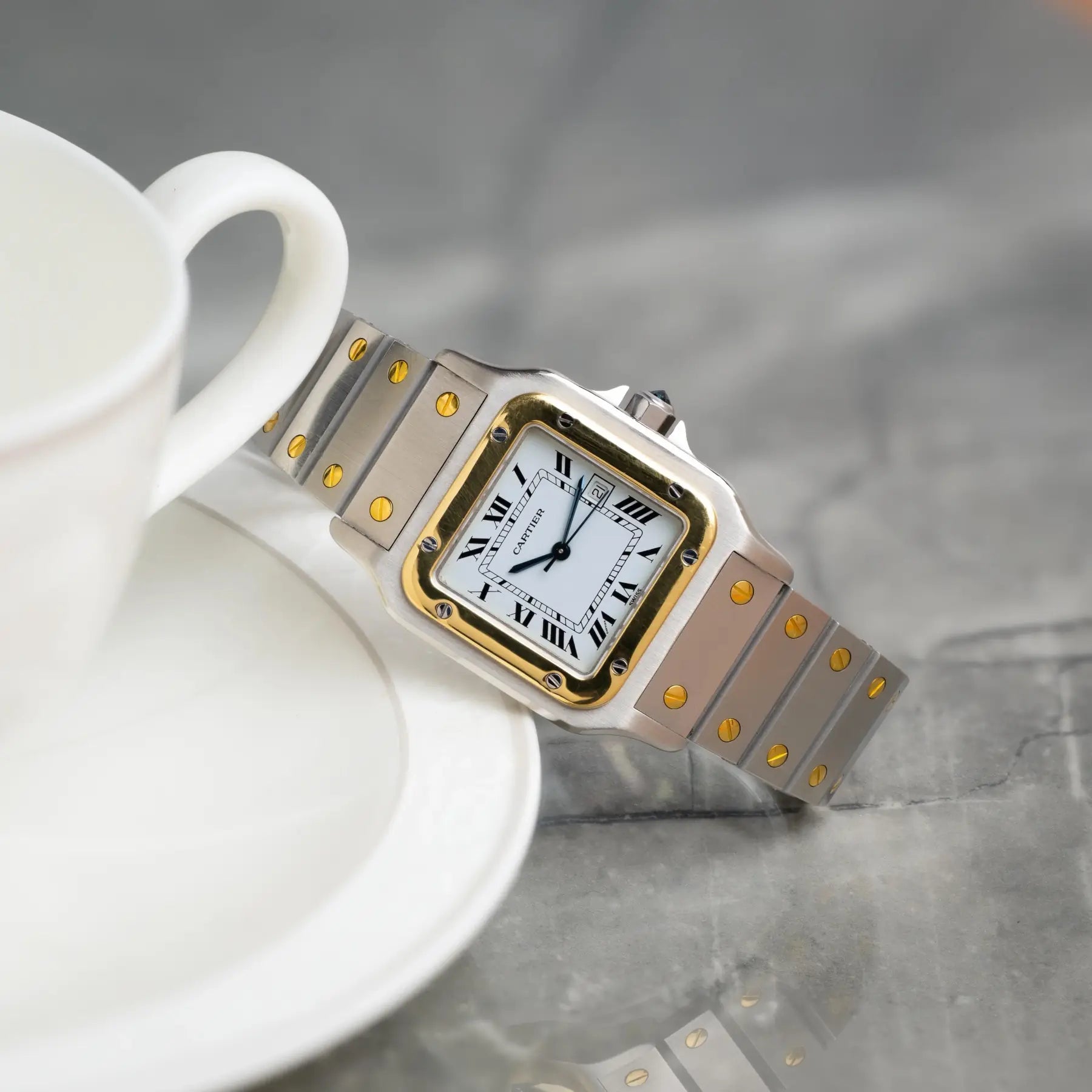
The heart of the Panthère is its bracelet. Unlike most metal bracelets it is especially finely linked and supple, so that it lays itself soft and flowing around the wrist, almost like a fabric or a jewellery band. That very feel sets the Panthère apart from an ordinary watch. The square case with the rounded edges and the fine screws recalls the Santos, but is here deliberately kept smaller and more delicate, so that the jewellery character stays in the foreground. Roman numerals and blue hands round off the classic Cartier picture. The Panthère is thus a watch whose beauty lies in the detail and in the feel on the wrist, not in technical display.
The sizes
The Panthère is offered in several sizes, from an especially small to a medium version. The smaller sizes emphasise the jewellery character and look especially fine and delicate on the wrist. The medium size is the balanced choice, which combines presence and elegance. Because the Panthère is conceived in the first place as a piece of jewellery, the size matters above all for the desired effect. Anyone seeking a discreet, fine piece reaches for the smaller version, anyone wishing for a somewhat more present appearance for the medium. In the atelier we like to lay the sizes side by side, because the right choice shows itself on the wrist at once.
Materials and diamonds
The Panthère comes in steel, in yellow gold, in two-tone combinations and in solid gold, and in versions with diamond settings. The steel version is the more accessible, more everyday-capable choice and yet keeps the full jewellery character through the supple bracelet. The gold versions are the most festive and finest readings, especially in yellow gold, which conjures up the shine of the eighties. Models with diamonds on the bezel or case turn the Panthère fully into a piece of jewellery. The choice of material determines more here than with many other watches, because the Panthère is conceived as jewellery anyway and the material shapes its character directly.
Quartz, a deliberate choice
The Panthère carries, as a rule, a quartz movement, and with this watch that is no weakness but a coherent decision. As a jewellery watch the Panthère is meant to be flat, light and uncomplicated, and a quartz movement allows precisely that. It makes the watch low-maintenance and everyday-capable and puts the beauty in the foreground, not the mechanics. Anyone who buys a Panthère buys not a mechanical experience but a piece of jewellery that reliably shows the time. This clarity about its own character is a strength of the Panthère. It does not pretend to be something it is not.
How the Panthère wears
The Panthère wears differently from any ordinary watch. Through the supple bracelet it nestles softly against the wrist and feels like a piece of jewellery, not like a technical device. It can be worn alone or deliberately combined with bangles and other jewellery, which rarely succeeds so well with a classic watch. In steel it is an elegant everyday companion, in gold with diamonds a festive eye-catcher. This versatility, from the discreet jewellery to the radiant statement, is a great part of its appeal. It is a watch that brings joy, anew every day.
For whom the Panthère is the right choice
The Panthère appeals to those who understand a watch as jewellery and take pleasure in elegance and shine. It is the obvious choice for all who seek a fine, festive watch that is at the same time a piece of jewellery. It suits the elegant appearance just as well as the deliberately set accent in everyday life and combines wonderfully with other jewellery. Anyone looking for a pure style watch with history and an unmistakable feel on the wrist finds in the Panthère a timeless answer. It is made less for the lover of technology than for the person who values beauty on the wrist.
Panthère, Tank or Santos
Within the Cartier world the Panthère is the pronounced jewellery watch. The Tank is the classic, rectangular style watch, calmer and more formal. The Santos is the sportier, more technical watch with the screws on the bezel. The Panthère differs from both through its supple bracelet and its pure jewellery character. Anyone looking for a classic style watch looks to the Tank, anyone who prefers it sportier to the Santos. Anyone, by contrast, who wants a genuine piece of jewellery that shows the time is right with the Panthère. A placement across the whole brand is given by our guide which Cartier to buy.
The Panthère as a style icon of the eighties
The Panthère is inseparable from the style of the eighties, and that very thing today makes a great part of its appeal. In a decade that celebrated shine, self-assurance and visible success, the Panthère was the perfect watch. It became the accessory of a whole generation of style-conscious women and some men and stands to this day for that glamorous era. With the reissue Cartier has brought back this spirit and at the same time shown how timeless the design is at its core. The Panthère is thus at once a piece of nostalgia and a completely present watch. Anyone who wears it plays deliberately with this history, without appearing old-fashioned. That very mixture of memory and present makes it so irresistible for many.
Vintage Panthère
The original Panthère models from the eighties and nineties are sought-after collector's pieces today. They have the authentic character of their time and differ in fine details from the reissued models. For many lovers it is precisely the vintage Panthère that is the real original, with the patina and the charm of the years. With these pieces a close look at the bracelet, the heart of the watch, and at the condition of the clasp and the links is worthwhile. Completeness and originality too decide the value. Anyone looking for a vintage Panthère finds a piece of lived style history, but should pay attention to a careful inspection, because the fine bracelets are stressed over the years and their condition reveals much about the watch.
Combining the Panthère
Unlike most watches, the Panthère invites being deliberately combined with jewellery. Because it is itself a piece of jewellery, it fits harmoniously beside bangles, fine chains or rings and can be part of a larger ensemble. A steel Panthère stays discreet enough for everyday life, while a gold version with diamonds becomes the radiant centrepiece. This freedom in combining is an appeal that classic watches rarely offer. In the atelier we often experience that the Panthère is chosen not as a single watch but as part of a personal style. That is precisely where its special strength lies. It is a watch that fits into the picture of its wearer rather than dominating it.
What to look for when buying a used Panthère
With a used Panthère the bracelet stands at the centre of the inspection. Pay attention to the play between the fine links, because too much play indicates intensive use, and to the clean run of the clasp. Check the case for traces of too intensive polishing and the originality of the dial and hands. With the diamond versions a look at the firm seat of the stones is worthwhile, and at whether the setting is factory-fitted, because stones set later can lower the value. Completeness with box and papers raises value and resale, more on that in box and papers, how important are they really.
Service and care
The Panthère, as a quartz watch, is especially low-maintenance. It needs above all a proper battery change, during which the seals should at the same time be checked. With this watch the supple bracelet deserves greater attention. Because it consists of many fine links, it is worth occasionally checking the firm seat and cleanliness, especially when the watch is worn a lot. With the diamond versions the seat of the stones should be checked. A well-kept Panthère with a documented history keeps its shine and its value over the years. Anyone wishing to enjoy this piece of jewellery for a long time should grant it the care it deserves.
Frequent questions about the Cartier Panthère
Is the Panthère a watch or jewellery? It is both, but jewellery first. Its supple bracelet and its fine case are conceived as a piece of jewellery that also shows the time.
Why does the Panthère have a quartz movement? Because it is conceived as a flat, light jewellery watch. Quartz allows a thin, low-maintenance movement and puts the beauty in the foreground.
Is the Panthère only a women's watch? It is worn predominantly by women, yet the larger versions in particular and the vintage models find lovers among men too. In the end one's own style decides.
Which Panthère size is the right one? That depends on the desired appearance. The smaller sizes emphasise the fine jewellery character and look especially delicate, the medium size combines presence and elegance. Because the Panthère is conceived in the first place as a piece of jewellery, it is less about pure legibility than about the effect on the wrist. The right size therefore shows itself best in direct comparison on the arm.
The Panthère at Time Boutique
In our atelier in Munich we advise on the Panthère with joy in its jewellery character and its history. We lay out various sizes and materials and take our time to find the fitting piece. An overview of our Cartier selection is in our Cartier collection. Anyone wishing to part with a Panthère or with questions about purchase can turn to us at any time. Appointments in Munich are by arrangement, in person and without haste.
- The panther, Cartier's heraldic animal
- The history, 1983 and the reissue
- What defines the Panthère
- The sizes
- Materials and diamonds
- Quartz, a deliberate choice
- How the Panthère wears
- For whom the Panthère is the right choice
- Panthère, Tank or Santos
- The Panthère as a style icon of the eighties
- Vintage Panthère
- Combining the Panthère
- What to look for when buying a used Panthère
- Service and care
- Frequent questions about the Cartier Panthère
- The Panthère at Time Boutique