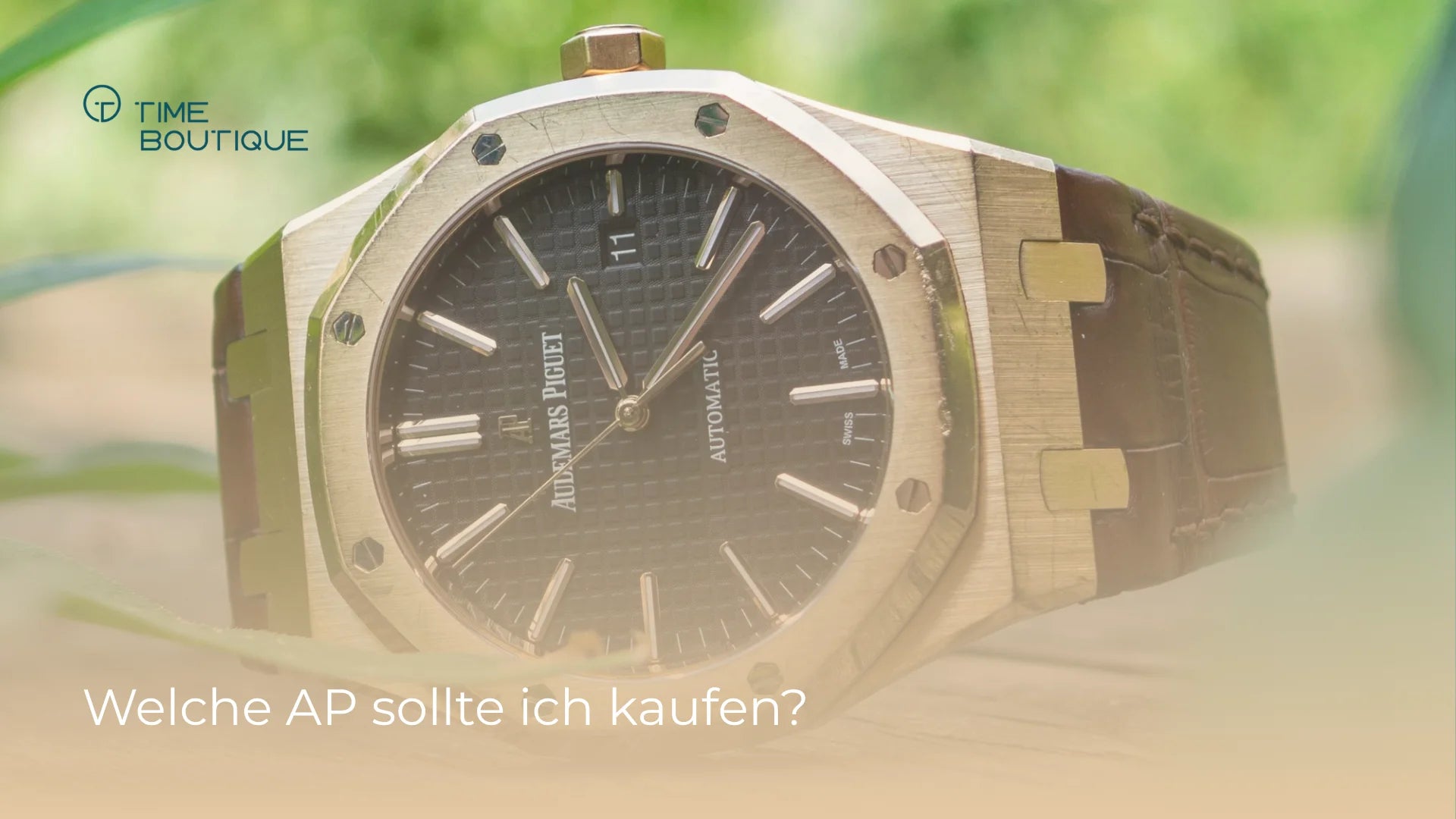

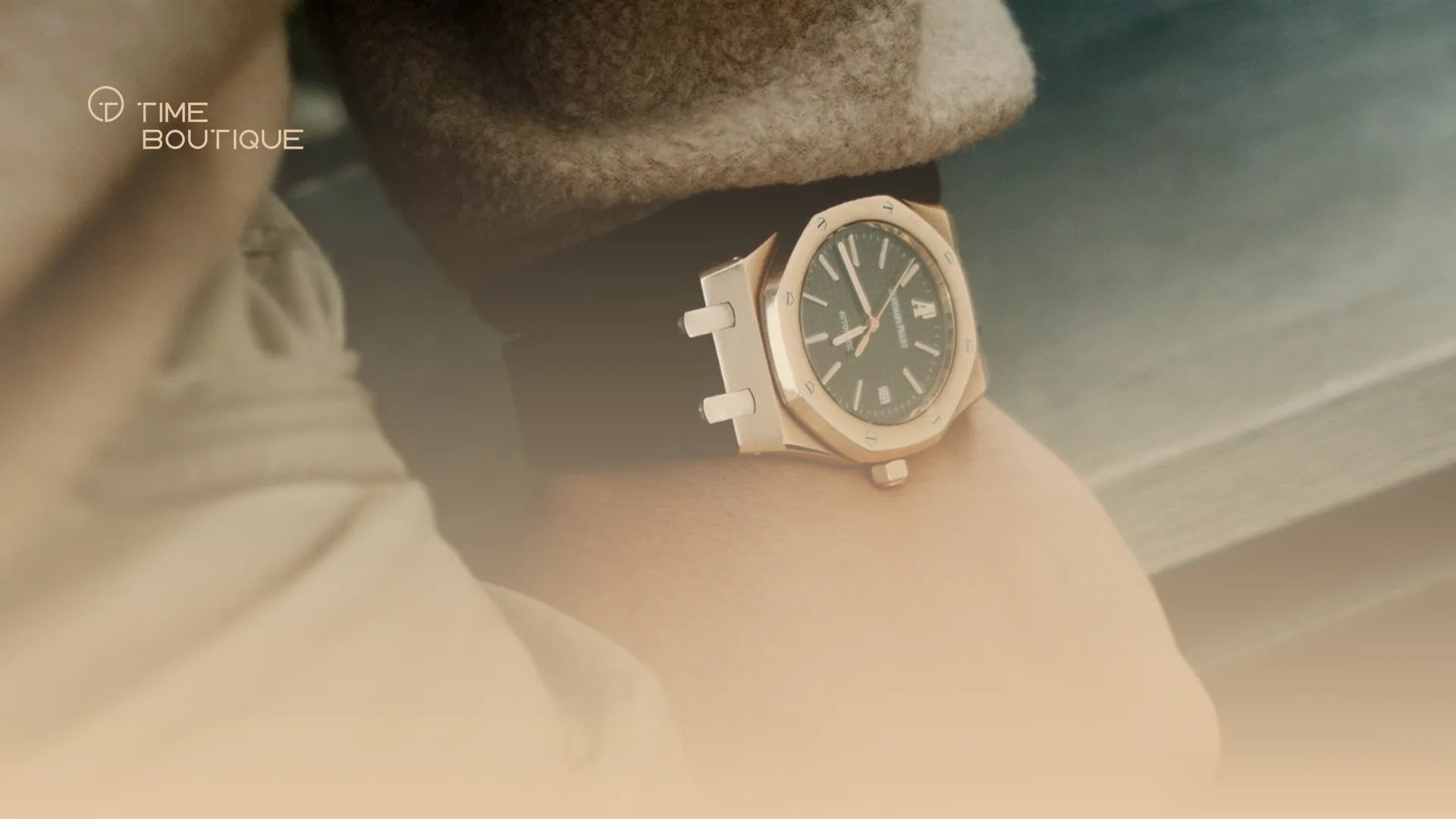
Few watches have shaped modern watchmaking as profoundly as the Audemars Piguet Royal Oak. It created a category that did not exist before, the luxury sports watch in steel with an integrated bracelet. To this day many collectors regard the AP Royal Oak as the benchmark for the genre, and it remains one of the most sought-after watches on the market.
This guide explains how the Royal Oak came about, what defines Gérald Genta's design and which references really matter, from the original Jumbo to the Selfwinding and the chronograph. It also covers sizes and materials, a qualitative look at prices and waiting times, and the points to check when you buy a pre-owned Royal Oak.
The history of the Royal Oak: a steel watch priced like gold
In the early seventies the Swiss watch industry was under pressure, with quartz watches pushing into the market. Audemars Piguet, a small family-owned manufacture in the Vallée de Joux known above all for fine complications, chose an unusual path. It commissioned the designer Gérald Genta to create a steel sports watch that would still read as a luxury object. Legend has it that Genta sketched the design in a single night.
In 1972 Audemars Piguet presented the Royal Oak at the Basel watch fair. Steel is harder and more difficult to work than gold, the angular case demanded a great deal of handwork, and so the price sat at the level of a gold watch. Many retailers and customers struggled with that at first, and the early years were slow, but the idea gradually took hold. The Royal Oak became the commercial backbone of the brand and the model for a whole generation of integrated sports watches. Its name comes from ships of the Royal Navy called Royal Oak.
Gérald Genta's design: bezel, screws and integrated bracelet
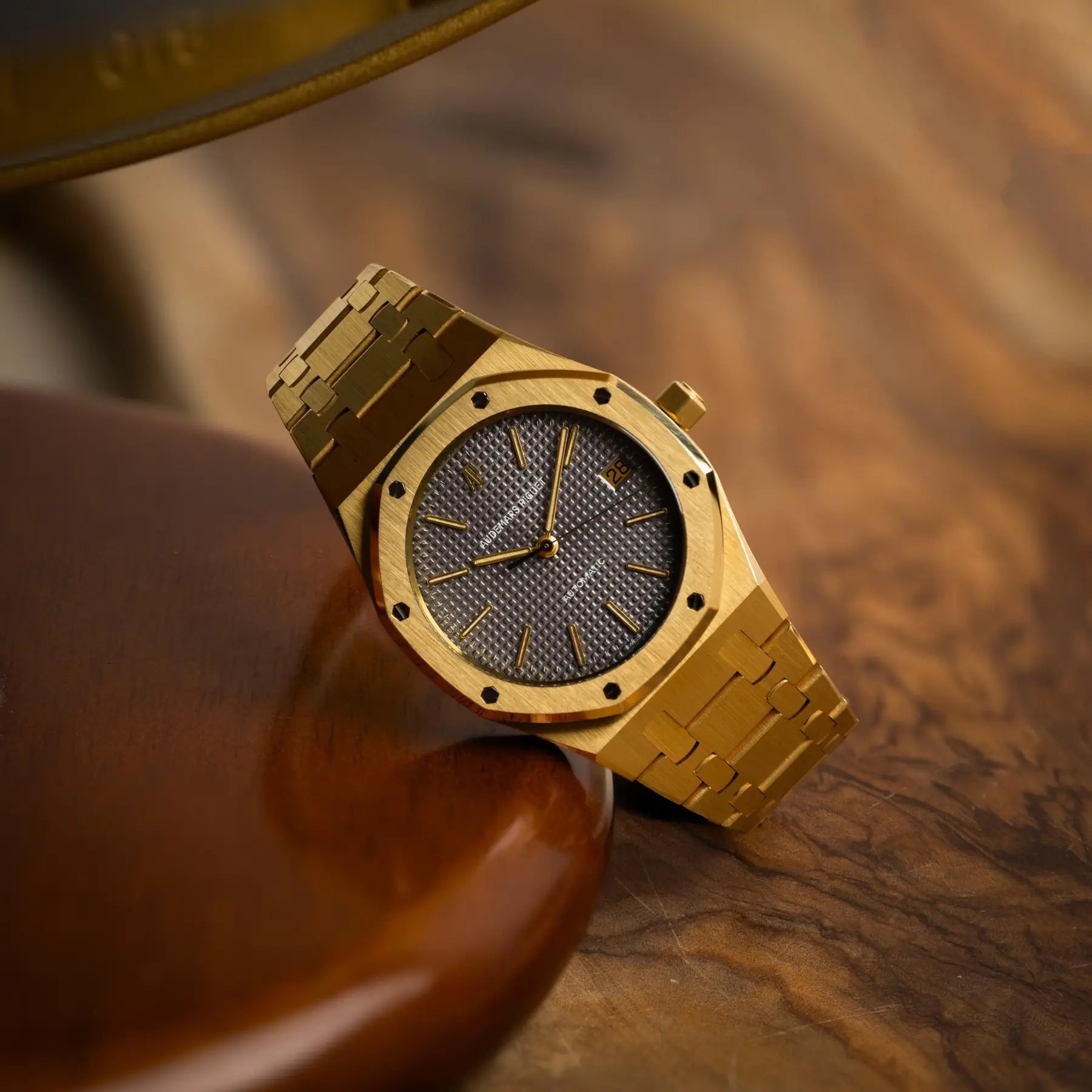
The Royal Oak is recognisable at once by three elements. The first is the octagonal bezel with eight hexagonal screws, a motif reminiscent of the porthole of a diving helmet. The screw heads are aligned uniformly. The second is the integrated bracelet, whose links flow from the case without a visible break and taper towards the clasp, so that case and bracelet appear to be cast in one piece. The third is the textured Tapisserie dial.
Then there is the finishing. Satin-brushed surfaces alternate with highly polished bevels, and this interplay of matt and gleaming light defines the character of the Royal Oak. The finishing is laborious to produce and just as demanding to restore.
A few years later Genta also designed the Nautilus for Patek Philippe, a related yet distinct interpretation of the integrated steel sports watch, presented in the Patek Nautilus guide. Vacheron Constantin offers its own answer to this category with the Overseas, discussed in the guide which Vacheron Constantin to buy.
The Tapisserie dial: Petite, Grande and Méga
The Royal Oak dial carries a relief of small squares that Audemars Piguet calls Tapisserie. It is produced with a guilloché technique and catches the light differently depending on the angle, so that even a plain blue looks alive.
The Petite Tapisserie, with very fine squares, belongs to the original Royal Oak and lives on in the Jumbo. The Grande Tapisserie, with larger squares, defines the 41 mm Selfwinding models. The Méga Tapisserie, with even larger, more sculpted squares, is the hallmark of the Royal Oak Offshore. The pattern alone often reveals the line. The classic colour is a deep blue that Audemars Piguet calls Bleu Nuit, Nuage 50 on the Jumbo. Grey, black, silver and other shades are available as well.
The key AP Royal Oak references at a glance
The number of references can seem confusing, but most buyers need only three lines: the 39 mm Jumbo, and the Selfwinding and the chronograph, both at 41 mm.
| Reference | Line | Diameter | In context |
|---|---|---|---|
| 5402 | Jumbo | 39 mm | The 1972 original, ultra-thin calibre 2121 |
| 15202 | Jumbo Extra-Thin | 39 mm | Direct descendant, still with calibre 2121 |
| 16202 | Jumbo Extra-Thin | 39 mm | 50th anniversary generation, calibre 7121 |
| 15400 | Selfwinding | 41 mm | First generation of the 41 mm Selfwinding |
| 15500 | Selfwinding | 41 mm | New in-house calibre 4302 |
| 15510 | Selfwinding | 41 mm | Further development, also calibre 4302 |
| 26331 | Chronograph | 41 mm | Chronograph in the 41 mm case |
| 26240 | Chronograph | 41 mm | Successor with calibre 4401 |
The Royal Oak Jumbo: from the 5402 to the 16202
The original Royal Oak carries the reference 5402. At 39 mm it was large by the standards of its day, which earned it the nickname Jumbo. At the same time it is remarkably slim, because it houses the ultra-thin automatic calibre 2121. Collectors distinguish several series of the 5402, and early examples in good original condition are among the most sought-after Royal Oaks of all.
The idea lived on for decades. The 15202, the Royal Oak Jumbo Extra-Thin, kept calibre 2121 and stayed very close to the original. For many connoisseurs it is the purest modern reading of the Royal Oak, with a date, two hands, Petite Tapisserie and not a single superfluous detail.
In 2022, for the Royal Oak's fiftieth anniversary, the 16202 followed. It keeps the size and proportions but uses the new in-house calibre 7121, which Audemars Piguet developed as the successor to the 2121. That brought a very long era of the old movement to a close. Since then the 15202 has only been available pre-owned and stands for the historic calibre, while the 16202 represents the technically renewed version of the same idea.
Royal Oak Selfwinding 41 mm: 15400, 15500 and 15510
For many people the 41 mm Selfwinding is the archetypal everyday AP Royal Oak. It is slightly larger and more substantial than the Jumbo, carries the Grande Tapisserie, a date and a central seconds hand, and comes across as sportier.
The 15400 was the core model of the line for many years and is correspondingly well represented on the pre-owned market. The 15500 introduced the in-house calibre 4302, a modern movement with a longer power reserve, together with a revised dial. The 15510 continues with calibre 4302 and is regarded as a further development with detail changes to case and dial.
Which generation is right is largely a matter of taste. If you prefer the more classic dial layout, look closely at the 15400; if you want the newer movement, the 15500 or 15510. On the wrist the differences are smaller than on paper, and the dial colour often changes the effect more than the generation does. For an overview beyond the Royal Oak, see the guide which Audemars Piguet to buy.
Royal Oak Chronograph, complications and the Royal Oak Concept
The 41 mm Royal Oak chronograph combines the Selfwinding case with two pushers and sub-dials. The 26331 was followed by the 26240 with calibre 4401, an integrated chronograph movement developed in-house. Compared with the Offshore, the Royal Oak Chronograph stays slimmer and more elegant, the choice for anyone who wants a stopwatch function without the Offshore's muscular presence.
Beyond these core lines, Audemars Piguet uses the Royal Oak as a stage for complications. The perpetual calendar in the Royal Oak case is among the brand's most characteristic models. Openworked versions expose the movement and turn the construction itself into the dial, and there are tourbillons and other highly complicated pieces as well.
The Royal Oak Concept occupies a special position as the family's experimental laboratory, with a futuristically shaped case, modern materials and usually very elaborate movements. It shares the attitude of the classic Royal Oak more than its form.
Sizes and materials of the Royal Oak watch
Besides 39 and 41 mm, the Royal Oak also comes in smaller sizes. A ladies' version appeared as early as the seventies, and today 37 and 34 mm are the most common. The 37 mm appeals to women and to men with slimmer wrists alike and is a serious unisex size. The 34 mm is the most delicate interpretation and is also offered with diamond settings. The smaller sizes carry the full design vocabulary too.
When it comes to materials, steel remains the reference, because the Royal Oak became famous as a steel watch. Yellow, white and rose gold lend the angular design a warm, festive note, and Frosted Gold versions with a finely hammered surface shimmer almost like jewellery. Two-tone steel and gold was popular above all in earlier decades and still has its admirers. Titanium makes the watch noticeably lighter. Ceramic is scratch-resistant and technical in character but particularly demanding to work, because the typical edges can only be brought out of this hard material with great effort.
Royal Oak or Royal Oak Offshore
In 1993 the Royal Oak Offshore arrived as a larger, bolder and sportier interpretation, with Méga Tapisserie, a more massive case and frequently a chronograph. The Royal Oak is the slimmer, more elegant and more versatile watch, the Offshore its deliberately loud sibling. The history, materials and buying criteria of the Offshore are covered in the Royal Oak Offshore guide.
Audemars Piguet Royal Oak price, market and waiting times
Prices shift with reference, material, condition and market phase, so understanding the mechanics helps more than any single figure. New Royal Oaks are sold at the brand's list price, but availability is limited, especially for steel models. In recent years Audemars Piguet has concentrated distribution more on its own boutiques, where sought-after references are usually allocated rather than freely sold. There are no official waiting times. Whether and when you are offered a watch often depends on your purchase history and your relationship with the boutique.
The pre-owned market reflects this scarcity. In strong market phases, steel models such as the Jumbo and the 41 mm Selfwinding in particular traded well above list price. The level has since calmed again; there is no automatic upward path. Precious metal models and smaller sizes often sit closer to list price, sometimes below it. Within a reference, condition, originality, completeness, dial colour and the status of a discontinued reference are the main drivers of value. A well-preserved, original Royal Oak with papers is the soundest basis for value retention, but there is no guarantee of it.
Buying a pre-owned AP Royal Oak: what matters
When buying a pre-owned Royal Oak, focus on the points that are hard to put right later.
Start with the edges. The sharp, polished bevels on bezel, case and bracelet are the heart of the Royal Oak. Every careless polish rounds them off and blurs the line between brushed and polished surfaces, and a correct restoration belongs in very experienced hands. Examine the edges under a loupe and in raking light. A watch with honest wear and crisp edges is often the better choice than an over-polished one.
Next, the bracelet. Hold the watch horizontally by the case. If the bracelet sags noticeably or the links show clear play, it has stretched. A replacement is expensive, and missing links can become a problem on a larger wrist. The hexagonal screw heads should be undamaged and uniformly aligned; scratches or twisted heads point to careless work. The dial should be original, with a clean Tapisserie relief and correct hands.
Finally, papers and service history. A warranty card or certificate, the box and ideally a proof of purchase add security and resale value, as explained in box and papers, how much do they matter. Because the Royal Oak is frequently counterfeited, the numbers on the case and in the documents should match. Service records show how the watch has been looked after; what a service involves is described in the Audemars Piguet service and overhaul guide. Information on servicing and refinishing is also available under Audemars Piguet service. A selection of pre-owned models can be found in the Audemars Piguet collection.
Audemars Piguet Royal Oak at Time Boutique
You will find the Royal Oak and other models from the manufacture in our Audemars Piguet collection, each inspected in our own workshop in Munich.
With sought-after references, availability changes quickly. If you are looking for a particular Royal Oak, we will find it for you. Get in touch.
For your own Audemars Piguet, we offer service and overhaul and purchase.
Frequently asked questions
How much does an Audemars Piguet Royal Oak cost?
The price depends on reference, material and condition, and even the steel models are at least in five-figure territory, with complications well above that. New watches are sold at list price but are hard to obtain. On the pre-owned market, sought-after steel references traded above list in strong phases, while precious metal and smaller sizes often sit closer to list price.
Is a pre-owned Royal Oak worth it?
For many buyers, yes, because you can choose exactly the reference you want without waiting, including discontinued models such as the 15202 or the 15400. What matters most are sharp, not over-polished edges, a firm bracelet, an original dial, and papers and service records.
How long is the waiting time for a Royal Oak?
Audemars Piguet does not publish official waiting times. Sought-after steel models are allocated in the boutiques, and whether and when you receive a watch often depends on your purchase history. If you would rather not wait, the pre-owned market offers an alternative.
What is the difference between the Jumbo and the Selfwinding?
The Jumbo measures 39 mm, is particularly slim, does without a seconds hand and carries the Petite Tapisserie, making it the closest to the original. The Selfwinding measures 41 mm, has a central seconds hand and the Grande Tapisserie, and looks sportier. The Jumbo is the purist's choice, the Selfwinding the more versatile one.
What is the Royal Oak Concept?
The Royal Oak Concept is the avant-garde line within the family, with a futuristic case, modern materials and usually highly complicated movements. It shares the classic Royal Oak's willingness to break with convention rather than its form.
- The history of the Royal Oak: a steel watch priced like gold
- Gérald Genta's design: bezel, screws and integrated bracelet
- The Tapisserie dial: Petite, Grande and Méga
- The key AP Royal Oak references at a glance
- The Royal Oak Jumbo: from the 5402 to the 16202
- Royal Oak Selfwinding 41 mm: 15400, 15500 and 15510
- Royal Oak Chronograph, complications and the Royal Oak Concept
- Sizes and materials of the Royal Oak watch
- Royal Oak or Royal Oak Offshore
- Audemars Piguet Royal Oak price, market and waiting times
- Buying a pre-owned AP Royal Oak: what matters
- Audemars Piguet Royal Oak at Time Boutique
- Frequently asked questions
- How much does an Audemars Piguet Royal Oak cost?
- Is a pre-owned Royal Oak worth it?
- How long is the waiting time for a Royal Oak?
- What is the difference between the Jumbo and the Selfwinding?
- What is the Royal Oak Concept?