

Audemars Piguet is the smallest of the three big Geneva houses and at the same time the one whose identity rests most heavily on a single model. When you buy an Audemars Piguet, you almost always buy a Royal Oak. Within that one line, however, sits a world of its own, from the quiet Jumbo to the Offshore chronograph. This guide sorts the Royal Oak generations and says which suits whom.
The short answer
- First Royal Oak, daily driver: Royal Oak Selfwinding 41 mm (15500ST or the current 15510ST), steel, blue Tapisserie dial.
- Classic and most purist: Royal Oak Jumbo Extra-Thin 15202ST or 16202ST, 39 mm, steel.
- Larger and more present: Royal Oak Offshore Chronograph 42 or 43 mm.
- New line, round case: Code 11.59 Selfwinding or Chronograph.
- Collector's complication: Royal Oak Perpetual Calendar 26574, Royal Oak Tourbillon, or Royal Oak Quantième Perpétuel (Perpetual Calendar).
Let us walk through it.
Audemars Piguet, Le Brassus since 1875
Audemars Piguet was founded in 1875 by Jules-Louis Audemars and Edward-Auguste Piguet in the Vallée de Joux, the mountain valley that still sits at the heart of Swiss haute horlogerie. Unlike Patek or Rolex, the house has remained in family hands and has never sold to a group.
Until 1972 AP was a manufacture for classical complications, perpetual calendars, repeaters, with annual output in the low four figures. An interesting but financially fragile business. The Royal Oak rescued the house and redefined its identity.
Today AP produces around 50,000 watches a year, a small fraction of Rolex output. Its top discipline is the combination of a Royal Oak case with highly complicated movements. In that niche it sits unchallenged.
Royal Oak, the 1972 steel-sports revolution
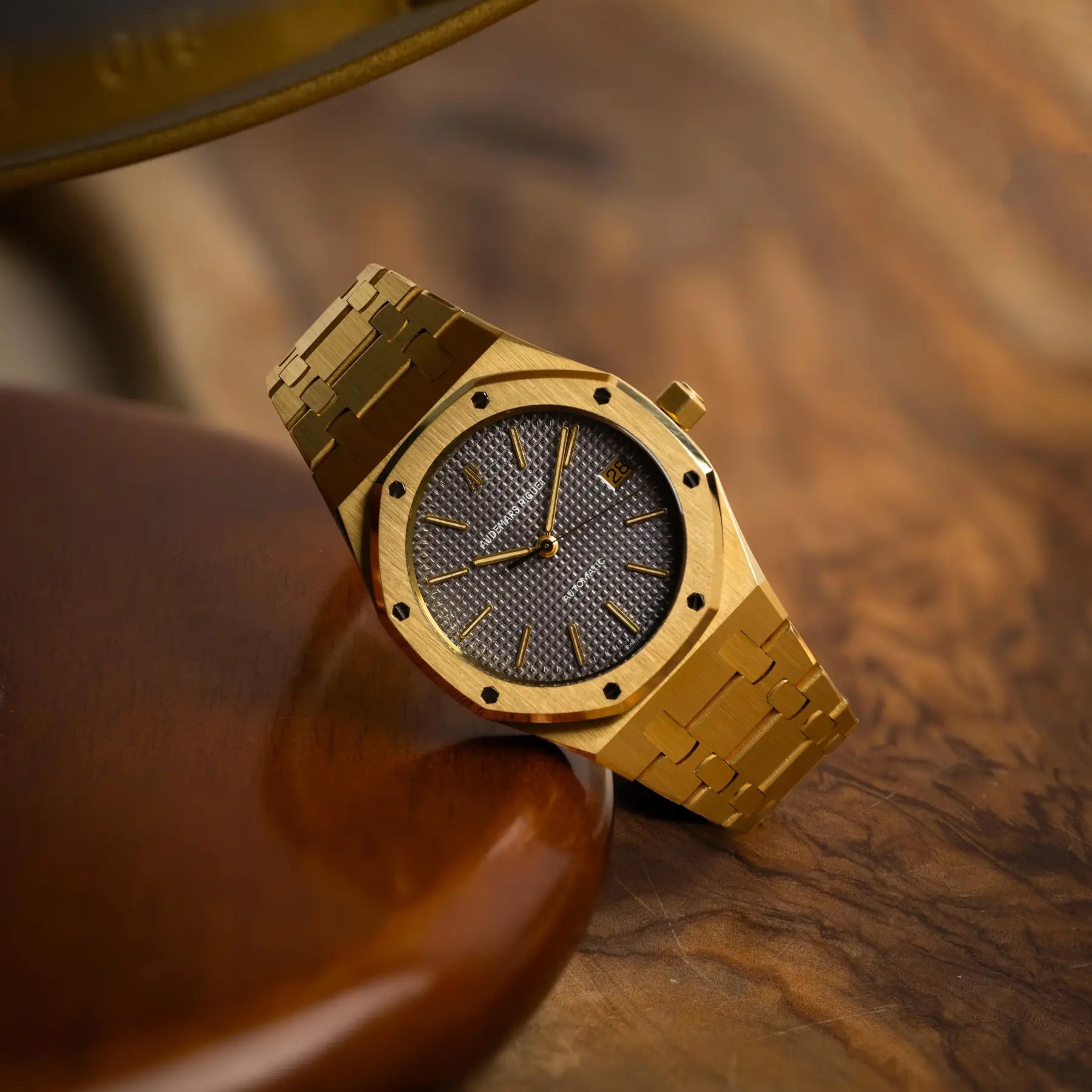
In 1972 AP launched the Royal Oak at Basel. Drawn by Gérald Genta in a single night. An octagonal bezel with eight visible screws, an integrated steel bracelet, a Tapisserie dial in the "Grande Tapisserie" check pattern. List price 1972: 3,300 Swiss francs, roughly ten times what a steel sports watch cost at the time. A steel watch priced like a gold watch, that was the provocation.
The Royal Oak was a risk at first. The piece sold slowly during its first three years. Today the line is the most important sports luxury watch alongside the Patek Nautilus and defines an entire design category, the "integrated steel sports bracelet design".
The architecture of the line over the last twenty-five years sorts roughly along three axes:
- Royal Oak Selfwinding (41 mm automatic with date). The standard size since 2012, the actual daily driver.
- Royal Oak Jumbo Extra-Thin (39 mm automatic with date, ultra-flat). The historically original version, without chronograph or complication.
- Royal Oak Chronograph (41 mm). Sporty and more complex.
Beyond that, variation in material (steel, rose gold, white gold, platinum, titanium, ceramic) and in complication (date, chronograph, perpetual calendar, tourbillon, openworked, frosted gold).
The generations 15400 → 15500 → 15510
The Royal Oak Selfwinding 41 mm has been the standard model since 2012 and has run through three generations. The differences matter to collectors.
Royal Oak 15400 (2012 to 2019). First generation of the 41 mm. Calibre 3120, fully visible bridges, Grande Tapisserie on the dial, the applied "AUDEMARS PIGUET" wordmark on two lines. Date window at three o'clock. Used market for steel blue in the range of 22,000 to 28,000 euros depending on condition.
The collector's argument for the 15400: the dial layout with the two-line script is considered by many collectors the finest of the three generations. Calibre 3120 is a proven automatic with 60 hours of power reserve.
Royal Oak 15500 (2019 to 2022). Second generation. New calibre 4302 with 70 hours of power reserve, new layout (smaller rotor, redrawn bridges). Dial with the "AUDEMARS PIGUET" wordmark centred on a single line. Larger date window. Case slightly thicker than the 15400.
The 15500 is seen ambivalently. The movement is technically more modern, but many collectors feel the dial layout is less beautifully resolved. Used market for steel blue in the range of 26,000 to 34,000 euros.
Royal Oak 15510 (from 2022, the 50-year anniversary generation). Current reference. New case finishing with improved bevelling, "50 Years" rotor in the anniversary version. Calibre 4302 as in the 15500.
Atelier view: anyone looking for a Royal Oak as a daily driver buys a 15400 for long-term value stability and the most beautiful dial layout of the three generations. Anyone who wants the newest movement and the current case execution reaches for the 15510.
Royal Oak Jumbo 15202 and 16202, the icon
The Jumbo Extra-Thin is the direct line to the original 1972 Royal Oak. 39 mm, flat, with the unmistakable Petit Tapisserie dial (smaller check pattern than on the Selfwinding), date at three, with the "AUDEMARS PIGUET" wordmark on two lines.
15202ST (2012 to 2022). Steel, blue dial, calibre 2121 (one of the thinnest automatic calibres ever built, based on a Jaeger-LeCoultre ebauche). Used market in the range of 75,000 to 100,000 euros for well-kept examples. The 15202 has moved into hype territory.
16202ST (from 2022). Successor for the 50-year anniversary. New in-house calibre 7121 (also flat, but fully developed internally). Dial layout closer to the 1972 original, "AUDEMARS PIGUET" on a single line at the bottom. List price around 36,000 euros, secondary market in the range of 65,000 to 85,000 euros.
The Jumbo is the canonical Royal Oak. Anyone who can (and wants to) buy one buys the watch the house launched in 1972, almost unchanged. The Jumbo handles suit and weekend equally well, and is at once flatter and quieter than the Selfwinding 41 mm.
A collector note: used 15202ST examples in original condition with box, papers and service history are among the most value-stable AP references in existence. If you find one, you buy a small collector category.
Royal Oak Offshore Chronograph
Launched in 1993, the Offshore was the answer to the question of what happens when you make a Royal Oak twice as robust. 42 mm, today 43 mm, a markedly thicker case, pushers at the edge of the bezel, a protected crown. Inside the in-house calibre 3126/3840 or, since 2018, calibre 4404.
The Offshore Chronograph 26420 (current 43 mm, steel) is a statement. Bigger, more present, sportier than the classic Royal Oak. New around 38,000 euros, used from around 28,000 euros.
The Offshore is not the right first AP for someone looking for a quiet watch. It belongs on broader wrists (above 18 cm circumference) and on a sporty, extroverted register. If you want a more classical Royal Oak, reach for the Selfwinding 41 or the Jumbo 39.
Vintage Offshore models from the 1990s (reference 25721ST, the first generation) have risen sharply in recent years and have become interesting as a collector category.
Code 11.59, the new line
In 2019 AP tried to establish a second independent line alongside the Royal Oak with the Code 11.59. Round case, octagonal middle ring, double-curved sapphire crystal, leather strap. A deliberately different language.
The Code 11.59 was received with mixed feelings at launch. Several years on, the line has found its place without reaching the Royal Oak's status. Market prices often sit below list, which makes the Code 11.59 one of the few ways to buy a current AP with a manufacture movement on fair terms.
Code 11.59 Selfwinding 41 mm (three-hand with date, various precious metal versions). Used market in the range of 22,000 to 30,000 euros.
Code 11.59 Selfwinding Chronograph (41 mm). A touch stronger in character than the simple Selfwinding version.
If you want an AP with a classical round shape without playing the Royal Oak hype, the Code 11.59 is a reasonable alternative. For a first AP, however, it is rarely the obvious choice.
Complications at AP
The real depth of the brand shows in its complications, almost always in a Royal Oak case.
Perpetual Calendar
The Perpetual Calendar (Quantième Perpétuel) displays date, weekday, month and leap year with no correction needed until 2100. The Royal Oak Perpetual Calendar 26574 is one of the most characteristic models of the brand, with the typical Tapisserie dial and four subdials in geometric arrangement. Used market in steel in the range of 75,000 to 120,000 euros depending on generation, precious metal versions clearly above.
Tourbillon
The Tourbillon has been a fixed part of the AP programme since the 1990s. The Royal Oak Tourbillon Extra-Thin 26510 in steel is a rare combination and highly sought on the collector market. Prices above 150,000 euros.
Rattrapante (split-seconds chronograph)
Royal Oak Concept Split-Seconds Chronograph or a classical split-seconds chronograph in the Royal Oak line. Collector territory, six-figure.
Openworked and Skeleton
Royal Oak Double Balance Wheel Openworked or simpler Royal Oak Skeleton models. The movement becomes visible, often with NAC anthracite coating. A polarising look with strong character.
A note on COSC: Audemars Piguet does not certify its movements consistently to COSC, because the house defines its own internal tolerances. At AP the in-house certification counts, documented on the warranty paper.
The movements, a brief overview
A short overview of the main Royal Oak calibres of the last few years, because the movement counts in any collector appraisal.
- Calibre 3120 (Royal Oak 15400, 41 mm). In-house movement with 60 hours of power reserve, full bridges visible through the sapphire caseback, characteristic Côtes de Genève. Proven, serviceable also outside the manufacture.
- Calibre 4302 (Royal Oak 15500 and 15510). Successor to the 3120 with 70 hours of power reserve, new rotor architecture, narrower bridges. Modern, slightly different in feel, debated by collectors because of the changed movement aesthetic.
- Calibre 2121 (Royal Oak Jumbo 15202). One of the thinnest automatic movements in the world, 3.05 mm thick, based on a Jaeger-LeCoultre ebauche. Discontinued since 2022. A collector's movement in the strict sense.
- Calibre 7121 (Royal Oak Jumbo 16202, from 2022). The first fully in-house developed ultra-thin automatic from AP, 3.2 mm, 70 hours of power reserve. The technical succession to the 2121 line.
- Calibre 4404 (Royal Oak Offshore Chronograph from 2018, later also Royal Oak Chronograph). Integrated chronograph with column wheel, 70 hours of power reserve. Substantially more modern than the 3120-based predecessors.
A note on service: AP movements are serviceable both at the Swiss manufacture and through qualified independent watchmakers. A full overhaul of a 3120-based movement sits in the upper four-figure range, a chronograph overhaul markedly above. For a complication (perpetual, tourbillon) the manufacture is almost always the right choice.
Which AP for whom?
A decision aid from atelier practice:
- First AP, daily driver, classical: Royal Oak Selfwinding 15400ST (out-going generation, best value stability) or 15510ST (current generation), steel, blue.
- Collector after the canonical Royal Oak: Jumbo Extra-Thin 16202ST in steel.
- Statement, sporty, broader wrist: Royal Oak Offshore Chronograph 26420 in steel.
- Something of one's own alongside the Royal Oak: Code 11.59 Selfwinding 41 in rose gold.
- First complication in collector quality: Royal Oak Perpetual Calendar 26574 in steel.
- High complication for collectors: Royal Oak Tourbillon Extra-Thin, Quantième Perpétuel in precious metal, or a Rattrapante.
If you want to wear an AP alongside a Patek Nautilus or a Rolex, the three houses operate differently. The Royal Oak is sporty and present, the Nautilus softer and rounder, a Rolex Submariner closer to a tool. Three steel sports watches with three different voices.
What to check when buying
Universal checks for a used Royal Oak or Offshore:
- Sharp bevelling on the case edges. Polishing on used AP pieces is common and visible, because the multi-faceted bezel loses its definition. A neglected Royal Oak wears softer on the wrist than an original-finish example.
- Tapisserie dial without dents, lume on indices even.
- Lugs without screwdriver marks from heavy workshop use.
- Original crown with AP logo, threads intact.
- Full original documentation: AP warranty card, box, ideally the original retailer's invoice. AP warranties have changed formally over the years, which is normal.
- Service history. AP movements are expensive to service; a full overhaul costs in the four to five-figure range.
At Time Boutique every Audemars Piguet passes through our watchmaker Helmut's workshop, including timing across several days and a full inspection of the bevelling. The result is recorded on the service pass of every watch we sell. For service or appraisal, see Audemars Piguet service.
Get in touch
We keep a curated selection of Royal Oak references at our atelier in Grünwald near Munich, mostly Selfwinding 41 and Jumbo 39, with occasional Offshore and complication pieces. Private appointment or insured transport across the DACH region.
If you are looking to sell an Audemars Piguet or want an appraisal, use our purchase enquiry form or call +49 89 38164962. We give an honest assessment with market reasoning rather than a blind quote.
More at the Time Boutique atelier: our Audemars Piguet stock and Audemars Piguet service in Munich.
- The short answer
- Audemars Piguet, Le Brassus since 1875
- Royal Oak, the 1972 steel-sports revolution
- The generations 15400 → 15500 → 15510
- Royal Oak Jumbo 15202 and 16202, the icon
- Royal Oak Offshore Chronograph
- Code 11.59, the new line
- Complications at AP
- Perpetual Calendar
- Tourbillon
- Rattrapante (split-seconds chronograph)
- Openworked and Skeleton
- The movements, a brief overview
- Which AP for whom?
- What to check when buying
- Get in touch