
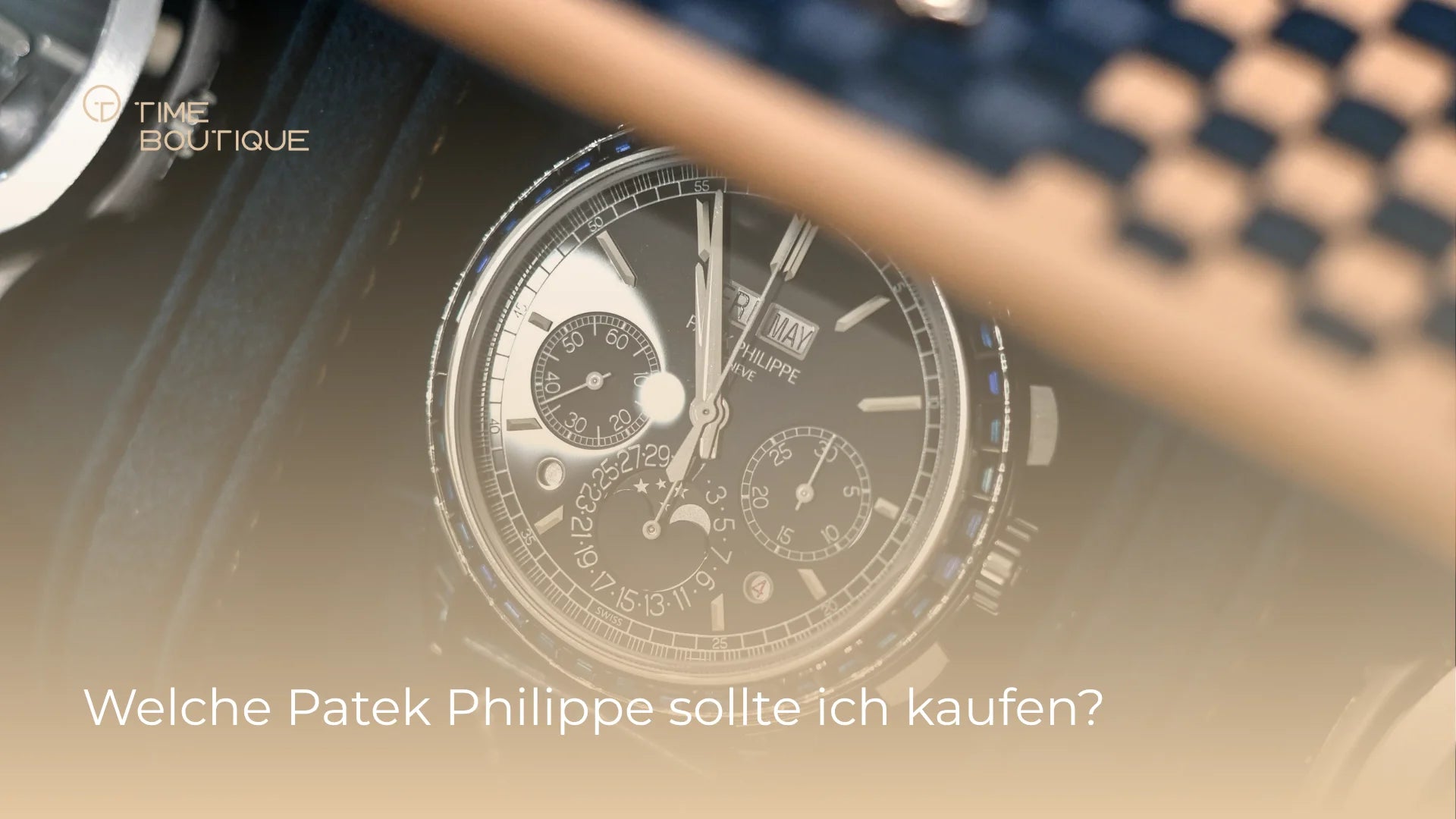
Anyone buying a Patek Philippe should understand it will not be a second Rolex experience. Patek operates in its own league, not just on price but in design language, movement engineering and market behaviour. The manufacture builds around seventy thousand pieces a year. For comparison, Rolex sits in the seven-figure range. From that one fact the entire collector logic of the Geneva house follows. Anyone who wants a specific Patek rarely waits in a list. They search. This guide sorts the important families and tells you which reference is the right one for whom.
The short answer
- First Patek, classically elegant: Calatrava 5227G or 6119G in white gold.
- Sporty and elegant, wearable immediately: Aquanaut 5167A.
- Collector's centrepiece, highest status: Nautilus 5711/1A (discontinued 2022) or successor 5811/1G.
- First ladies' watch: Twenty~4 Automatic 7300/1200A or Calatrava 6007A.
- First high complication: Annual Calendar 5396G.
- Collector heavyweight: Perpetual Calendar 5320G or Chronograph 5172G.
If you recognise yourself in this list, you can stop here. If you want the background, read on.
The Patek reality: why this works differently
Before we go into models, a word on market mechanics, because Patek buyers often come in with the wrong expectations.
Patek is rarely a walk-in purchase at an authorized dealer. For the central references (Nautilus, Aquanaut, Annual Calendar, Perpetual Calendar) the ADs run waiting lists that are effectively frozen. Anyone ordering a Nautilus 5711 at a German AD today has no idea whether they will ever get a call. For the 5811/1G the picture is slightly better, but we are still talking about multi-year waits and a purchase history the AD wants to see.
People who want a Patek and do not want to wait go to the secondary market. That is where the pieces actually change hands, often with a premium over list, sometimes without, depending on reference and market phase. Specialist houses like ours operate exactly in that space. In the atelier we see the Patek references that are not available at ADs, and we inspect them like property before passing them on.
That is the most important point for first-time Patek buyers. A serious atelier source is not a premium mechanism, it is a search-and-vetting service. People who do not see the value buy at the AD and wait. People without the time, or after a piece that simply is not on the shelf anywhere, come to us.
Calatrava, the Geneva dress watch
The Calatrava line starts in 1932 with reference 96. It has been synonymous with the Geneva dress watch ever since: round case, finely applied index dial, slim bezel, leather strap. A watch needs no more than that, and that is the point.
The 5227G is the contemporary Calatrava in white gold with the famous officer's-style hinged caseback in some variants, automatic calibre 324 SC, 39 mm. Secondary market currently in the 22,000 to 30,000 € range. It is the quietest of the modern Calatravas. People drawn to Geneva classicism buy the 5227G.
The 6119G is the youngest Calatrava generation, introduced in 2021. Clous-de-Paris fluted bezel, hand-wound calibre 30-255 PS, 39 mm. It has clearly more presence than the 5227 without slipping into sports-watch territory. AD list price around 32,000 €, secondary market 35,000 to 42,000 €. In the atelier we increasingly see the 6119G as the Calatrava younger collectors enter the brand with, because the fluted bezel gives the piece its own line.
The 6007A is a special figure: steel, 40 mm, sporty-elegant, originally a limited 175th-anniversary edition (6300A/G), now a regular reference. Secondary market 25,000 to 35,000 €. A steel Calatrava is the rare exception in the Patek catalogue, which explains its appeal.
The 5320G is built in Calatrava style but belongs to the perpetual calendar family (more on that below).
Who the Calatrava is for: people who do not want to impress but want to know what is on their wrist. People drawn to Geneva classicism. People looking for a first Patek that sits quietly in the secondary market, outside the hype.
Nautilus, the sports-luxury icon
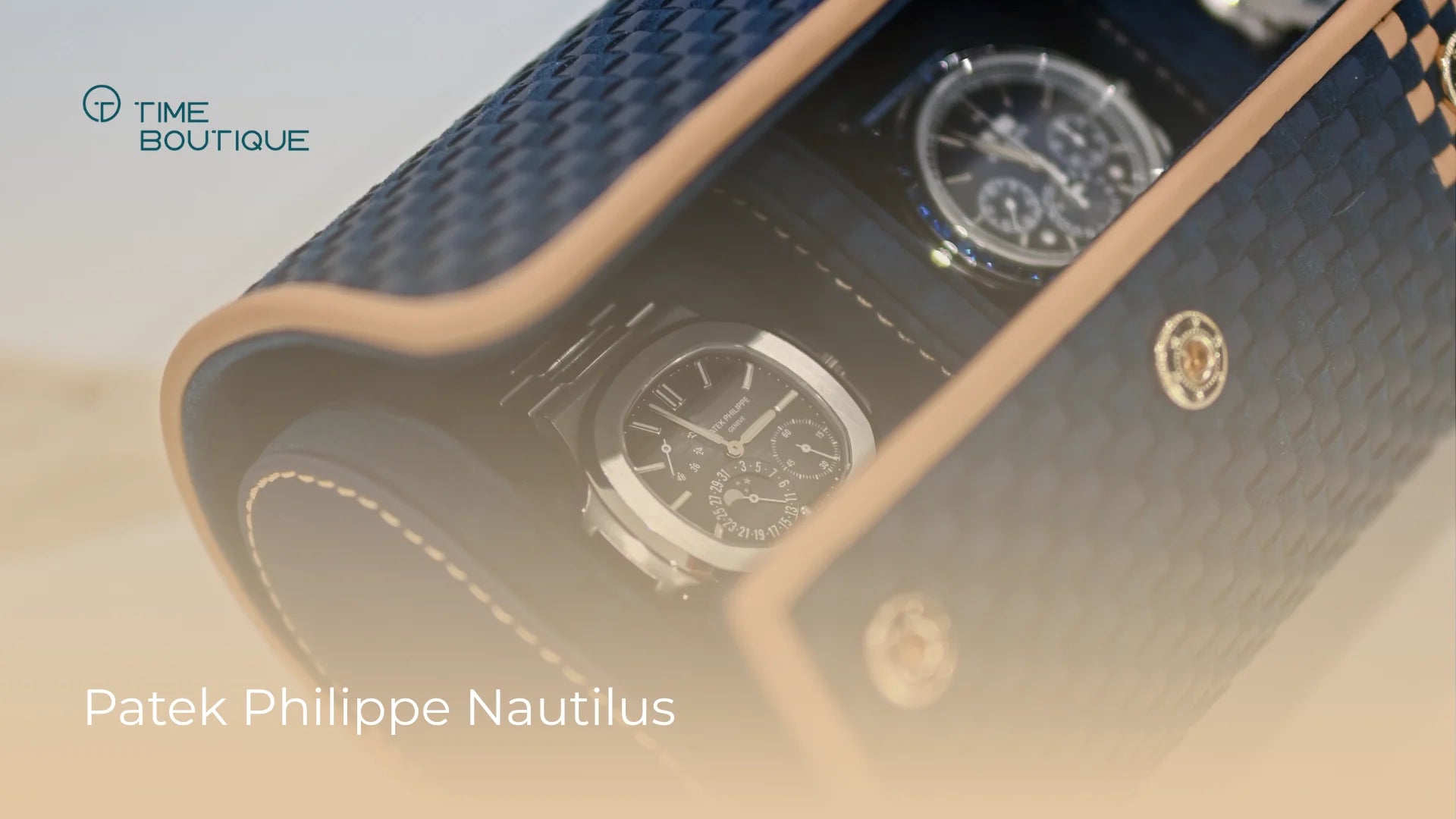
Drawn by Gérald Genta in 1976, five years after the Royal Oak. Octagonal bezel with rounded corners, integrated steel bracelet, horizontally fluted dial. Genta himself spoke of "a watch you could wear with a wetsuit or a black tie". That is what it has remained.
The 5711/1A in steel with blue dial was the most pronounced hype phenomenon on the luxury market between 2020 and 2022. AD list price around 35,000 €, secondary market at times over 220,000 €. Patek discontinued the reference at the end of 2021, which reinforced the hype. Since 2024 the market has been sober. Current secondary range: 90,000 to 115,000 € depending on condition and completeness. A 5711/1A with full set, light wear and a clean service history sits at the upper end of that range.
The 5811/1G is the official successor to the 5711, launched in 2022. White gold instead of steel, 41 mm instead of 40, the dial a slightly darker "Nuit blue". AD list around 68,000 €, secondary market currently in the 110,000 to 145,000 € range. Patek deliberately moved to white gold to defuse the sports-steel hype. The intent only partly works: the 5811 is desired, but the secondary premium is noticeably more rational than the 5711 at its peak.
The 5712/1A is the Nautilus with moon phase, power reserve and a small date subdial at six, in steel. More complex dial layout than the 5711, same sports-steel character. Secondary market 95,000 to 130,000 €. The Nautilus for collectors who want the same case with more movement substance.
The 5980/1AR is the Nautilus chronograph in bicolour (steel and rose gold). High visual presence, more polarising. Secondary market 75,000 to 95,000 €.
The 5990/1A is the Travel Time chronograph in steel. Two time zones plus chronograph. Complex movement in the sports case. Secondary market 130,000 to 170,000 €. One of the most sought-after contemporary Patek complications.
In the atelier the Nautilus is the Patek asked about most often, and at the same time the one where we most often have to say honestly: not available right now, or only beyond what we would consider sensible. We sell Nautilus only when the market price is defensible and the piece has been through our workshop.
Who the Nautilus is for: collectors who want the most iconic sports-luxury watch of the brand. Lovers of the Genta design. People who see the value through the waiting time.
Aquanaut, the more accessible Nautilus sibling
Launched in 1997, deliberately conceived by Patek as a sporty complement to the more elegant Nautilus. The rounded octagonal bezel and the embossed dial with its square grid are the visual signatures. Tropical rubber strap instead of steel links, which gives the piece a lighter, sportier feel.
The 5167A in steel with black dial is the central Aquanaut reference. 40 mm, automatic calibre 324 S C. AD list around 25,000 €, secondary market currently 58,000 to 72,000 €. Considerably less hyped than the Nautilus 5711, easier to source, more stable in price. Anyone who wants a sports-steel Patek with a clear identity, without paying the Nautilus premium, buys the 5167A.
The 5168G Jumbo is the 42 mm version in white gold. Secondary market 95,000 to 130,000 €. The larger presence appeals to a different audience, often collectors who already had a 5167A and are looking for more wrist presence.
The 5267/200A is the ladies' Aquanaut in steel with diamond bezel. Secondary market 55,000 to 75,000 €. One of the most sought-after references in the ladies' Patek space.
Who the Aquanaut is for: people who want a sports Patek without Nautilus waits or Nautilus premiums. People drawn to the younger face of the brand. People who prefer the rubber strap to a steel bracelet.
Annual Calendar, the elegant complication
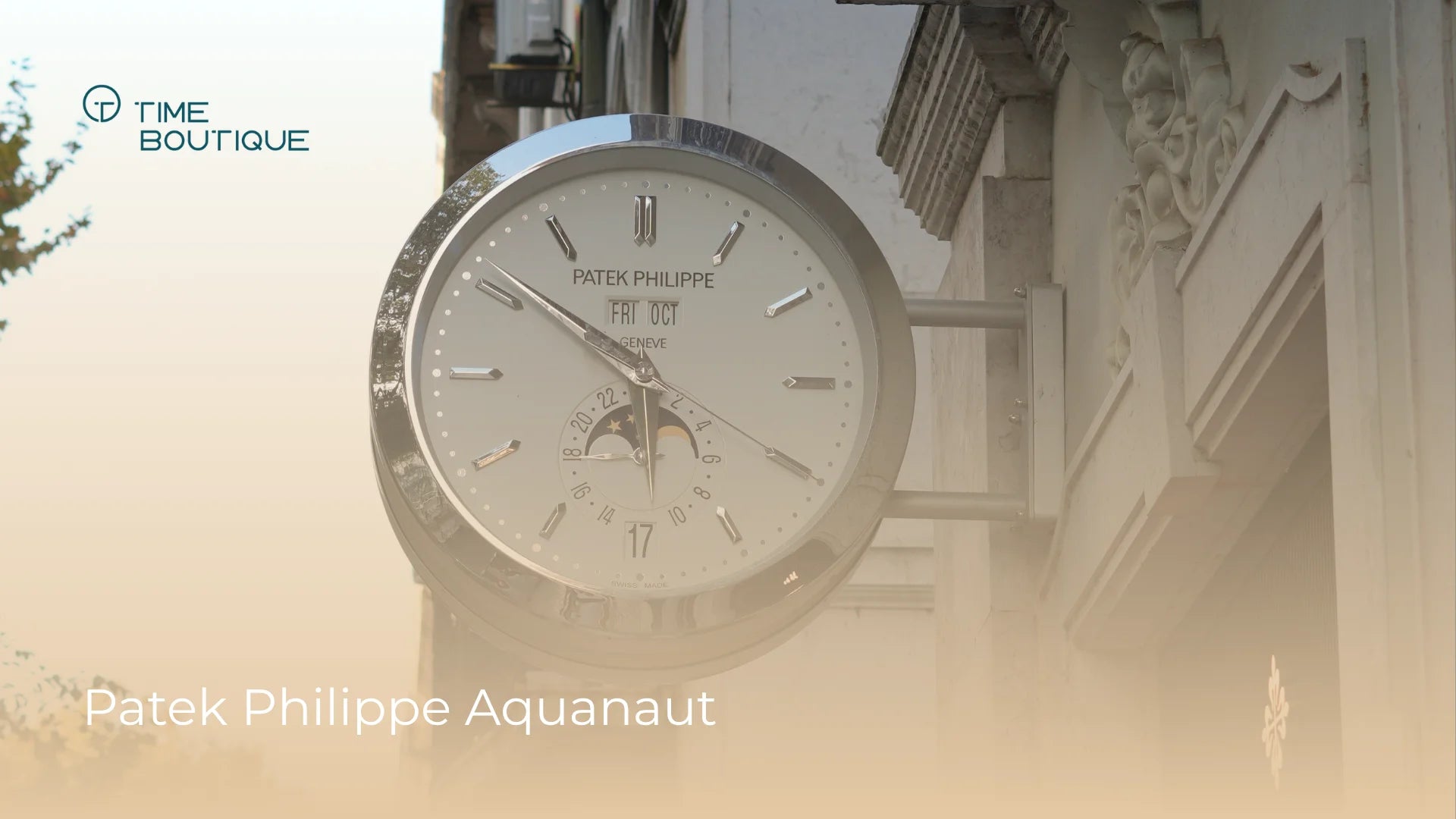
Patek invented the Annual Calendar in 1996. The movement handles the different month lengths automatically and needs manual correction only once a year, at the transition from 28 February to 1 March. An elegant solution between a simple date and a perpetual calendar.
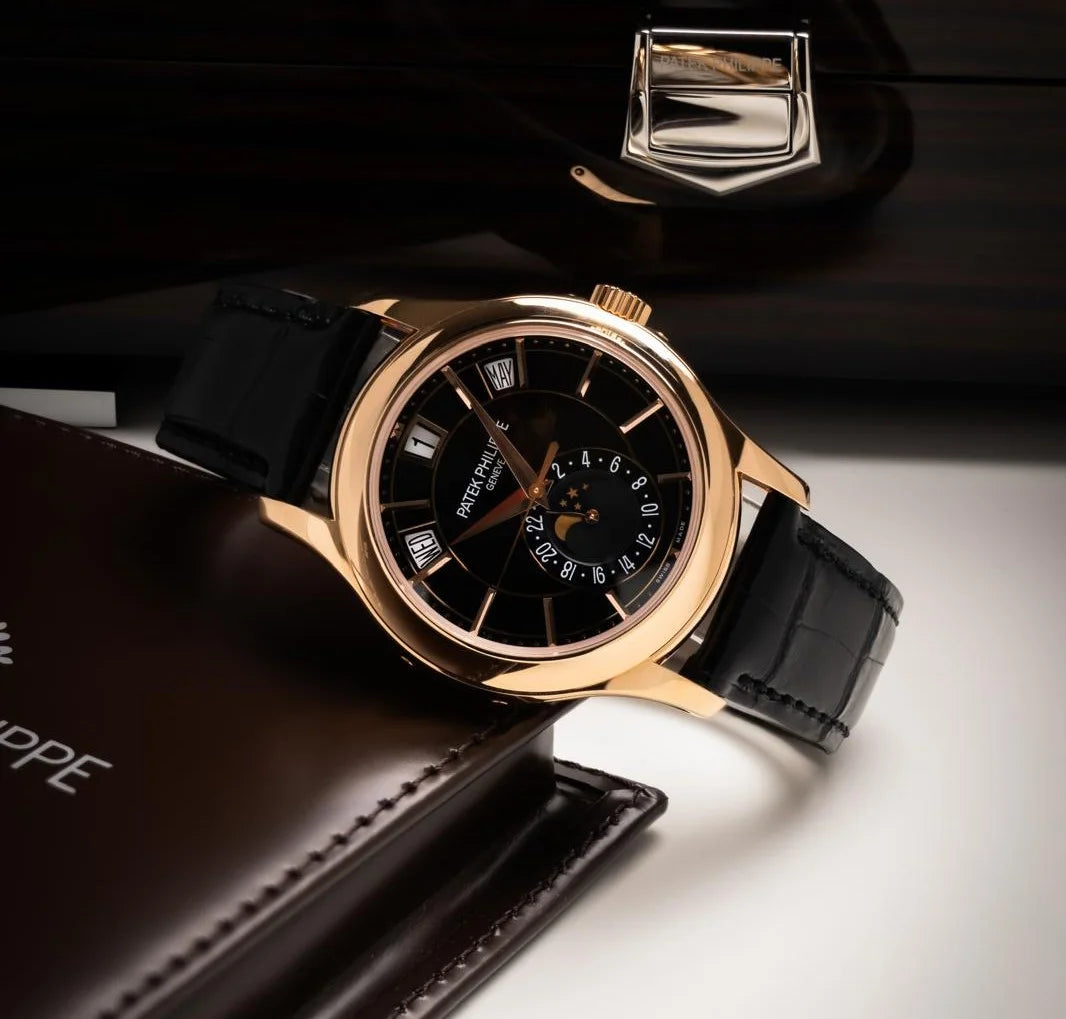
The 5396G is the central modern Annual Calendar reference: white gold, moon phase, small date subdial at six, three hands plus day and month in apertures. Secondary market 38,000 to 50,000 €. One of the most elegant complications in the current catalogue.
The 5905 is the Annual Calendar Chronograph in white or rose gold. More complex display, more crowded dial. Secondary market 70,000 to 95,000 €. For collectors who want two Patek inventions (Annual Calendar and the in-house CH 28-520 chronograph movement) in one piece.
In the atelier the Annual Calendar is the complication we recommend most often to first-time Patek collectors who do not want to stop at the Calatrava. It is mechanically demanding enough to show what Patek can do, but uncomplicated to live with. Helmut points out that an unserviced Annual Calendar becomes meaningfully more expensive to overhaul than a Calatrava. Checking the service history is not optional here.
Perpetual Calendar, the Patek heartland
The Quantième Perpétuel handles month lengths and leap years fully automatically until 2100. This is the complication Patek built its reputation on from the early twentieth century onwards. People who buy a Patek complication most often buy a perpetual calendar.
The 5320G is the vintage-inspired variant in white gold, launched in 2017. Day, month, date, moon phase, leap-year indicator, day/night indicator. Case design borrowing from the early 1940s references 1518 and 2497. Secondary market currently 95,000 to 135,000 €. In the atelier this is the Patek that opens collectors' eyes first. It combines contemporary movement engineering with an openly vintage-leaning face.
The 5327 is the classic perpetual calendar form in white gold, quieter in appearance, with a more modern dial layout. Secondary market 90,000 to 115,000 €.
The 5236 is the in-line perpetual calendar, with date, day and month in a single horizontal aperture at twelve. Launched in 2021. One of the most unusual movement solutions in recent Patek history. Secondary market 105,000 to 140,000 €.
Who the perpetual calendar is for: collectors who want the canonical Patek complication. People who value movement substance over marketing. People looking for a Patek that mechanically represents what the brand stands for.
Chronograph, the classical school
Patek chronographs are a category of their own. The current hand-wound chronograph calibre CH 29-535 PS (introduced 2010) is one of the few modern column-wheel chronographs built fully in-house.
The 5170G was, until 2019, the central modern chronograph of the brand. Classic two-subdial layout, white or black dial, column-wheel architecture. Secondary market 80,000 to 115,000 €. One of the Patek references whose market has risen meaningfully since discontinuation.
The 5172G is the successor, introduced in 2019, with classical stepped horn lugs and a navy dial. Secondary market 95,000 to 130,000 €. More character on the wrist than the 5170, which makes it a polarising piece.
The 5270 is the Perpetual Calendar Chronograph, one of the most demanding contemporary Patek complications. Secondary market 140,000 to 195,000 €.
Ladies' lines
The ladies' Patek world is its own. We treat it briefly because it has a specific audience in the atelier.
The Twenty~4 is the Patek ladies' watch in cuff form. Twenty~4 Quartz (4910) is the classic variant with rectangular case, often with diamond setting. Twenty~4 Automatic 7300/1200A is the round, mechanical version in steel, 36 mm. Secondary market 35,000 to 50,000 € depending on diamond configuration.
The Calatrava 6007A in steel is also popular with women, because the 40 mm case with its detailed dial is an unusually characterful Calatrava.
The Aquanaut 5267/200A is the ladies' Aquanaut (see above). In the ladies' Patek space, the most sought-after sporty reference.
Grand Complications, the other league
Here we leave the territory where price ranges are communicated normally. Patek's Grand Complications are individual pieces we source on request in the atelier, vet and pass on.
The 5208P (minute repeater plus perpetual calendar plus chronograph) in platinum sits beyond 1.2 million €. The 5102PR Celestial with star-chart complication, the 5101P (10-day tourbillon), the 6300A (Grandmaster Chime in steel, made for the 175th anniversary in 2015) are collector pieces operating in auction logic.
Buyers in this category usually already hold a Patek portfolio and work with specialist houses and auctioneers. In these cases we advise without holding the piece in stock ourselves.
What to check on a Patek purchase
With Patek the rule applies particularly strictly: only buy with a full set. Original papers, service receipts, certificate of origin from the Geneva manufacture, ideally with the original AD invoice. Without this documentation, even average market prices are difficult to achieve.
What to inspect specifically:
Movement seal. Sigille Genève on older models, Patek Philippe Seal since 2009. Visible on one of the bridges through an opened caseback. Helmut checks this in the atelier on every Patek piece we take in.
Service history. Patek service is excellent but expensive. An unserviced complication can mean tens of thousands of euros in service work. If a seller cannot produce service receipts and the piece is older than ten years, factor the service in.
Original dial. On vintage Patek a service-replacement dial reduces value meaningfully. Original dials usually show finer printing details, different hand patina and are documentable through provenance.
Case edges. Patek cases are particularly sensitive to over-polishing because the bevelling of the lugs needs to stay sharp. An over-polished Patek visibly loses material and character.
Original lugs and bracelet attachment. On the Nautilus and Aquanaut the integrated lug area is a wear point, because friction with the steel bracelet leaves micro-scratches. Look out for an over-polished lug zone.
Our house policy on Patek Philippe
We only buy and sell Patek when we admire the pieces ourselves. The brand does not tolerate routine handling. Every Patek in our atelier has been checked by Helmut, with a documented movement inspection, full service history and a service pass carrying a 12-month warranty on the movement.
When we do not have a specific reference in stock, we go and find it. Through our dealer network in Munich, Geneva, London and Zurich we usually find the central modern references within two to six weeks. Grand Complications can take longer. We quote openly in these cases, without hidden markup, and we run the piece through our own workshop before it reaches you.
Personal consultation in the atelier
Patek Philippe is a consultation product. Arrange a conversation through our enquiry form, by phone on +49 89 38164962 or by email at info@timeboutique.de. In the atelier in Grünwald near Munich, or via video call if you are further away.
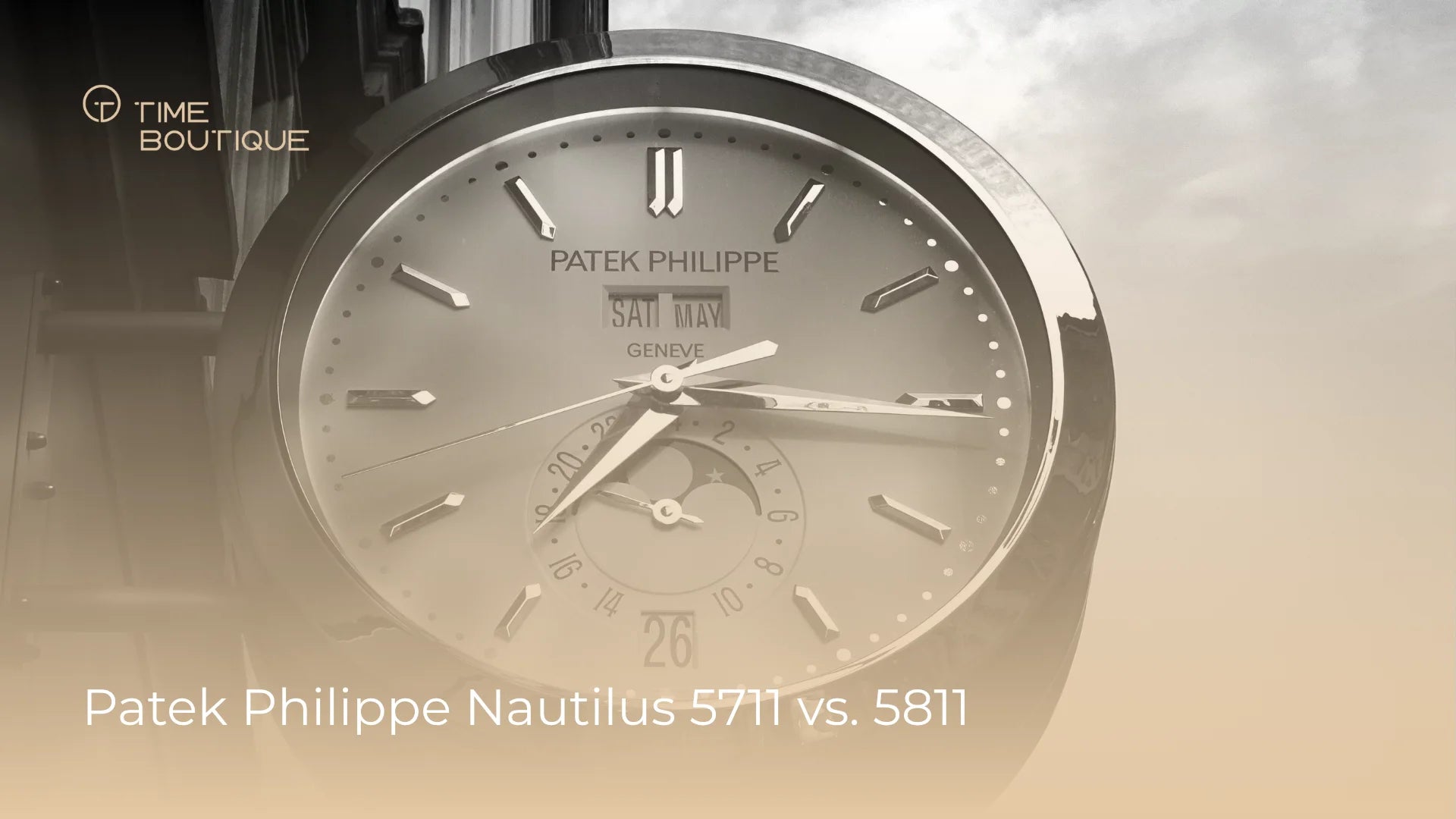
Anyone still torn between the two central Nautilus generations will find the details in our comparison Nautilus 5711 vs 5811. For the workshop background, our page on Patek Philippe service in Munich.
- The short answer
- The Patek reality: why this works differently
- Calatrava, the Geneva dress watch
- Nautilus, the sports-luxury icon
- Aquanaut, the more accessible Nautilus sibling
- Annual Calendar, the elegant complication
- Perpetual Calendar, the Patek heartland
- Chronograph, the classical school
- Ladies' lines
- Grand Complications, the other league
- What to check on a Patek purchase
- Our house policy on Patek Philippe
- Personal consultation in the atelier