

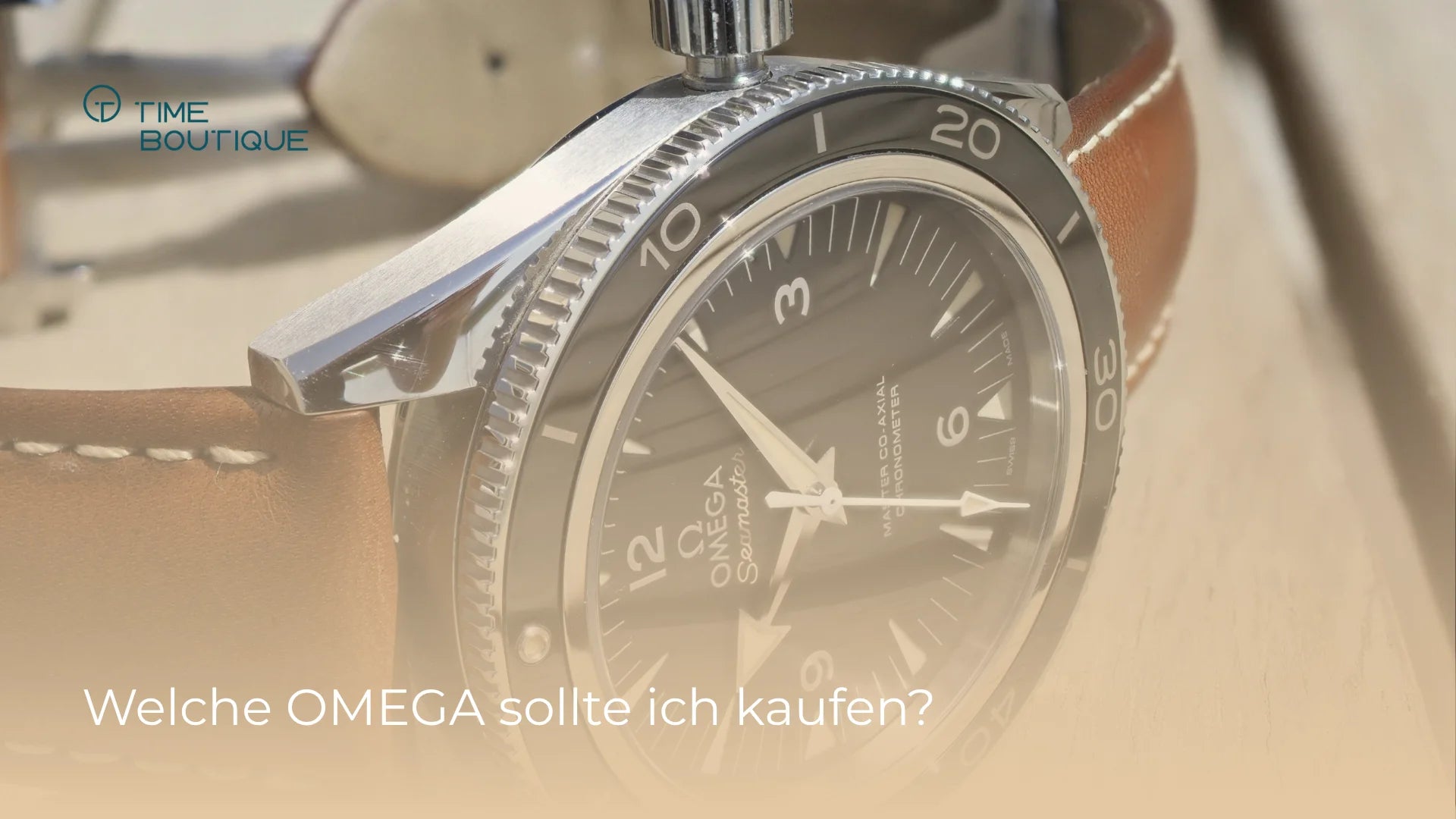
Omega is the brand on which the question "classic luxury watch or tool watch" can be answered most usefully. Speedmaster on the moon, Seamaster on the wrist of James Bond, Aqua Terra in the office of Geneva bankers. The lines look similar side by side but differ considerably in mechanics. This guide sorts the most important models and tells you who they suit.
The short answer
- First Omega, iconic: Speedmaster Moonwatch Professional 310.30.42.50.01.001.
- Sporty-elegant, daily driver: Aqua Terra 150M 41 mm.
- Diver with character: Seamaster Diver 300M 210.30.42.20.03.001.
- Heritage, vintage feel: Seamaster 300 Heritage 234.30.41.21.01.001.
- Outdoor and deep sea: Planet Ocean 600M.
- Quietly elegant: Constellation 39 mm or De Ville Prestige.
- Ladies' first watch: Aqua Terra 38 mm, Constellation 29 mm, Mini-Trésor.
Let us go through the lines one by one.
Omega, Bienne since 1848
Omega was founded in 1848 by Louis Brandt in La Chaux-de-Fonds, has been based in Biel/Bienne in the Jura since 1880, and has been part of the Swatch Group since 1999. The manufacture has produced at industrial scale for decades without giving up the ambition to develop its own calibres. The co-axial escapement, developed by George Daniels and first introduced in serial production in 1999, remains the technical signature of the brand. It reduces friction between pallet and escape wheel and so extends service intervals compared with the classical Swiss lever escapement.
Since 2015 Omega has additionally certified its movements to the METAS Master Chronometer standard, which goes beyond COSC: magnetic resistance up to 15,000 gauss, rate deviation 0/+5 seconds per day, eight consecutive tests on the fully cased watch rather than on the isolated movement. In this combination of volume and technical level, Omega currently stands alone in the market.
The consequence for the buyer is straightforward: every modern Omega from 2015 onwards carries a movement that has passed two independent certifications. In the same price bracket this is not the case for Tudor, Longines or classical Rolex models without the METAS stamp.
Speedmaster, the Moonwatch and the professional line
The Speedmaster Professional is the watch that travelled to the moon with Buzz Aldrin in 1969. To this day it carries the NASA seal "Flight-qualified for all manned space missions". Manual winding, black tachymeter bezel, hesalite crystal, asymmetric case with crown and pusher protection.
The current reference 310.30.42.50.01.001 with calibre 3861, introduced in 2021, is the co-axial Master Chronometer version. Those who want a historically correct piece choose the hesalite variant; those who prefer a sapphire caseback and crystal take the 310.30.42.50.01.002.
The Moonwatch is almost always in stock at the atelier. It is mechanically honest, optically unmistakable, and stable in value. Market prices used (as of 2026): between 5,500 and 7,500 euros depending on generation and configuration. Older calibre 1861 pieces (pre-2021) sit at the lower end, newer 3861 references with sapphire caseback at the upper.
A point often underestimated with the Speedmaster: the hand-wound movement asks for a daily ritual. Anyone who wears it winds it in the morning, feels the gear train through the crown and sets the time. That is not for everyone. For those who appreciate it, the Moonwatch provides a daily contact with the movement that no automatic ever will.
Speedmaster variants: Mark II, Racing, Co-Axial, '57
The Speedmaster family is considerably wider than the Moonwatch alone. A short orientation:
- Speedmaster '57 (332.10.41.51.02.001). Sapphire caseback, co-axial Master Chronometer calibre 9906, no pusher protection. More classical line, closer to the pre-NASA original from 1957.
- Speedmaster Racing (329.30.44.51.01.001). Sportier, with minute-track on the rim and Master Chronometer movement. 44 mm.
- Speedmaster Dark Side of the Moon. Ceramic case, dark aesthetic, co-axial calibre 9300. From around 8,000 euros used.
- Speedmaster Mark II (2014 reissue). Tonneau case, short production, now a collector item.
Anyone looking for the classical chronograph character of the brand without the lunar reference should look at the '57. In our view it is the quietest piece of the family.
Seamaster: Diver 300M, Seamaster 300 Heritage
The Seamaster line is broad. Two models stand out.
The Seamaster Diver 300M (reference 210.30.42.20.03.001) has been the Bond watch since GoldenEye in 1995. Currently with co-axial calibre 8800, Master Chronometer, blue or black wave dial, cerachrom bezel and helium escape valve. 42 mm. It is the obvious alternative to the Rolex Submariner, at a considerably friendlier price and with a more characterful dial.
The Seamaster 300 Heritage (234.30.41.21.01.001) is the reissue of the CK 2913 from 1957. 41 mm, anodised aluminium bezel, beige vintage lume, very quietly drawn. Co-axial calibre 8912 with Master Chronometer certification. This is the more elegant, less playful diver in the range and is particularly appreciated among collectors.
Market prices used: Diver 300M between 3,800 and 4,800 euros, Seamaster 300 Heritage between 4,800 and 6,500 euros. Both sit in a very fair range for a Master Chronometer with in-house calibre.
A note on the Diver 300M: the wave dial has been laser-engraved rather than printed since the 2018 reissue. In low light this gives the dial a depth that photographs rarely capture. Anyone comparing the watch only online tends to miss this point; at the atelier it is the most common reason buyers end up choosing the Omega over the Submariner.
Aqua Terra, the elegant daily driver
The Aqua Terra 150M is the unobtrusive line of the Seamaster family. Flat bezel, vertically structured dial (teak pattern, inspired by yacht decks), classical lugs, water resistance of 150 metres. Available in 38 and 41 mm, with co-axial Master Chronometer calibre 8900.
When someone asks for a day-and-night watch, the Aqua Terra is often the most honest answer. Unlike the diver models it has no helium valve, no rotating bezel, no sporting cue. In return you get an exceptionally calm appearance and a movement that requires little attention over years of daily wear.
Market prices used: between 3,500 and 5,000 euros depending on generation and dial variant. Among Omega models the Aqua Terra is the most price-stable in daily use because it is not affected by hype cycles.
At the atelier we often recommend the 41 mm model with black or grey dial on the steel bracelet for a first Aqua Terra. It is the most universal configuration we know: office-ready, summer-ready, without the need to swap straps. For smaller wrists the 38 mm version offers the same movement specification.
Seamaster vs Aqua Terra, the most common question at the atelier
The short decision guide:
- Seamaster Diver 300M, if you want a sporty appearance, a rotating bezel and water-sport robustness.
- Aqua Terra, if you are looking for a quiet daily driver that works equally well with a suit and with jeans, without announcing "diver".
Both lines share manufacture, movement architecture and Master Chronometer certification. It is a question of design language, not of build quality.
Planet Ocean, the professional diver
The Planet Ocean is the serious diver in the Omega line-up. Introduced in 2005, now in its fourth generation. 600 metres water resistance (some Ultra Deep references up to 1,200 metres), helium escape valve, cerachrom bezel with Liquidmetal indications, more substantial case than the Diver 300M.
The current Planet Ocean 600M 43.5 mm (215.30.44.21.03.001) with co-axial Master Chronometer calibre 8900 is the middle variant. There is also the GMT version with a second time zone and the Deep Black in ceramic. For wearers below 18 cm wrist circumference the Planet Ocean feels noticeably large. Those who like the size get one of the most robust mechanical divers on the market.
Market prices: between 4,500 and 6,500 euros for the standard steel version, considerably higher for GMT or ceramic versions.
Constellation and De Ville
Outside the sport lines Omega runs two classically elegant families.
The Constellation is the status line. Its signatures are the claws at three and nine o'clock that hold the crystal on the fluted base plate. The current Constellation 39 mm (Manhattan, reference 131.10.39.20.06.001) is a quiet dress watch with co-axial Master Chronometer calibre 8900. Market price used: 3,800 to 5,000 euros.
The De Ville Prestige and De Ville Trésor are the actual dress watches in the range. Slim, on a leather strap, often hand-wound. The Trésor with calibre 8511 is one of the thinnest Master Chronometer movements on the market and is less in demand at the atelier, but belongs in any serious overview of the Omega line.
The Mini-Trésor in 26 mm is a remarkable ladies' watch: quartz movement, very flat, with a reduced index dial and a fine leather strap. It is the quiet alternative to the Aqua Terra 28 mm for wearers who prefer a classical, non-sporting silhouette.
Which Omega for whom?
- First luxury watch, iconic, with history: Speedmaster Moonwatch Professional. Hesalite variant for the classic, sapphire back if you want to see the movement.
- Sporty, daily, water: Seamaster Diver 300M.
- Elegant daily, no sport look: Aqua Terra 150M in 38 or 41 mm.
- Vintage feel, collector orientation: Seamaster 300 Heritage.
- Outdoor and deep sea: Planet Ocean 600M.
- Dress watch, quiet: De Ville Trésor or Constellation 39 mm.
- Ladies' first watch: Aqua Terra 38 mm in steel, Constellation 29 mm, or Mini-Trésor on leather.
Speedmaster and Aqua Terra together cover a large part of what a collection needs: an iconic sports watch and a quiet daily driver. Starting with both gives a sensible basis for everything that follows.
What you should check when buying
Universal checks for every used Omega:
- Caseback with correct reference and serial numbers. Master Chronometer models carry the METAS reference on the back or dial.
- Co-axial movements run quietly, with a noticeably softer tick than Swiss-lever movements. A professional timegrapher measurement in several positions is mandatory.
- Dial free of lume discolouration (modern), indices without displacement.
- Helium valve on Diver 300M and Planet Ocean: correctly screwed in, with no pressure loss.
- Service history documented. Omega service is good, but on older co-axial movements (calibres 2500, 8500) an inspection every five to seven years is realistic.
- Box and papers complete. With the Speedmaster, the extra-strap set and the NATO box have been part of the full Moonwatch delivery since 2021.
At our atelier every Omega passes a movement inspection by our watchmaker Helmut, including rate measurement in several positions, a water-resistance test and a visual check. The result is attached to the service pass of every watch sold.
See it at the atelier
We continuously curate selected Omega models at our atelier in Grünwald near Munich. Personal appointment or insured transport throughout Germany and the DACH region.
By telephone at +49 89 38164962, by e-mail at info@timeboutique.de, or visit us by appointment. We will help you find the right piece, honestly and without pressure. If you would like to sell an Omega, you will speak with Matthias directly.
More at the Time Boutique atelier: our Omega stock and Omega service in Munich.
- The short answer
- Omega, Bienne since 1848
- Speedmaster, the Moonwatch and the professional line
- Speedmaster variants: Mark II, Racing, Co-Axial, '57
- Seamaster: Diver 300M, Seamaster 300 Heritage
- Aqua Terra, the elegant daily driver
- Seamaster vs Aqua Terra, the most common question at the atelier
- Planet Ocean, the professional diver
- Constellation and De Ville
- Which Omega for whom?
- What you should check when buying
- See it at the atelier